
Renaissance painting background

Agentic Commerce

The End of the SaaS Dashboard as You Know It

An Ionio Strategic Briefing for Retail & E-Commerce SaaS Leaders

Agentic Commerce

The End of the SaaS Dashboard as You Know It

An Ionio Strategic Briefing for Retail & E-Commerce SaaS Leaders

· · ·

If you are in B2B Ecom SaaS selling to brands & retailers, the metrics you've optimized for a decade—login frequency, session depth, feature adoption—are about to invert. In 24 months, your most engaged customers will be the ones who never log in at all...what?...Read on.

You built beautiful, sticky dashboards. You worked hard on onboarding, feature-flagging, and making that analytics section shine. We all did. But the very friction that required a login will very soon be seen as software & operational overhead.

While your team is busy shipping the next feature, a far more profound revolution is taking shape—one that might, in all likelihood, make this dashboard—this UI of your B2B SaaS—obsolete. Or perhaps even the very nature of SaaS itself. We are talking about the dawn of agentic commerce: a world where autonomous AI agents, acting on behalf of customers, execute billions of dollars in transactions without a single human ever visiting a single website. Why does this affect you...? You'll see.

This briefing is NOT another content-writer-written ChatGPT-fluff... It is a survival guide and strategic framework. Based on current adoption trends, leading research papers, discussions with executive teams across the industry, and hundreds of real-world product interactions—you have a two-year window before this shift makes traditional e-commerce—and in turn, SaaS platforms that support it—feel as outdated as the publishing houses that made print catalogues.

While every industry is being reshaped, your world—e-commerce & retail SaaS—is Ground Zero. Why? Because your entire business model is built on providing the exact interfaces and workflows that agentic commerce is poised to demolish. You are the shovel-seller in a gold rush where the miners are about to be replaced by autonomous robots.

In this article we will be talking about:

  • How UI Becomes a Ghost Town: The value of your meticulously crafted user experience will plummet when the primary "user" is another machine accessing your API. User logins, your North Star metric, will become a vanity metric.
  • How "Features" Become Commodities: Merchant loyalty will no longer be to the platform with the best analytics dashboard, but to the one whose data and APIs empower their agent to win more negotiations and close more sales in the new automated economy.
  • And How a New Gatekeeper Sits Between You and Your Merchant: The emergence of "Broker Agents"—think "AI Amazons"—threatens to disintermediate your hard-won relationships, turning your platform into a faceless, commoditized data provider in a hyper-competitive market.

This is a strategic briefing on how to survive the wholesale evaporation of the SaaS dashboard as a business model. We will dissect the three-layer architecture of this new world and reveal the pivot required to win. This is your guide to transforming from a UI-centric platform into an API-first intelligence engine.

Introduction

The Inflection Point is Here

The conversation around AI in your meetings has probably felt abstract, distant & gimmicky for years. It's 2026, OpenAI GPT3 was launched over half a decade ago. We're past the gimmicks. According to NVIDIA's latest reports (Report), 9 out of 10 companies are now actively using or piloting AI. That's nine of your ten competitors, partners, — ecom & retail SaaS platform rivals who are already mobilizing. For generative AI specifically, usage has climbed to 8 out of 10 companies. What was once experimental has become mission-critical.

AI Adoption in Retail & E-Commerce

Enterprise Adoption Rates • 2025

9 of 10

Companies actively using or piloting AI technologies

Your competitors are already mobilizing

AI / ML
8 of 10

Companies now actively using generative AI

What was experimental is now mission-critical

Generative AI

The barriers to entry are also changing. The old conversation centered on just feasibility, experimentation. Today, the roadblocks are more structural and far more threatening to you as a SaaS leader — specifically one that's neither an enterprise nor an indie hacker side-project. One in the middle. 5-200M:

  1. Inadequate Technology Architecture: Your legacy-database-dashboard-CRUD-CRM SaaS wasn't built for this. It was built for humans clicking buttons, not for millions of agents, hell or even thousands of Claude users trying to access it via MCPs.
  2. The AI Talent War: The engineers who can build this future are scarce and expensive, and they're being snapped up by the giants.
  3. Insufficient Data Quality: The "garbage in, garbage out" problem becomes catastrophic at an agentic scale. Your platform's data integrity is no longer a "nice to have"; it's the foundation of your future relevance.

Your challenge isn't just to adopt AI — (ship a chatbot, or something); it's to survive its consequences.

Part I: Understanding the Commerce Evolution

To see where the retail SaaS is going, you have to be brutally honest about where we are right now, as a society & in turn as "consumers shopping in a 2026 world"

The value of your platform has moved through two eras and is now entering a third that will invalidate the assumptions of the last two.

Evolution of Commerce

1995

2015

Digital Migration

Blue Ocean Era

2015

Present

AI-Assisted Commerce

Red Ocean Era

2026

2035

Agentic Commerce

The Revolution

Completed
Current
Emerging

The Three Eras of Platform Value

Phase One

The Digital Migration (c. 1995-2015)

This was the easy part. You put physical stores online. You gave merchants tools to manage a catalog and a checkout. Your value was providing the basic digital real estate for commerce. It was a blue ocean, and just having a platform was enough.

Phase Two

The AI-Assisted Dashboard (c. 2015-Present)

This is the red ocean you're swimming in today. The battle is for the best interface. You're on a relentless feature treadmill, shipping analytics, personalization tools, and whatever else you see in a Shopify press release. Your "AI strategy" likely consists of a recommendation engine or a chatbot—features inside your dashboard designed to help a human merchant make a better decision. Your value is judged by how well you assist a human user. It is a constant, grinding war for differentiation.

Phase Three

Agentic Commerce (c. 2026-2035)

Over the past few weeks, I, along with Rohan and the entire Ionio team, have been conducting deep research into where the e-commerce and retail industry is headed with the rise of AI. We've been talking to vets with over +20 years of experience in the SaaS & retail software space—members of our advisory board—asking them one critical question: "Where do you see this industry going?" We've published multiple research pieces, held countless strategy sessions, and stress-tested every insight that emerged from these conversations.

What emerged from these discussions wasn't just another trend but it was something we couldn't unsee.

Your merchants' customers are about to delegate shopping entirely to their personal AI agents.

This is the inversion. The revolution. In this world, a merchant's success is no longer determined by how skillfully they use your dashboard, but by how well their business can be understood, queried, and negotiated with by that customer's agent.

Let me be clear about what we're predicting:

The point of sale is moving to a personal bot.

It could be ChatGPT. It could be Gemini or Claude. It might be a new player we haven't seen yet.

But based on the trajectory of AI adoption, the infrastructure being built, the behavior changes we're already observing, hundreds of interactions across our own products that we've shipped for brands & conversations we are having with folks almost thrice my age—the most probable scenario is that one of the existing foundation model companies (OpenAI, Google, Anthropic) will own this relationship.

These agents won't just help with shopping. They'll be the shopping experience. They'll have complete context: your purchase history, your calendar, your location data, your browsing patterns, your budget constraints, your aesthetic preferences. They'll be connected to everything. And they'll use all of that interconnected data to make recommendations, execute purchases, negotiate prices, and manage the entire commerce relationship on your behalf.
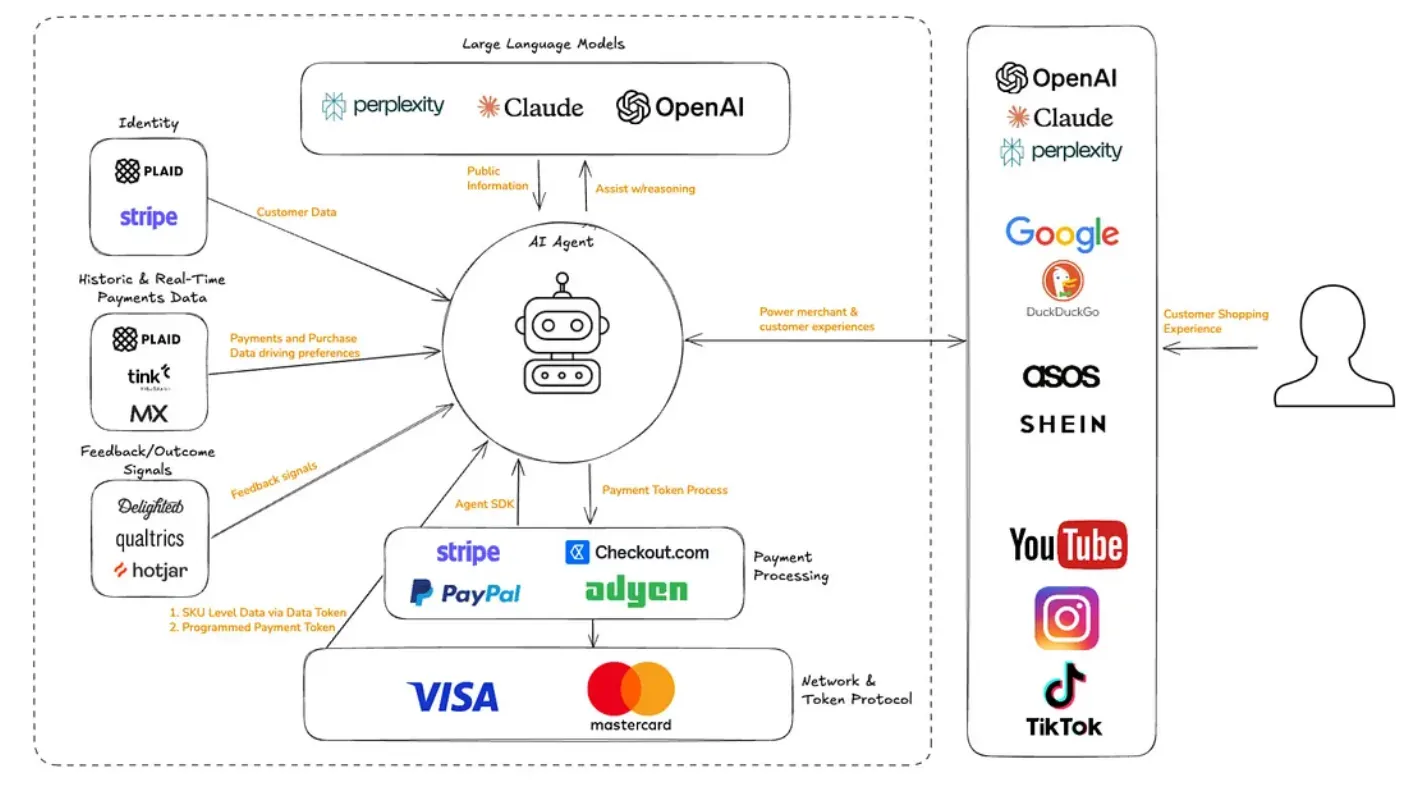
The AI Shopping Assistant Ecosystem - How AI Agents Orchestrate End-to-End Commerce

When we first started mapping this out, it felt speculative. But the more we dug in—the more conversations we had with our to-be advisory board, the more we studied the underlying technology shifts—the more obvious it became. This isn't a possibility. It's an inevitability. The question isn't if this happens, but how quickly it unfolds and who survives the transition.

To better explain the likelihood of this—Think about the cognitive shift. Ten years ago, writing an essay by hand was normal. Today, writing without AI assistance feels laborious because our expectations have changed. The same will happen with shopping. Right now, scrolling through a website and clicking "buy" feels easy. In three years, after you've experienced an AI agent handling a complex multi-product purchase automatically, the friction of manually comparing options, reading reviews, and filling out checkout forms will feel unbearable. Your merchants' customers will demand an agentic experience.

This level of intricate context and intent understanding is what creates the paradigm shift. No human can process this much data. No beautiful dashboard you design can compete with this level of automated efficiency.

Part II: The Three-Layer Architecture for Your New Reality

Understanding this shift requires understanding the architecture that will enable it. Based on our research, we see three distinct integration models emerging—each representing a different level of sophistication and competitive advantage.

The Three-Layer Architecture of Agentic Commerce

Layer One

Agent-to-Site (The Table Stakes)

This is the minimum viable integration. A customer's AI agent navigates your merchant's website just like a human would—reading product pages, comparing prices, filling out forms. Your platform doesn't need to change; the agent adapts to it. This sounds convenient, but it's a trap.

Why? Because the agent is doing all the work, and your merchant gets no credit. The agent might find a better deal elsewhere in seconds. There's no loyalty, no relationship, no data exchange that benefits the merchant. Your merchants are commoditized. The agent sees their store as just another URL to scrape.

The risk: If your platform only supports this layer, your merchants are invisible. They're competing purely on price and availability, with zero ability to differentiate.

Layer Two

Agent-to-Agent (The Competitive Edge)

Here's where it gets interesting. Instead of an agent scraping a website, the customer's agent talks directly to the merchant's agent. This is machine-to-machine commerce. The merchant's agent can negotiate, offer personalized bundles, provide real-time inventory, and even upsell—all in milliseconds, with no human involved.

This is enabled by emerging protocols like Google's A2A (Agent-to-Agent) and Anthropic's MCP (Model Context Protocol). These aren't theoretical; they're being deployed now. A2A allows agents to discover each other's capabilities and negotiate transactions. MCP provides a standardized way for agents to access tools and data.

Machine-to-Machine Commerce

👤 Agent
Customer
A2A Protocol
🏪 Agent
Merchant
🔗
A2A — Google Agent discovery & negotiation
MCP — Anthropic Tool access & data retrieval

Direct Agent Communication Replaces Website Scraping

The platform that enables this layer gives its merchants a voice in the agentic economy. They're not just a storefront; they're a participant in a negotiation. They can build relationships, capture preferences, and create value that goes beyond a single transaction.

Layer Three

Broker Agents (The Strategic Moat)

This is the endgame. The chaos of millions of personal agents trying to contact millions of merchant agents is inefficient. A new, massively powerful layer will emerge to solve this: the Broker Agent.

Think of it as an "AI Amazon" or a "Google for Agents." The Broker becomes the central marketplace. Personal agents don't call you; they call the Broker. The Broker then queries you and all your competitors, aggregates the results, and takes a cut.

Broker Agent Architecture - Multi-vendor transaction orchestration

The Broker Agent becomes the new gatekeeper. They control demand. They set the technical standards. They dictate the commission structures. If your platform isn't architected to be a preferred, high-performing partner for these Brokers, your merchants become invisible.

Your direct relationship with the merchants you serve is now mediated by a new, massively powerful entity that owns the entire ecosystem. Becoming a Broker is the "build Amazon" opportunity of this era. For you, the SaaS provider, it's the single biggest threat and partnership opportunity on the horizon.

Part III: The Agentic Ecosystem—Mapping Uncharted Territory

Here's where things get less certain—and far more interesting.

Over the past few weeks, as we've been stress-testing our thesis with advisors, conducting research, and mapping out where this all leads, we've arrived at a framework that we believe explains how the e-commerce industry will restructure itself. This isn't set in stone. The architecture is still forming.

But based on everything we've seen, the conversations we've had, and the underlying technological shifts already in motion, here's what we believe is coming:

The e-commerce industry will split into two distinct layers: the Core Layer and the Enablers Layer.

The Core Layer: AI Agents

🛒
Personal Shopping Agents
🏪
Merchant Commerce Agents
🔗
Broker Agents
⚙️
Specialized Agents

The Enablers Layer

E-Commerce Platforms
Payment Gateways
Cloud Infrastructure
Marketplaces
Supply Chain Mgmt
Inventory Tracking
Delivery Systems
BI Analytics
Recommendation Engines
Segmentation Tools
Marketing Automation
A/B Testing
Fraud Detection
Authentication
Data Encryption
Compliance Mgmt

The Two-Layer Stack of Agentic Commerce

The Stack

The Core Layer: Where Commerce Decisions Happen

This is the new decision-making layer—where the actual shopping, negotiating, and purchasing happens. It consists of three types of agents:

01

Personal Shopping Agents

These are the AI assistants your merchants' customers will use. ChatGPT, Claude, Gemini—whoever wins this race becomes the new storefront. These agents hold complete user context: purchase history, preferences, budget, calendar, location. They are the new customers.

02

Merchant Commerce Agents

Your platform must provide this. It's the autonomous representative of your merchant's business—capable of receiving queries, understanding intent, presenting product options, and negotiating terms. This is your new "UI." It doesn't have buttons. It has an API and the intelligence to respond to other agents.

03

Broker Agents (or Specialized Marketplace Agents)

Here's where it gets interesting. It's possible—perhaps even likely—that the Personal Shopping Agents themselves evolve to handle brokering. But there's also a strong case for a middle layer: a specialized Broker Agent that aggregates offers from thousands of Merchant Agents, handles the negotiation complexity, and takes a cut. Think "AI Amazon" or "Google for Agents." This could be the biggest value capture opportunity of the next decade.

And then there are Specialized Agents—fraud detection agents, payment routing agents, logistics coordination agents—handling specific, high-complexity tasks that neither Personal nor Merchant Agents want to manage directly.

This Core Layer is where the future of commerce lives. If you're not integrated here, you don't exist.

Your Current Position

The Enablers Layer: Where You Survive (If You Adapt)

Here's the truth: you're not going to become a Core Layer player. You're not ChatGPT. You're not building the Personal Shopping Agent. That ship has sailed, and the capital required to compete there is in the tens of billions.

But that doesn't mean you're obsolete.

Below the Core Layer sits the Enablers Layer—the infrastructure that makes the Core Layer function. This is where your platform lives. This is Shopify, Stripe, Klaviyo, your CDP, your analytics stack, your inventory management system, your fulfillment partners. These tools don't disappear. They evolve.

The shift: Personal Shopping Agents aren't built to manage end-to-end operations. They're not built to send emails, manage inventory, handle fraud detection, run A/B tests, optimize supply chains, or process international payments. They're built to orchestrate—to understand what the customer needs and then delegate the work to specialized enablers.

Here's how it works:

A customer tells their Personal Agent: "I need to set up omnichannel marketing for my new Shopify store."

The Personal Agent doesn't build an email system. It doesn't become Klaviyo. Instead, it queries the Enablers Layer, finds Klaviyo's Merchant Agent, brokers the integration, and connects the store. From that point forward, Klaviyo handles email and SMS. The Personal Agent just orchestrates.

This is your survival path: Become deeply, natively integrated with the Core Layer.

The Critical Integration Challenge

Right now, you're competing on features. Better analytics. Smarter personalization. Shinier dashboards. You're trying to win the battle of Phase Two while Phase Three is already here.

The companies that win over the next 5-8 years won't win because they have the best dashboard. They'll win because they're the easiest for agents to work with.

Here's what that means in practice:

Your world-class personalization engine is useless if your API can't expose its logic to a Merchant Agent in real-time.
Your advanced analytics are irrelevant if they can't inform dynamic pricing during an agent-to-agent negotiation.
Your inventory management system is obsolete if a Personal Agent can't query stock levels, lead times, and shipping options in milliseconds.

Your primary engineering challenge for the next five years is building the bridges—the APIs, the structured data models, the agent-readable protocols—that connect your platform to the Core Layer. This isn't about adding an AI chatbot to your dashboard. This is about making your entire platform natively agent-accessible.

The Massive Opportunity in the Enablers Layer

Here's the good news: as the Core Layer scales, it will generate enormous demand for specialized enablers.

Fraud detection becomes exponentially more complex when millions of agents are transacting autonomously. Payment routing, international settlements, tax compliance—these all become harder, not easier, in an agentic world. Supply chain coordination, A/B testing in agent-mediated environments, analytics that track agent behavior instead of human clicks—these are new categories of problems.

The companies that solve these problems—that build the enablers the Core Layer depends on—will capture massive value. But only if they're architected correctly from the start.

Through our thorough breakdown we positively believe -

The Enablers Layer doesn't disappear. It becomes more valuable. But only for those who adapt.

The question isn't whether you should pivot to serve the Core Layer. The question is whether you'll do it fast enough.

Part IV: The Advertising Apocalypse (And What Comes After)

Your merchants have been pouring billions into Facebook ads, Google Shopping campaigns, and retargeting pixels. They've mastered the art of the algorithmic auction, optimized their CAC:LTV ratios, and built entire businesses on the back of performance marketing.

That entire playbook is about to be incinerated.

When the primary "user" viewing products is an AI agent—not a human with eyeballs and emotions—your current advertising infrastructure becomes worthless. Agents don't click banner ads. They don't get swayed by lifestyle photography. They don't impulse buy because of a well-timed retargeting campaign.

The Death of Display, The Birth of Decision Influence

Let me paint you the coming future of "A customer" - it tells their Personal Agent, "I need running shoes." That agent doesn't browse Instagram. It doesn't see your merchant's Google Shopping ad. It queries 50 merchants simultaneously, evaluates based on price, availability, reviews, and shipping times, and makes a purchase decision in 300 milliseconds.

Where exactly does your merchant's $10,000 monthly ad spend fit into that equation?

It doesn't. Which is why three entirely new advertising models are emerging to replace everything you know:

01

The AI Ad Recommendation: Paying to Be in the Consideration Set

This is already happening. Perplexity is testing it. OpenAI is building it. Within 18 months, it will be the dominant advertising model.

When you ask for recommendations, it will show 1-2 paid recommendations which fits what you are looking to buy.

The New Advertising Interface

🤖
Personal Shopping Agent
● Online
I need running shoes for marathon training
Based on your running history, foot profile, and budget preferences, here are my top recommendations:
👟
Hoka Rocket X2
$229 · 4.7★ · Ships in 3 days
👟
Asics Metaspeed Sky+
$199 · 4.6★ · Ships in 2 days

Paid Placement in AI Recommendations

The targeting precision makes Facebook's algorithm look like a shotgun blast. We're talking about 100x better conversion rates because the AI only shows ads when the intent-to-purchase probability crosses a threshold.

The Paradox here: This will initially feel like paradise for your merchants. Higher ROAS than they've ever seen. But they're about to trade one monopoly (Google/Meta) for another (OpenAI/Anthropic). And this time, the gatekeeper has even more power because they control not just discovery, but the entire purchase decision.

02

Brand Embedding: The Fight for Namespace Dominance

Here's the second-order effect most people miss: When customers delegate purchasing to agents, brand preference becomes pre-decision.

Think about what happens today when someone says, "Hey Siri, order me some batteries." If they don't specify a brand, Siri defaults to Amazon Basics. The entire consideration set is eliminated before the search even begins.

Now scale that to every purchase decision. The customer doesn't say "I need running shoes." They say "I need Nike running shoes" or "Order my usual Allbirds." The brand that owns the namespace owns the sale.

This creates a new advertising battlefield: memory warfare. Brands won't advertise products; they'll advertise recalls. The goal isn't to convince you to buy; it's to ensure that when you delegate the purchase, you include their brand in the instruction.

How SaaS comes into picture here?

You need to help your merchants win the namespace battle. That means providing tools for brand-building, not just performance marketing. The platform that helps merchants become the reflexive choice wins.

03

Intent Signal Monopolies: The New Data Cartel

This is the nuclear weapon of agentic advertising, and almost no one sees it coming.

Today, Google knows what you search. Facebook knows what you like. Amazon knows what you buy. But your Personal Agent? It knows everything. Every conversation, every question, every hesitation. Every abandoned intent.

These agents aren't just using this data to help you shop—they're monetizing it to advertisers. But not in the way you think.

Companies like Perplexity and OpenAI are launching their own browsers. When you browse through their browser, they capture every page visit, every hover, every scroll pattern. They're building intent graphs that make Google's data look prehistoric.

The New Data Power Structure

👤
User
Every interaction, hesitation, abandoned intent
🤖
AI Agent
Complete context graph across all touchpoints
🏢
Brands
Pay for intent signals & placement access
Intent Data
Paid Access

Intent Signal Monopoly Architecture

The potential goldmine: As these AI models integrate with more apps and collect intent signals across the entire user journey, they create an unprecedented advertising opportunity. The depth of context would make current targeting look primitive.

The Reality Check Here

This is still a grey area—and internally, we're split. Our tech team believes this is technically feasible and likely inevitable. Our business team remains skeptical, citing data privacy regulations (GDPR, CCPA), user consent frameworks, and the reputational risk for platforms built on user trust. The question isn't just can this data be used for advertising, but will foundation model companies risk their core value proposition to monetize it.

Part IV: The Advertising Apocalypse (And What Comes After)

Your merchants have been pouring billions into Facebook ads, Google Shopping campaigns, and retargeting pixels. They've mastered the art of the algorithmic auction, optimized their CAC:LTV ratios, and built entire businesses on the back of performance marketing.

That entire playbook is about to be incinerated.

When the primary "user" viewing products is an AI agent—not a human with eyeballs and emotions—your current advertising infrastructure becomes worthless. Agents don't click banner ads. They don't get swayed by lifestyle photography. They don't impulse buy because of a well-timed retargeting campaign.

The Death of Display, The Birth of Decision Influence

Let me paint you the coming future of "A customer" - it tells their Personal Agent, "I need running shoes." That agent doesn't browse Instagram. It doesn't see your merchant's Google Shopping ad. It queries 50 merchants simultaneously, evaluates based on price, availability, reviews, and shipping times, and makes a purchase decision in 300 milliseconds.

Where exactly does your merchant's $10,000 monthly ad spend fit into that equation?

It doesn't. Which is why three entirely new advertising models are emerging to replace everything you know:

01

The AI Ad Recommendation: Paying to Be in the Consideration Set

This is already happening. Perplexity is testing it. OpenAI is building it. Within 18 months, it will be the dominant advertising model.

When you ask for recommendations, it will show 1-2 paid recommendations which fits what you are looking to buy.

The New Advertising Interface

🤖
Personal Shopping Agent
● Online
I need running shoes for marathon training
Based on your running history, foot profile, and budget preferences, here are my top recommendations:
👟
Hoka Rocket X2
$229 · 4.7★ · Ships in 3 days
👟
Asics Metaspeed Sky+
$199 · 4.6★ · Ships in 2 days

Paid Placement in AI Recommendations

The targeting precision makes Facebook's algorithm look like a shotgun blast. We're talking about 100x better conversion rates because the AI only shows ads when the intent-to-purchase probability crosses a threshold.

The Paradox here: This will initially feel like paradise for your merchants. Higher ROAS than they've ever seen. But they're about to trade one monopoly (Google/Meta) for another (OpenAI/Anthropic). And this time, the gatekeeper has even more power because they control not just discovery, but the entire purchase decision.

02

Brand Embedding: The Fight for Namespace Dominance

Here's the second-order effect most people miss: When customers delegate purchasing to agents, brand preference becomes pre-decision.

Think about what happens today when someone says, "Hey Siri, order me some batteries." If they don't specify a brand, Siri defaults to Amazon Basics. The entire consideration set is eliminated before the search even begins.

Now scale that to every purchase decision. The customer doesn't say "I need running shoes." They say "I need Nike running shoes" or "Order my usual Allbirds." The brand that owns the namespace owns the sale.

This creates a new advertising battlefield: memory warfare. Brands won't advertise products; they'll advertise recalls. The goal isn't to convince you to buy; it's to ensure that when you delegate the purchase, you include their brand in the instruction.

How SaaS comes into picture here?

You need to help your merchants win the namespace battle. That means providing tools for brand-building, not just performance marketing. The platform that helps merchants become the reflexive choice wins.

03

Intent Signal Monopolies: The New Data Cartel

This is the nuclear weapon of agentic advertising, and almost no one sees it coming.

Today, Google knows what you search. Facebook knows what you like. Amazon knows what you buy. But your Personal Agent? It knows everything. Every conversation, every question, every hesitation. Every abandoned intent.

These agents aren't just using this data to help you shop—they're monetizing it to advertisers. But not in the way you think.

Companies like Perplexity and OpenAI are launching their own browsers. When you browse through their browser, they capture every page visit, every hover, every scroll pattern. They're building intent graphs that make Google's data look prehistoric.

The New Data Power Structure

👤
User
Every interaction, hesitation, abandoned intent
🤖
AI Agent
Complete context graph across all touchpoints
🏢
Brands
Pay for intent signals & placement access
Intent Data
Paid Access

Intent Signal Monopoly Architecture

The potential goldmine: As these AI models integrate with more apps and collect intent signals across the entire user journey, they create an unprecedented advertising opportunity. The depth of context would make current targeting look primitive.

The Reality Check Here

This is still a grey area—and internally, we're split. Our tech team believes this is technically feasible and likely inevitable. Our business team remains skeptical, citing data privacy regulations (GDPR, CCPA), user consent frameworks, and the reputational risk for platforms built on user trust. The question isn't just can this data be used for advertising, but will foundation model companies risk their core value proposition to monetize it.

Part V: From SEO to GEO to GXO—The Discovery Evolution

Over the past 25 years, being discovered online has gone through two paradigm shifts. We're about to hit the third.

The Past

SEO

Search Engine Optimization

You mastered this. Rank for keywords. Win traffic. The skill was content and backlinks.

Prize Traffic
Skill Content & Backlinks

Right Now

GEO

Generative Engine Optimization

Happening right now. It's about getting cited when someone asks ChatGPT, "What's the best project management tool?" The prize is still visibility. The skill is structured data and semantic relevance.

Prize Visibility
Skill Structured Data

The Endgame We See Coming

GXO

Generative Experience Optimization

But here's what almost no one is preparing for—and what we at Ionio are introducing as the critical framework for the next decade.

Prize The Transaction
Skill Agent-Ready APIs

GXO isn't about being mentioned by an AI. It's about being chosen by an AI—and winning the transaction that follows.

This is our thesis: Discovery is becoming irrelevant. Performance is everything.

When a Personal Agent queries your Merchant Agent, it's not asking, "Do you sell running shoes?" It's simultaneously evaluating:

GXO: Generative Experience Optimization

👤
Personal Agent
"I need running shoes, size 10, by Tuesday"
Various Parameters
📦 Real-time inventory across sizes and colors
🚚 Delivery time to specific zip codes
↩️ Agent-executable return policies
Live customer satisfaction scores
🌱 Sustainability certifications
💰 Dynamic bulk discount capabilities
💳 API-native payment methods
50 Merchants
M1
M2
M3
M4
M5
M6
M7
M8
M9
M10
M11
M12
0.297s
Fifty merchants · One hundred data points · Winner takes all

Why GXO Changes Everything?

Here's what we've realized through our research: SEO and GEO are human-centric optimizations. Even when an AI generates a response, it's still presenting information to a human who makes the final decision.

The Key Insight

GXO is post-human commerce. The discovery, evaluation, negotiation, and purchase all happen between machines. Your merchant never gets a "second chance to make a first impression" because there is no impression—just data.

About This Research

The Ionio Perspective

Our Vantage Point

We occupy a unique position at the intersection of AI innovation and commerce infrastructure. While management consultancies deliver strategy decks and development shops execute specifications, we've chosen a different path: embedding directly with platform teams to architect and deploy revenue-generating AI capabilities in 90-day cycles.

This strategic briefing emerges from Ionio's deep immersion in the retail and e-commerce SaaS ecosystem. Over the past five years, we've partnered with 35+ platforms to navigate precisely the transformations outlined in this document—from building agent-ready APIs to creating AI-native intelligence layers that preserve platform relevance in the agentic economy.

Our Work Spans the Critical Battlegrounds
01 // Personalization

Personalization Engines

Systems that discover micro-segments invisible to traditional analytics—unlocking audiences with dramatically higher lifetime value.

40% Higher LTV
02 // Prediction

Predictive Systems

Churn identification models that surface at-risk signals months before cancellation, giving retention teams actionable intervention windows.

30-90 Day Early Warning
03 // Attribution

Attribution Frameworks

Measurement architectures built for the post-cookie reality—solving the attribution challenges that legacy analytics can't address.

Post-Cookie Ready
04 // Architecture

Agent-Compatible Systems

Infrastructure designed for the GXO era—preparing platforms for autonomous agent interactions before competitors recognize the shift.

GXO Era Ready

The Path Forward

The three-layer architecture described in this briefing isn't theoretical—we're actively building these bridges. Our AI Overlay™ framework transforms existing platform capabilities into the intelligent, API-first infrastructure that agents will demand.

This includes unified data layers that consolidate fragmented streams, predictive logic that surfaces non-obvious patterns, and autonomous systems that act on insights without human intervention.

For platforms facing the strategic inflection point outlined in this document, the question isn't whether to transform but how quickly you can move. The 2-4 year window is generous for early movers, unforgiving for those who hesitate.

Next Step

Let's See If There's a Fit

30 minutes. No deck. We'll talk through your challenge, share some relevant work, and see if it makes sense to work together. Or honestly, just grab coffee and chat—no agenda needed.

Book an Intro Call →

Prefer email? cm@ionio.ai

12 min left in article 0%