
Industries
Two Live · More Coming
Coming SoonEducation
Solutions
ServicesSolutions
Case Studies
35+ Projects Delivered
Research
Technical Articles · 100+ PostsWhite Papers
Ionio partnered with the founders of SupplierHQ to design, build, and launch the world's first database of high-ticket suppliers—a SaaS platform that transforms days of manual supplier research into minutes.
Built on top of an existing e-commerce coaching program, SupplierHQ validated product-market fit within weeks, recovered 3x development costs in the first month, and continues to grow as a recurring revenue engine. For the founders, it wasn't just software—it was enterprise value created in eight weeks flat.


At Ionio, we approach every project through a two-layer framework. This framework guided every decision we made with SupplierHQ.
Layer 1: how does this help users achieve their goals 10x better/faster/cheaper?
Layer 2: how does solving that problem create compounding business value?
How does this help users achieve their goals 10× better?
How does solving this create compounding business value?
Solve the surface problem well, and you unlock exponential value beneath.
One of the co-founders runs a large high-ticket e-commerce coaching program. Students join every month, and they all hit the same wall: finding suppliers. Before they can sell anything, they need to:
Each supplier record took 3–7 minutes to research manually. Students were spending days—sometimes weeks—on this tedious groundwork before they could even begin selling. It was the first obstacle every student hit. It was bleeding their time and momentum dry.
SupplierHQ transformed this from days of manual labor into minutes.
Users can now export hundreds of verified suppliers—complete with contact details—with a few clicks. That's not incremental improvement. That's a 20x acceleration in one of the most painful steps of their journey.
The coaching program already had the hardest asset in business: a loyal, paying audience facing a specific, validated problem every single day. New students joined monthly. Every one of them hit the supplier roadblock. The problem wasn't acquiring customers—it was monetizing the relationship more deeply.
SupplierHQ addressed this on multiple fronts:
Let's be honest: technically, this wasn't hard. SupplierHQ was an opportunity to combine skills we'd already sharpened—not learn new ones.
25+ software products over two and a half years. Database SaaS in e-commerce? Done it. Coaching programs needing software? Our bread and butter. The tech stack was familiar. The architecture patterns were proven. We weren't experimenting—we were executing.
"No micromanagement. No debates about code formatting. He asked smart questions, provided context, and stayed out of the way. That trust is what allows fast movement."
— On working with Brad, CTOThe success depended on factors outside our control—that's the kind of hard that keeps you up at night.
No fully baked specifications. No finished database. Just rough wireframes and a vision. We had to fill in the gaps while building—making product decisions on the fly while maintaining technical quality. Every gap is a decision, and every decision has downstream consequences.
The course ran on Active Campaign with tags and segments for every user state. We had to sync SupplierHQ into that system—purchase tags, upsell tags, cancellation tags, abandoned cart tags. Getting this wrong meant confused users receiving contradictory emails. Getting it right meant invisible infrastructure that just worked.
This wasn't a soft beta. Thousands of people would hit the platform from cold traffic ads on the biggest shopping days of the year. If something broke, the ad spend burned. If the servers couldn't handle the load, first impressions were ruined. Miss the deadline, miss the opportunity—potentially by a full year.
The success of the project depended on factors outside our control—and that's the kind of hard that keeps you up at night.

Most software companies start with a product and then hunt for customers. They build something they think is useful, launch it into the void, and spend months—sometimes years—trying to find people who care. Distribution is the hard part. Finding product-market fit is expensive.
SupplierHQ inverted that model entirely.
The coaching program already had the hardest asset in business: a loyal, paying audience experiencing a specific, validated problem every single day. New students joined monthly. Every one of them hit the supplier roadblock. The distribution was already solved. The market was already proven. The only question was whether software could serve them better than manual work.
Audience built. Problems validated. Distribution solved.
Recurring revenue. Increased LTV. Enterprise value.
Build products for customers who are already there.
This isn't about building products and hoping customers appear—it's about building products for customers who are already there.
When you have an audience experiencing a shared problem, software that solves it has a built-in market. The coaching program wasn't just a business—it was a distribution channel. Every new student was a potential subscriber. Every pain point they voiced was a feature request. The feedback loop was immediate and constant.
For founders with coaching programs, courses, or communities—this is the model. Your first act built the audience. Your second act monetizes the relationship more deeply. Software creates recurring revenue, stickier customers, and enterprise value that a coaching program alone can never achieve.
Most software companies start with a product and then hunt for customers. They build something they think is useful, launch it into the void, and spend months—sometimes years—trying to find people who care. Distribution is the hard part. Finding product-market fit is expensive.
SupplierHQ inverted that model entirely.
The coaching program already had the hardest asset in business: a loyal, paying audience experiencing a specific, validated problem every single day. New students joined monthly. Every one of them hit the supplier roadblock. The distribution was already solved. The market was already proven. The only question was whether software could serve them better than manual work.
Audience built. Problems validated. Distribution solved.
Recurring revenue. Increased LTV. Enterprise value.
Build products for customers who are already there.
This isn't about building products and hoping customers appear—it's about building products for customers who are already there.
When you have an audience experiencing a shared problem, software that solves it has a built-in market. The coaching program wasn't just a business—it was a distribution channel. Every new student was a potential subscriber. Every pain point they voiced was a feature request. The feedback loop was immediate and constant.
For founders with coaching programs, courses, or communities—this is the model. Your first act built the audience. Your second act monetizes the relationship more deeply. Software creates recurring revenue, stickier customers, and enterprise value that a coaching program alone can never achieve.
Product Walkthrough
From endless manual research to verified supplier contacts in minutes. Here's what the SupplierHQ experience looks like from the inside.
01 / Supplier Search
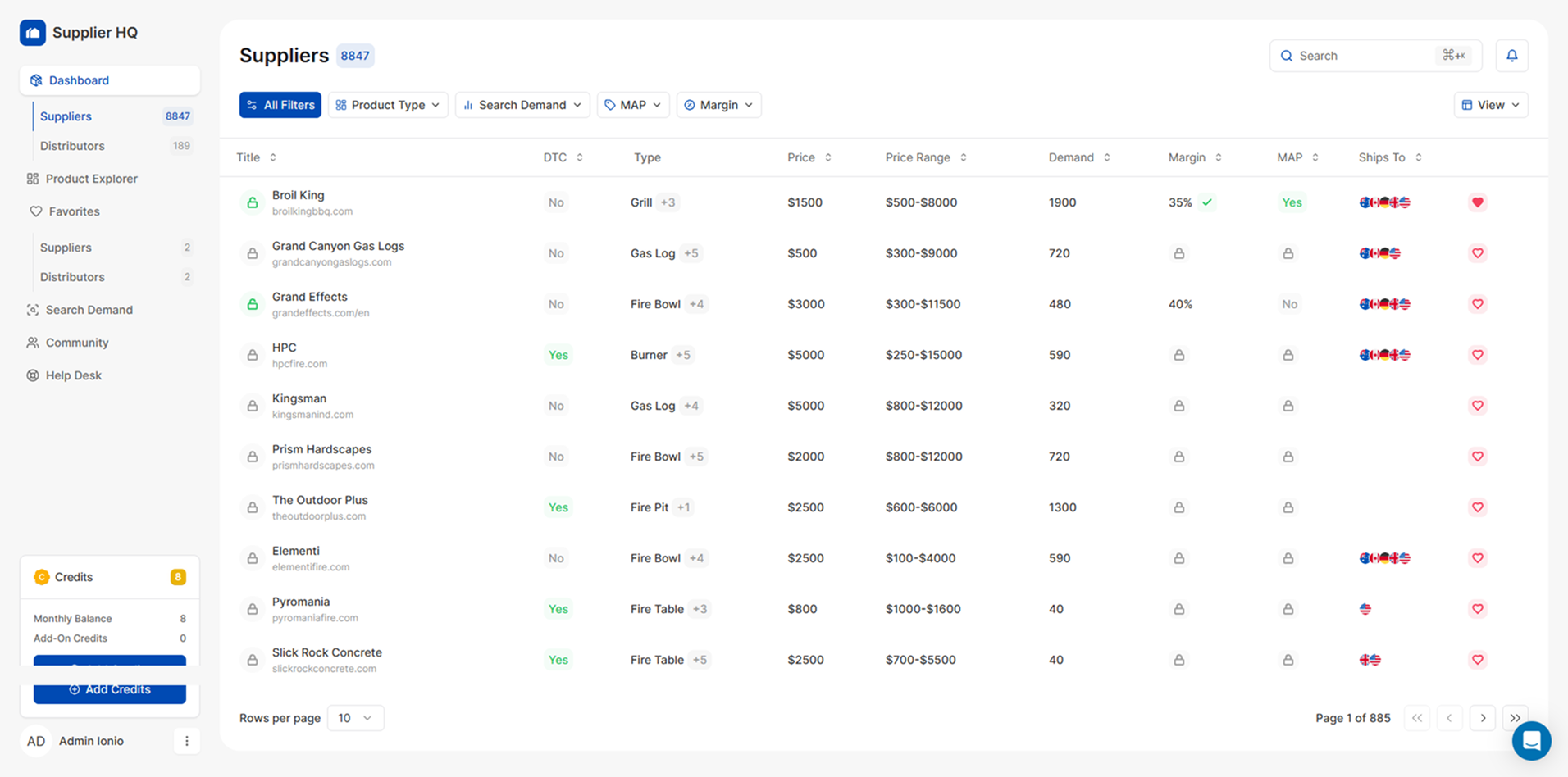
The moment you log in, the supplier database opens up. Search through thousands of verified suppliers and distributors, filter by category, product type, and country. Every record includes the supplier name, website, product types they carry, average price points, price ranges, search demand data, average margins, MAP policy status, and direct contact access. What used to take hours of Googling—laid out in a single, searchable interface.

02 / Smart Filtering
Drill down with precision. Select from over 700 product types across every category imaginable—from halogen generators to portable heaters, from chest freezers to gas logs. Filter by distributor, category, product type, country, and date added. Toggle competitive metrics like MAP and DTC policies. Adjust search demand sliders to find high-opportunity niches. The filtering system was built to collapse weeks of research into seconds.

03 / Distributor Database
Toggle between Suppliers and Distributors with a single click. The distributor view shows you the middlemen who aggregate multiple brands—CPS Distributors, Outdoor Kitchen Distributors, MODE Distributing—along with every supplier they carry. See which distributors work with which brands at a glance. Find the right distribution partner without the guesswork. One platform, two complete databases, zero duplicated research effort.
04 / Category Search
Not sure where to start? Browse by category. Cooking, Backyard, Health, Furniture, Automotive, Technology, Marine—29 categories covering every high-ticket niche. Click any category to dive into its product types. Perfect for students exploring which vertical to enter, or experienced sellers expanding into adjacent markets. The entire supplier landscape, organized and waiting.

05 / Product Explorer
Once you select a category, explore every product type within it. See search demand numbers—Lamp at 80,000, Lighting at 63,000, Lantern at 49,000. Check seasonality ranges, top months, and average CPC. Click "View Suppliers" to instantly see every verified supplier for that exact product type. The data that used to require expensive research tools, built directly into the platform.
06 / Editor's Picks
Every week, the founders curate a new product drop—highlighting high-potential niches with detailed breakdowns. Massage Chairs for the Christmas gift season. Saunas with big prices and great margins. Snow Plows for seasonal plays. Home Gyms for the New Year's resolution crowd. Each drop includes supplier lists, market insights, and timing strategies. It's like having a product research team working for you, every single week.
The Solution
Ionio was responsible for the complete product lifecycle—from initial wireframes to production deployment and handoff. Every single thing: wireframes, UI/UX mockups, look and feel, design, development, deployment.
The founders came with roughly half a dozen ideas. We helped them map where each would fit in a typical student's journey through the coaching program—graphing impact against effort, identifying the intervention point that would serve the widest group of users.
That analysis led to SupplierHQ: automating the first obstacle every student faced. We produced wireframes and UI/UX mockups that defined the complete user experience before a single line of code was written. The client could see exactly what the product would look like and provide feedback before we committed to implementation.
The platform gave users access to the world's largest database of high-ticket suppliers and distributors. Users could log in, search through thousands of verified records, filter by category and criteria, and export contact details—all the information they needed to reach out and become authorized resellers.
We built advanced search and filtering systems that could handle complex queries across thousands of records. Database indexing and Redis caching ensured sub-2-second response times even under heavy load. Users could unlock contacts, export lists, and access instructional material—everything designed to collapse days of manual research into minutes.
Payment integration with Stripe handled recurring billing. Users subscribed monthly, and the system managed the full lifecycle—signups, upgrades, downgrades, cancellations. Usage tracking gave visibility into platform engagement.
One of the less obvious challenges: syncing with the coaching program's existing marketing infrastructure. The course ran on Active Campaign for email marketing, with tags and segments for every user state. We integrated SupplierHQ into that system—purchase tags, upsell tags, cancellation tags, abandoned cart tags—so messaging across both products stayed coherent.
When someone bought the course, they saw SupplierHQ as an upsell. The marketing spoke to them as one unified experience, not two disconnected products.
The technical challenge was clear: build a system that could handle thousands of simultaneous users on launch day, with complex database queries returning in under two seconds.
Powers the user interface. Every interaction—searching suppliers, filtering results, exporting contacts—happens without page reloads. The interface needed to be intuitive enough that someone could find and export hundreds of suppliers without reading documentation.
Handles server-side logic. The framework gave us solid foundations for API development, database management, and user authentication. JavaScript throughout kept the stack consistent.
The database layer handled complex filtering, sorting, and search across thousands of supplier records. We optimized query patterns and indexing to ensure performance at scale. Redis caching stored frequently-accessed data, reducing database load and ensuring sub-2-second response times even under heavy traffic.
Instrumentation from day one. Understanding how users actually interacted with the platform was critical for rapid iteration—we could see exactly how people were using the software and iterate based on real behavior, not assumptions.
Docker containers on AWS gave us the flexibility to scale resources as traffic demanded. The system handled the Black Friday traffic spike without performance degradation, maintaining fast load times throughout the highest-traffic period of the year.
Brad Milne, Co-Founder of SupplierHQ, on working with Ionio
"This is probably the fastest that I've ever gotten out a very honest MVP" —despite having spent "an unbelievable amount of money" developing software throughout his career.
"You're essentially getting the brain of a co-founder on board while you think through some early critical details that you don't have answers to."
"We could still get started knowing that you would help fill in the gaps on the way."
"Your team was there to support the launch and to very quickly work through all the bugs... at almost any hour of the day."
"Yes we made an ROI financially, but more importantly... there's a huge ROI with regards to your time and the opportunity cost."
"Very professional levels of documentation and support and assisting with the handoff... it's not a small thing."
Every feature served two masters: the user who needed their problem solved, and the business that needed sustainable growth.
Not months of iteration. Not years of pivoting. Eight weeks to product-market fit.
"Yes we made an ROI financially, but more importantly... there's a huge ROI with regards to your time and the opportunity cost."
Brad Milne, Co-FounderWe structured the engagement in four overlapping phases—moving from discovery to production launch in just eight weeks, timed perfectly for Black Friday.
SupplierHQ remains one of our cleanest success stories—a project where the idea, timing, team, and execution all aligned. These are the lessons that made it work.
When you have an audience experiencing a shared problem, software that solves it has a built-in market. This isn't about building products and hoping customers appear—it's about building products for customers who are already there.
When building software for a coaching program, automate the first obstacle students face. That's where adoption is highest, because it affects the widest group of people. Not the most interesting problem—the first one.
We instrumented PostHog from day one and used that data to guide every iteration. Understanding how users actually behave—not how we assumed they would—was critical for rapid improvement.
Brad provided technical oversight without micromanagement. He asked smart questions, provided context, and stayed out of the way. That trust relationship is what allows fast movement without sacrificing quality.
An MVP that can't be maintained by an in-house team isn't an MVP—it's technical debt. We invested in documentation and structured handoff from the start, knowing that success meant the product would outlive our engagement.
We learned how upsells, downsells, and marketing strategies work differently when you're selling software alongside education. The two can reinforce each other in powerful ways—but only if you design for it.
SupplierHQ proved that coaching programs sitting on engaged audiences have untapped software opportunities. Ten thousand students hitting the same obstacle, manually researching suppliers for hours. We turned that pain point into a platform that collapsed days of work into seconds—and launched it in time for Black Friday.
What made this work wasn't just execution speed. It was the combination of product thinking, technical capability, and a client who trusted us to make decisions on the fly. We didn't just build what was specified—we filled in the gaps, made product calls in real-time, and delivered a platform that generated revenue from day one.
You're facing a version of what this client faced—valuable data locked in fragmented systems, the need to compete with AI-native experiences, or the gap between your technical vision and the specialized talent required to execute it.
You need a strategic partner who understands both the technology and the business model—not a dev shop that builds what you specify.
You want a chatbot for your dashboard, AI for the press release, or features that OpenAI will commoditize in six months.
We'll tell you that directly.
30 minutes. No deck. We'll talk through your challenge, share some relevant work, and see if it makes sense to work together. Or honestly, just grab coffee and chat—no agenda needed.
Book an Intro Call →Prefer email? contact@ionio.ai