
Industries
Two Live · More Coming
Coming SoonEducation
Solutions
ServicesSolutions
Case Studies
35+ Projects Delivered
Research
Technical Articles · 100+ PostsWhite Papers

Why Quoting Still Runs on Spreadsheets and Email
An Ionio Strategic Briefing for Manufacturing Leaders
Introduction
An Ionio briefing for the people who own quoting and new business. Machined parts. Weldments. Fabricated assemblies. Metal, cut to somebody else's print.
An RFQ lands at four in the afternoon and it is never one clean file. There is an eight page request with the commercial terms buried somewhere inside it. Fourteen sheets of dimensioned prints. A thirty six page quality document. An Excel line list where some of the part numbers do not match the print.

One request, fourteen sheets, thirty six pages of quality, and a line list that disagrees with the print.
One person opens all of it. Usually the most experienced person in the building, who also runs the floor. He builds the routing in his head, saw to mill to deburr to anodize to inspection. He remembers a part close to this one from two years ago and roughly what it cost. Then he prices it. Two days later, sometimes a week later, a number goes back. Sometimes no number goes back at all.
You have lived this. A program part gets quoted once and you live with that number for five years while the price-down clause eats it every January. You lose a job by three percent and nobody ever calls to tell you by how much. An estimate sits half finished for six days because the plating shop has not written back. Rev C becomes Rev D and the takeoff starts again on a blank sheet. None of it appears in any report you have ever read.
So this is not a piece explaining what an RFQ is. You run them every day. It is about a mistake the whole industry has made in how it decided to automate quoting, and what that mistake has been costing you.
The mistake is treating quoting like a geometry problem.
For a decade, the software built for it has been CAD to cost. You upload a solid model, it reads the shape, it nests the part, it calculates machine run time from the features, and it hands you a price. Clever engineering, honestly built, and useless on most of what actually lands on your estimator's desk. A very good calculator.
But quotes do not go out late because the arithmetic was hard. They go out late because the answer already exists somewhere in your building and nobody can reach it.
That is a different problem. It is a memory problem. And no calculator solves a memory problem, however good the calculator is.
This piece is about that gap. Where it comes from, why it keeps costing you programs you never counted, and why two people in your building are the only thing holding it together. Then what changes when the price stops being assembled from memory under a deadline and starts coming from the jobs you have already run.
The Package
Talk about the RFQ as a single document and any estimator will know you have never seen one. It is not a document. It is a pile with four different animals in it, and every one of them reads differently.
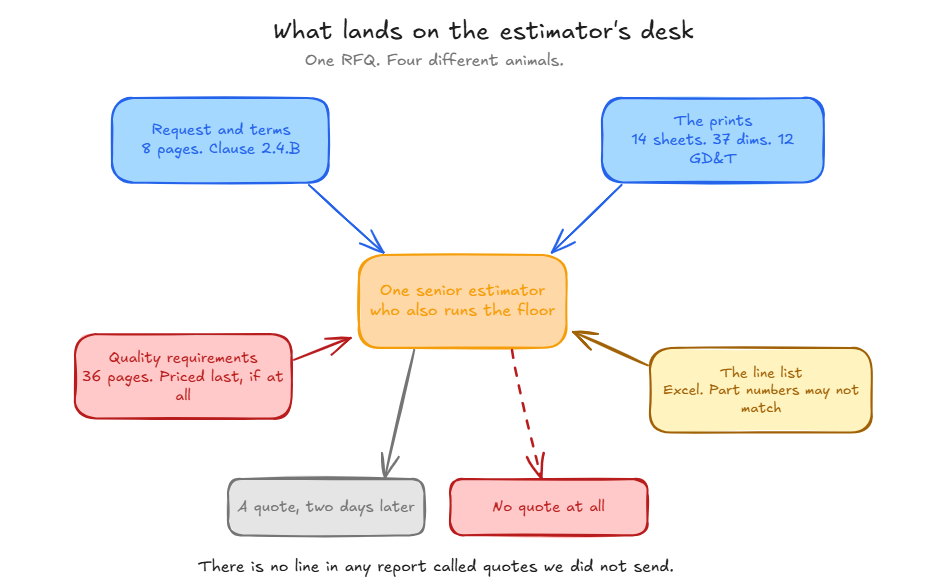
Four files, one estimator, and a quote that goes out two days later.
| What arrives | What it looks like | Why it hurts |
|---|---|---|
| The request and commercial terms | Five to twenty pages. Quantity, delivery, payment terms, price validity. | The number that changes your price is on page 148, clause 2.4.B. Net 45 with a thirty day price hold is not the same risk as Net 30 with sixty. |
| The prints | Ten to fifty dimensioned sheets. Views, dimension strings, GD&T frames, title block, revision clouds. | The dimensions live inside the drawing views, not as clean data anywhere. This is the hard extraction, and nothing else can start until it is done. |
| The quality requirements | Twenty to sixty pages. PPAP level, material certs, inspection, customer specific rules. | The cost of quality is real and it is the first thing forgotten in the price. Nobody quotes a FAIR until the customer asks where it is. |
| The line list | An Excel file, a few sheets, with the release schedule buried in one of them. | Quantities and part numbers that may not agree with the print. Somebody has to notice, and that somebody is your estimator. |
In the build we demo, a fourteen sheet print set for one hydraulic manifold block carries thirty seven dimensions and twelve GD&T callouts. Every one of them has to come off the sheet and into a routing before a single dollar of cost can attach to anything. A person does that with a highlighter.
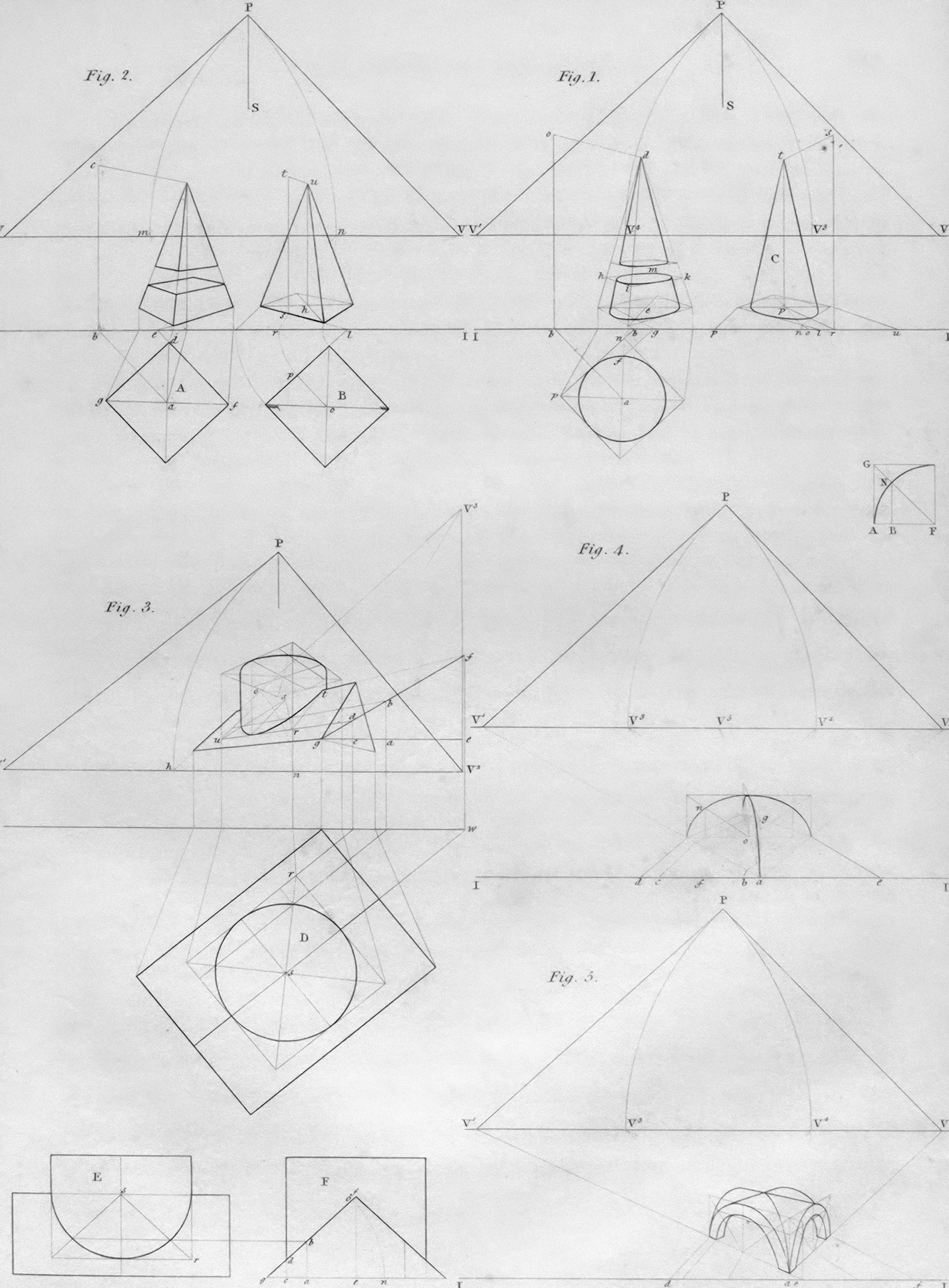
The dimensions live inside the views. There is no clean data anywhere on the sheet.
Then the reading gets worse in three specific ways.
The bought-out lines poison the estimate. You cannot finish a number until the plater, the heat treater or the coater quotes back. So the estimate sits half built while your estimator waits on somebody else's inbox. When the supplier number finally lands it looks nothing like the placeholder he used, and the price he was ninety percent done with has to be rebuilt.
Revisions reset the work. Rev C becomes Rev D and the takeoff may change completely. Done by hand, that means starting again on a blank sheet. Estimators hate this more than almost anything, and they do not say so out loud, because until now there was nothing to be done about it.
And the answer already exists, unreachable. Every manufacturer has already priced a part like this one. The answer is sitting in an old quote folder, in an ERP nobody queries, on a costing sheet on somebody's desktop, in a job number from 2023. It cannot be searched. So the estimator prices from memory instead, and the memory is good, and it belongs to one person, and it is written down nowhere.
That last one is the whole thing. The data exists. It is just unreachable.
The Interpretation Layer
Here is a question worth sitting with. Send the same print to five capable manufacturers, with the same quantity and the same delivery date, and ask each of them for a price.
You get five different numbers, and not because four of them are wrong. Different routings. Different work centers. Different cycle times for the same operation. Different scrap assumptions. Different views on whether the tight bore sitting near the process limit is going to bite.
Same part. Same print. Five defensible answers.
The same drawing, priced five ways. None of the difference is written on the sheet.
An estimate is not a calculation performed on a drawing. It is an interpretation of one, made by somebody who knows your building.
Somewhere in your operation a senior estimator looks at that print and makes a hundred judgment calls that appear nowhere on the paper. Whether this runs on the five axis cell or the old three axis with two setups. Whether the deburr is two minutes or five, given how this alloy behaves. Whether to carry eight percent drop on the billet or ten. Whether this customer always demands a first article and never says so in the RFQ. Whether you lost the last three jobs to this buyer on price and should sharpen your pencil, or won them all and should not.
None of that is on the drawing. All of it is in his head.
The industry has a name for the two ways to build a number. Engineered costing means you build a fully burdened rate for every work center, direct labour plus fixed and variable overhead per hour, then you estimate how long each operation takes from the features of the part, then you multiply time by rate down the routing and add material and margin. The rates are real, and they differ per work center, which is the point.
| Work center | Illustrative burdened rate |
|---|---|
| Laser cutting | about $150 per hour |
| Machining | about $120 per hour |
| Fabrication | about $75 per hour |
| Welding | about $65 per hour |
Remembered costing means you look at what a similar part actually cost you last time, and you adjust. No formula. Pattern matching against experience. On bespoke, low volume, messy work, estimators use the second one. Every time.
The industry half knows this about itself. The standard costing references in adjacent trades are built as learning curves, where the first unit takes longest and each repeat runs faster, and the serious manufacturers throw out the book times and substitute times pulled from their own operations. That is pricing from history, done badly, in a spreadsheet, by hand.
So see the estimate for what it is. It is the externalisation of one expert's understanding of how your operation makes this part and what it costs you when you do. Not a document. A judgment, written as a number.
The pricing judgment lives in two or three heads. Those heads also run the floor.
Two things follow from that, and both are strategic problems rather than paperwork problems.
The first is fragility. When those people are on the floor, quoting stops. You cannot clone them and you cannot hire them, because a costing engineer who understands five axis work or powder metallurgy is not sitting on a job board. When they retire, the interpretation retires with them, and what is left behind is a folder of old quotes, which is the output of the judgment and not the judgment itself.
The second is inconsistency inside your own building. If interpretation lives in people, two estimators will price the same part with different logic. Your customer sees the variance across a program even when they cannot name it. You are not one supplier to them. You are a couple of individuals who share a logo.
The real asset in your quoting process is not the quotes. It is the interpretation layer underneath them. It is scarce, it is walking out of the door, and it has never been written down. Hold that thought, because it is the reason the technology conversation is about to matter.
The Source of the Number
Geometry pricing tools read the solid model and compute machine time from the shape. On clean CAD, a standard process and repeat volume, they work, and they work well. That is a real business and we do not compete with it.
They fall down in two places, and both places are where your work lives. The first is simple. Half the packages that reach an estimating desk have no usable CAD at all. They have a PDF of a print with the dimensions sitting inside the drawing views. A geometry engine has nothing to eat.
Everything it knows was in the file. Everything that sets your price was not.
The second place is the deeper one. Geometry knows the shape of the part. It does not know that your five axis cell runs slow on the second shift. It does not know that this customer always demands a first article and never writes it into the RFQ. It does not know that you quoted this buyer twice, won once, and that he is sensitive on price. It does not know what you charged for a manifold in 2024, and it certainly does not know what that job actually cost you when it closed.
Your past jobs know all of it.
They price the part. You price your history.
That is the whole difference, and it is not a small one. A model can tell you how long a pocket takes to cut. It cannot tell you what you charged for the last part that had one, or what you gave up to win it. That number was never in the model. It is in a job folder, and it is the only number that has ever been proven right or wrong by your own bank account.
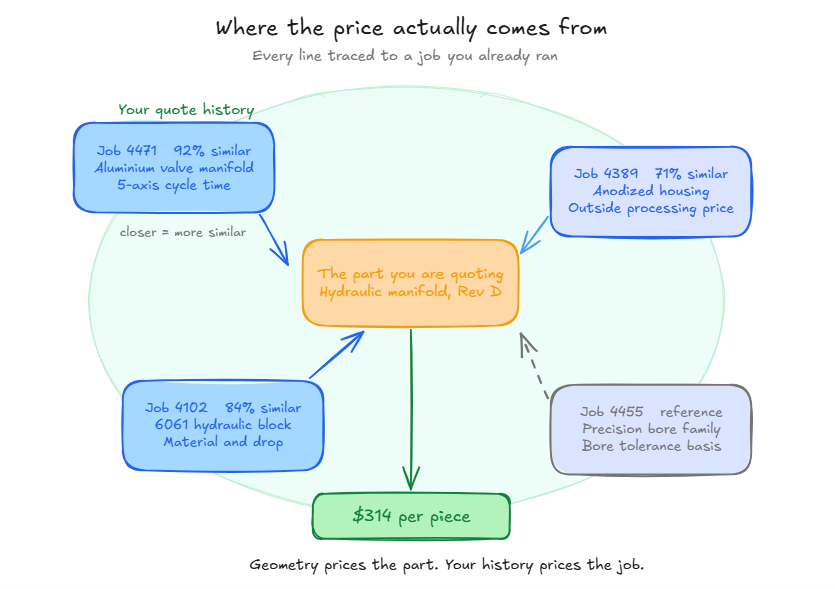
Every line traced to a job you already ran. The closer the match, the harder it argues.
Before we go further, the three fixes everybody tries first, and why each one fails in exactly the same way.
Hire another estimator. Costing engineers who understand your process are scarce and expensive, and then it is months of knowledge transfer before they are useful. At the end of it the expertise still lives in a few heads, and now you have one more head to lose.
Build it internally. One manufacturer we know put ten people on this for eighteen months and spent about a crore and a half. It never worked. To build it you have to become a software company first, and that is a culture, not a project.
Buy an off the shelf quoting tool. Generic CPQ software does not understand how your parts are costed. It knows nothing about tooling amortisation over program volume, or press tonnage, or five axis setup strategy. Estimators try it, hit the wall in the second week, and quietly slide back to Excel.
Notice that all three failures share one root. The pricing logic is specific to your operation and it is written down nowhere. Every fix that ignores that fact fails the same way, and it fails after you have already paid for it.
The Numbers
Take the block from our demo build. A hydraulic manifold in 6061-T6 aluminium, machined from billet, Revision D. A batch of 240 pieces against an annual usage of 1,536. PPAP Level 3 with a first article. Eight week delivery, Net 45, prices firm for thirty days.

Two five axis setups, priced off a valve manifold that ran in 2024.
Seven operations. The raw material comes off job 4102. The two five axis setups are priced off job 4471, a valve manifold sitting at ninety two percent similarity. Saw, deburr and final inspection carry standard times. The hard anodize goes outside, quoted by three platers already on the approved list, and awarded at $58.40 a piece, three dollars and sixty cents under the provisional estimate.
That saving lands in the price before the price is set, rather than turning up as a margin surprise after the job has already run.
Every rupee of it traceable to a print or to a job that already closed.
The batch comes to $75,396. The annual comes to $482,534. The margin floor in this business is thirty percent, and this one clears it at thirty four.
The RFQ opened at 10:14 in the morning. The quote was ready at 12:23.
Be clear about what that sentence is and what it is not. That is our demo build, on a manufacturer we invented, with numbers designed rather than measured off a live customer. We are not going to dress a prototype up as a case study. The point of it was never the two hours.
The point is the shape. Every line on that quote traces back to a place on a print. Every price on it traces back to a job that actually ran, and to what that job actually cost when it closed. Your version of this is built on your parts, your work centers and your own history, and the first thing we do is show you that it reproduces the quotes you already sent.
Where We Come In
We kept hitting this same problem across our manufacturing work.
So we built the system this whole piece describes, and we call it RFQ Intelligence. It reads the messy package, builds the takeoff against your work centers, quotes the outside processing before it prices anything, prices every line from jobs you have already run, and keeps your estimator in the seat where he signs.
It is built on your parts, your routings, and your own quote history, because a number from another manufacturer is worth nothing in your building. The connected model your estimating desk has needed since the first time a good quote went out late and a bad one went out fast.
A working build on a sample package, a hydraulic manifold block to Kessler Fluid Power. Real structure, every line drafted by the copilot, every stage approved by a person.


This Is a Demo Build
What you just walked through is a demo. Your build is trained on your parts, your work centers, and your own closed jobs. Same engine underneath, shaped to how your operation already prices.
The Next Step
Not a demo of features. We look at your RFQ history, find where the reading and the pricing are bleeding days and programs, and tell you what it is worth to close it.
Book a call