How We Added a Million-Dollar Recurring Revenue on a Six-Week Build
An e-commerce education business was earning $10 million a year selling a
course people bought once, and every month it started again from zero to do it.
We became its software arm and built a subscription product for the audience
it already had. It reached $100,000 a month within four months and has earned
over $2.5 million across three years, on a build that cost under $50,000. A
return of 50x, and a line a buyer could value in the millions.
$10 million a year, and not a dollar of it recurring
Our client taught people how to start and run their own online stores. He sold that teaching as
a course, and he sold a lot of it. Ads pointed at a free training session, the training session
filled a mailing list in the hundreds of thousands, and a two-hour webinar sold the course at a
few thousand dollars a seat. That funnel earned $10 million a year, on a team of
fewer than 10 people. There was no public personality behind any of it, no following worth
speaking of, just the list and the funnel. He was good at this, and we were not walking in to
rescue anybody.
The catch was that every customer paid once. They bought the course, finished it, and nothing
came back the following month, so the machine had to be pointed at a fresh set of
strangers again, every month, forever. Stop pushing and it stops.
We run every project through two layers.
Layer 1 — what would make this 10x better for the people using it?
Every student hit the same wall before they could sell anything, which was deciding what to
sell. Find a product, check the margin, find a supplier, work out shipping, then write the advert
and the description from a blank page. Hours per product, across several tools, repeated for
every product they tested. The task never changed and every student did it the same
way, which is the shape of something software does in seconds.
The Same Task, Every Time
Layer 1 · For the User
The same steps, over and over — the exact shape of a product.
Layer 2 — what does solving it do for the business?
A course business is valued as the operator's personal income, because that is what it is. There
is nothing to sell but a mailing list. Turning that repeated task into a subscription gives the
same audience a reason to pay every month, which is revenue that arrives without being sold
again, and an asset somebody could eventually buy.
Income You Keep vs An Asset You Own
Layer 2 · For the Business
One is worth this month — the other is worth selling.
The Philosophy
The Leverage Test
Most people are sitting on distribution they have never fully used
A lot of people are sitting on distribution they have never fully used. They have spent years and
real money building an audience that trusts them, and they earn from it in bursts. A launch goes
out, the ads run, a few hundred people buy, and then the funnel goes quiet until the next one. The
audience is still there. The money is not, because everyone in it already bought the only thing
there was to buy.
That is the gap. Distribution is the hardest and most expensive thing to build in any
business, and most of the people who own it are collecting one payment per customer from it.
So we run every prospective build through the same check. We call it the leverage test, and it
asks three things.
Distribution.Does this person own an audience they control rather than rent?
A complex repetitive task.Is there something inside the work they teach that their audience does the same way, over and over?
Domain expertise.Do they know exactly how that task should be done?
When all three line up, there is a product waiting to be built, and the person is already
holding the expensive half of a software business without treating it as one.
This client had all three
A mailing list in the hundreds of thousands who bought when he recommended something.
The product research every student performed the same way before every product they tested.
Years of knowing which products were worth selling and why.
The distribution was finished and paid for long before we arrived. The only missing piece was the
product, and the product is the cheap half.
That is the leverage, and what it buys is a different kind of revenue. Course sales are earned
once and never heard from again, so the business is only ever worth what its owner can generate
this month. A subscription arrives without being sold again, it compounds, and it can be valued
and sold on its own terms. Same audience, same expertise, a completely different business
underneath.
He was already holding the expensive half of a software business without treating it as one.
Product Walkthrough
The Platform in Action
01 / Idea Research
Every vetted product in one place
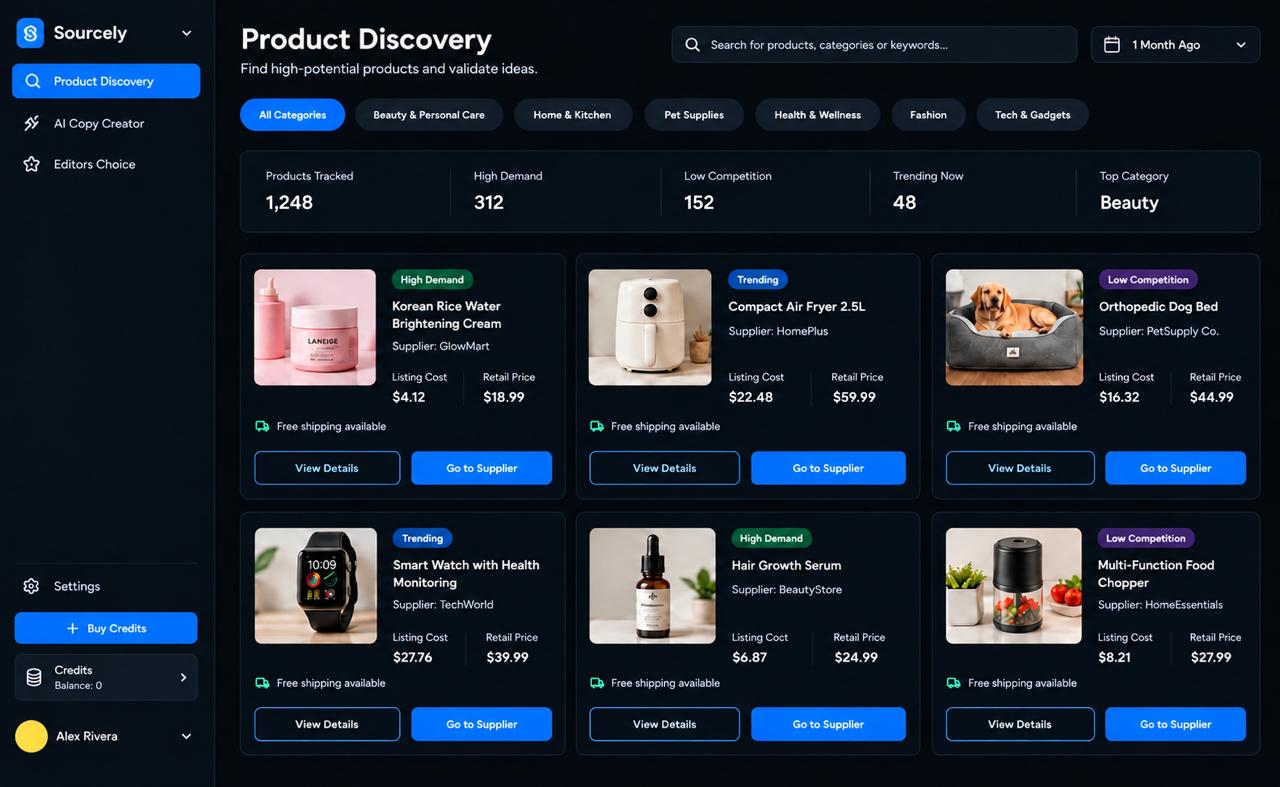
The home screen is a product grid with categories across the top and a counter strip above it:
products tracked, how many are high demand, how many low competition, what is trending, which
category is running hottest. Each card carries its badge, the listing cost against the retail
price, shipping time, and a route straight to the supplier.
02 / Product Detail
The whole case for one product
Cost against retail price at the top, so the margin is the first thing you see.
Below it the logistics that decide whether a product is workable: shipping time, where it ships
from, processing time, returns. The insights panel repeats demand and competition for that item
and closes with a plain note on why it made the list.
03 / AI Copy Creator
Pick what needs writing
An advertisement, or a product description. Two options and a button.
04 / The Brief
A short form, then finished copy
A writing framework to work within, AIDA by default. What the product is, the brand, who it
is for, then price and category. Five fields between finding a product and having the
copy to sell it.
The Solution
What We Built
We owned the whole arc, from the product decision through design, build, launch and the years of support that followed. Only a small part of that was the software.
One of the client's marketing agencies referred him to us. We had already built for two of that agency's other clients, so there was trust in the room before the first conversation. There was never another dev shop in the running and never a bake-off. The idea was his and the agency's together, he brought it to us fully formed, and we were hired to build it. He did not try three things first. He had one idea, hired us, and it worked the first time.
The Build
A catalogue kept current by hand, a content generator, a login and a billing system with monthly, annual and lifetime tiers. Six weeks. We have covered why that was the easy part.
Familiar Parts, Stacked Fast
The Build
Parts we had built before — stacked into a product.
The Commercial Wiring
This is where the real work sat. Pricing the tiers so they strengthened the course business instead of undercutting it, with monthly, annual and lifetime options. The lifetime tier turned out to do a second job nobody planned for: offered to anyone asking for a refund on the course, it turned a request for money back into a subscriber kept. Billing handled signups, renewals and cancellations cleanly, and the checkout dropped into a funnel already tuned to convert without disturbing the thing that already worked. Get this wrong and it does not throw an error, it quietly loses money or breaks the page the whole business runs on.
Planted Once, It Keeps Growing
The Commercial Wiring
Planted once by the wiring — it grows and keeps giving.
The Launch
The product did not go out to a cold audience, it went into a machine that was already running, and it went in on more surfaces than one. It was pre-sold to the email list before it existed. It launched into a paid community. It went out as a mass email to the list. It sat as an upsell on the thank-you page every buyer already saw. And it was sold from the webinar stage that was already selling the course. Because every one of those surfaces was already paid for, the cost of acquiring a subscriber came out close to nothing.
Built on the Pad, Then Launched
The Launch
It assembled on a pad already built — then it launched for almost nothing.
Hundreds of people were paying for the platform before there was a platform to log into. Over five hundred on the day it opened. The audience did not need convincing that the operator's tools were worth buying, they had already decided that about him, and the subscription inherited that trust the moment it was offered.
It was launched to a list, not bundled into the course. An upsell after the sale, and a product in its own right.
Internal Infrastructure
Technical Infrastructure
The stack was deliberately ordinary. Everything here is mainstream and staffable anywhere,
because the client would own the product long after we handed it over.
Frontend
React
The subscriber-facing application, the catalogue, the filters and the generator, all running without page reloads.
Backend
Node and Express
The application logic, the accounts and the API. One language across the stack kept it simple to pick up.
Database
PostgreSQL
The catalogue, the categories and the subscriber records, in a conventional relational database.
Admin
Off-the-shelf panel
Rather than build an admin interface from scratch, we put an existing one over the database so a non-technical team could keep the catalogue current themselves. It saved weeks and meant they could run it without us.
Cloud
AWS
Everything deployed on AWS, with room to grow as the subscriber base did.
The Results
The Business Impact
A business that earned in bursts now had money coming in every month
Before the platform, revenue came in spikes. A launch landed, the line jumped, then it went
flat until the next push. The software changed that shape. Within three to four months of launch
the product was bringing in around $100,000 a month, arriving whether or not
there had been a launch, whether or not the operator was at his desk. It kept climbing from
there, past $200,000 a month at its peak.
From Bursts to a Standing Line
Monthly Revenue Shape
The old line spiked and fell. The new one just arrives.
We did not get on a single call with the client until the product had already made its first
$100,000. The whole build ran on a written description and a handful of messages, and it has
been running ever since, with us supporting it for three years. The build cost under $50,000 and
runs on under $15,000 a year, a return of roughly 50x. It launched into a
funnel that was already paid for, so the cost of finding each subscriber was close to nothing
and almost all of what it earned dropped through. Six weeks of work added around a tenth of the
revenue of an $8 to $10 million business.
The bigger number never shows up in a monthly report. A course business sold through paid ads
has close to zero enterprise value. There is nothing to sell but an email list, because the
business is the operator, and a buyer is not purchasing an asset so much as his continued
attention. A subscription product earning over $1 million a year is a different proposition
entirely. At the conservative multiples these businesses trade on, that line alone is worth
somewhere in the region of $5 to $8 million, sellable without the man attached to
it. Six weeks of work created an asset worth several times what the software has earned
in cash.
As a course business≈ $0Nothing to sell but an email list. The business is the operator.
As a recurring line$5–8MAn asset that can be valued and sold without the man attached.
That is what changes when revenue recurs. $100,000 a month with no webinar behind it covers the
team and the overhead and the operator's own life before the course earns a dollar, and behind
that monthly number sits something the business never had before, which is
a thing somebody could one day buy.
Project Roadmap
Our Approach
Six weeks from a description to a product taking payments, then
three years of keeping it running.
Execution Timeline (2023 → today)
Wireframes
The Build
Launch
Support
WireframesFirst 10 days
The product drawn out before any of it was built
Working from the client's description and the tools his students already used
Every screen a subscriber and an admin would touch, turned into wireframes he could react to
This was very nearly the only point in the whole engagement where his input was needed, and it
came in writing rather than on a call.
The BuildWeeks 2 to 6
Execution against a known target, with the screens already agreed
The catalogue and admin panel first, so the client's team could start stocking it
Then the subscriber-facing application
Then the content generator and the billing
A properly staffed team working through a stack we had used many times
LaunchEnd of week 6
Into the funnel rather than out to a cold audience
Across every surface the business already had
Subscribers began arriving immediately, because the audience was there and
already warm.
Three years of support2023 to today
After handover, we stayed on to keep it running
The software never gave us much trouble
A single virtual assistant handled day-to-day support
Us behind her only when something needed an engineer
The engagement that began as a six-week build has
now run for three years.
The same product would take us two weeks now, not six.
What took six weeks in 2023 took a designer, project managers and several engineers working
together. Today one product lead builds the mockups in a day and
ships the whole thing in two weeks. The tools caught up with the process we
already had, which is why a build like this is now within reach of far smaller operators than
the one in this story.
Retrospective
What We Learned
I.
Sell it before you build it
Hundreds of subscriptions were paid for before there was a product to log into. That is the
sequence worth copying. An operator with distribution can sell a subscription to their own
audience before a line of code exists, which means the build is de-risked
before it starts and the thing arrives already earning.
II.
The audience is the expensive part, and it was already paid for
What sinks most software is finding people to sell it to. That risk never existed here,
because the audience was built, warm and buying before we wrote a line. The first question
on a project like this is not what to build. It is
whether there is already a paid-for audience to build it for.
III.
Recurring revenue changes what a business is, not just what it earns
The point was never a better tool. It was giving a business that earned in one-time spikes a
line that arrived every month, and with it an asset that could be valued on its own rather
than as the operator's personal income. Same audience, same expertise, worth
more.
IV.
A product that earns still needs someone whose job is to grow it
This is the one we would do differently. The software never broke and support was never a
burden, but nobody was feeding the top of the funnel, and by the end of 2024 the product was
adding around 46 new users a month while the revenue coasted on the subscribers already
inside. Keeping a product running and growing a product are different jobs,
and only the first one was ever bought.
V.
The build was never the hard part
A catalogue and a text generator, both of which we had built before. What mattered was the
judgement around it: which piece of the method to turn into software, what to charge, and how
to place it in a funnel without breaking what already worked. That is
the part an operator cannot do alone and the part a shop paid by the build
has no reason to think about.
The Fit
Who This Is For
It fits an operator with real distribution and a proven method. Course sellers, coaches,
consultants, community owners, the people the industry calls operators. Someone doing $2 to $3
million a year or more, with a reliable way to reach their own market at volume, a method their
students follow the same way every time, and the domain expertise to know how the work should
actually be done. When that is the shape of the business, the distribution is already there and
already paying, and
a subscription product has somewhere to land on day one.
The shape that fits
Distribution
Already there, already paying
Repeatable methods
The same steps every time
Domain expertise
They know how the work should be done
A product lands on day one — somewhere to go from the start
It does not fit everyone. If the business is under $100,000 a month, or there is no distribution
it controls, or there is no repeatable method underneath it, or nobody inside it knows how the
work should actually be done, the thing that made this work is missing. The product was never
the hard part. The distribution was, and this operator had already built it. Without that,
there is nothing for the software to inherit.
Nobody is impressed by software any more. What still works is
distribution that pays before the thing exists.
We became the software arm of a business that had spent years building distribution and had
nothing recurring to sell through it. Six weeks turned its method into a product, hundreds of
people were paying for that product before there was anything to log into, and three years on it
has earned over $2.5 million.
The sequence is the whole thing. An operator with real distribution, a complex repetitive task
inside the method, and the domain expertise to know how the work should be done, selling a
subscription into a market they already own before a line of code exists. Building is
the cheap, fast, solved part now and it gets cheaper every year. What decides whether a
product earns is everything that happens around it.
The software is the least interesting thing here. Put a recurring product in front of an
audience that already pays, and you change
what the business is, not just what it earns.
We became the software arm of a business that already owned the expensive
half, the audience, the distribution, the proven method, and built the recurring product it
never had. Six weeks turned one operator's method into a product, and three years on it has
earned over $2.5 million.
The sequence is the whole thing: real distribution, a repeatable task worth encoding, and a
subscription sold to that audience before a line of code exists. Building is the cheap, fast,
solved part now. Everything that happens around it is the work.
How We Operate
01 // Integration
We embed with your technical team. The work you just read represents how we operate. We build production systems that connect into your existing architecture, and transfer the knowledge so you own what we build.
02 // Acceleration
We do not start from zero. The tooling we have developed across our engagements, the pipelines, the agent frameworks, the eval systems, accelerates every project we take on. You are not paying us to learn on your time.
03 // Experience
We know what works. We have been building AI systems for a decade. We shipped architectures before they became mainstream, and we know the pitfalls because we have made the mistakes already.
When to Talk to Us
You are an operator with a real audience and a proven method, a course, a coaching program, a community, doing $2 to $3 million a year or more into a funnel that already converts, with nothing recurring to sell the people who already trust you.
You want a partner who understands the business model as well as the technology, not a dev shop that only builds what you specify.
When We're Not a Fit
You want a chatbot for your dashboard, AI for the press release, or features a foundation model will commoditize in six months.
We will tell you that directly.
Next Step
Let's See If There's a Fit
30 minutes. No deck. We will talk through your challenge, share some relevant work, and
see if it makes sense to work together. Or honestly, just grab coffee and chat, no agenda
needed.

.jpeg)
.jpeg)
.jpeg)