How We Turned 1,000+ Unsearchable Documents Into Research That Answers in Seconds For a Non-Profit
Education.org had already paid for its research, but reaching it took days,
so most of it went unused. Their evidence decides where NGO funding and effort go, and it sat
in scanned PDFs and languages the reader didn’t speak.
We changed the economics of an archive they already owned. We mapped their
research workflow stage by stage and built for each one. The centrepiece made the whole of
their research answerable in one question, for their team first and then for
the public they serve.
Education.org came to us through Sallyann, founder of Gleac, whose community Ionio serves as its AI team. She brought us in and stayed close to the work.
On why she chose us
“I try to make sure when I’m bringing in teams, when my internal team can’t handle it, that I bring in someone who can handle it from A to Z.”
On staying out of the way
“I had very little involvement. I think I attended three or four meetings, and you and your team handled that project.”
On the trust
“I was comfortable already with you. I knew that you could manage that, and your team handled that project.”
On the depth of the work
“There was such depth in terms of the work. They’re an example of an NGO that really took the first step.”
The Problem
The Expensive Problem
The Business Problem
Education.org had decided where it wanted to be: an AI-first organisation, one of the few
NGOs in its field building AI into how it actually works. That was
a positioning bet as much as a technical one. In a space where credibility
and being early both matter, an NGO that can show it runs on AI stands out to the funders and
partners it depends on, and it opens the door to more of the work it wants to do.
The trouble was the gap between wanting that and living it. The organisation ran on knowledge
work, and while people had started reaching for AI here and there,
none of it was regimented. There was no system, no shared tooling, nothing
that turned scattered experiments into a way of working. Closing that gap is what the
engagement was really about.
The Same Piece, Six Players
No Shared Tooling
Everyone played it their own way, and nothing was keeping time.
The Workflow Problem
Underneath the positioning sat the daily reality, and it is easiest to see through one
researcher. Picture someone who needs to know what the organisation has already established
about, say, girls’ schooling outcomes in a particular region. The answer almost
certainly exists somewhere in the research. Getting to it is the hard part.
They would start searching, one repository at a time. Some of what they need is in languages
they don’t read. Some is locked in scanned PDFs with no searchable text. Some was filed
years ago by someone who has since moved on. So the search becomes a hunt, and
the hunt takes days, and at the end of it they have a stack of documents
they still have to read before they can answer the question they started with.
The Widening Search
One Question · Days of Hunting
1A language they don’t read
2Scanned, with no searchable text
3Filed by someone who has moved on
Days of searching outward, and the answer was at the centre.
That was one stage of a longer chain. Searching, then cataloguing, then screening each source
against the inclusion criteria, then coding it, then pulling findings together, each step
manual, each done in a different tool, each eating the time of skilled
people. Every hour spent on it was an hour not spent on the judgment only a
researcher can provide.
The organisation’s most valuable people were spending their days on work a machine could
carry, and its research was going underused because reaching it cost too much.
Why This Was Hard
We began in 2024, before the current generation of reasoning models existed, inside a
specialist discipline neither of us could shortcut.
Almost none of what made this difficult was code.
A Closed Research Discipline
Domain
Evidence synthesis is a specialist craft with its own rules, and
getting it wrong means the output can’t be trusted. We had to
learn how their researchers actually work, what grey literature is and why it’s
hard to source, how inclusion and exclusion criteria get applied, and what a librarian
needs to see before they’ll rely on a tool for real work.
What this meantWe spent real time learning the discipline before we designed anything.
The Models Weren’t Ready Yet
Core
We began in 2024, before the current generation of reasoning models existed. One of the
projects we took on, automating the judgment-heavy screening and coding work,
ran into a wall the models of that moment couldn’t clear, so we
held it at the pilot stage rather than ship something unreliable into a research
organisation. When reasoning-focused models arrived not long after, that work became
possible.
What this meantKnowing when to wait was as important as knowing what to build.
Messy, Multilingual, Real-World Sources
Complex
The source material was not clean text. Scanned PDFs with no readable layer, documents in
languages the reader didn’t speak, formats that changed from one repository to the
next. Before anything could be searched it had to be pulled in, read by OCR where needed,
and translated into one common language, so that
a single question could reach across the whole collection.
What this meantThe ingestion pipeline had to make messy documents behave like clean ones.
Building for Experts New to AI
Audience
The people we were building for were deep domain experts who hadn’t yet had reason
to work closely with AI. That changed the job. Part of the delivery was
showing them what these tools could and couldn’t do, setting honest expectations,
and designing something that felt trustworthy to someone encountering it for the first
time.
What this meantWe were teaching as much as we were shipping.
A closed discipline, a technology that was not ready, and a room of experts who had to trust
the thing before they would use it. The engineering was the tractable part.
The Philosophy
Adoption Before Automation
Rolling out AI inside an organisation that is excellent at one thing is not mainly a technical
problem. The people who have to trust the tool are often the ones with the least reason to have
kept up with AI, because they were busy being expert at the actual work.
Education.org was a room full of exactly that: sharp researchers who simply hadn’t had
time to dig into what these models do or don’t do.
So the job was never just to automate a workflow. It was to bring a team of experts along at a
pace they could trust, while building the thing that would earn that trust. In practice that
meant three things:
Understand the knowledge work before proposing anything. We mapped how their researchers actually work before we designed a single screen.
Be candid about what the models of the day could and couldn’t do. Honest limits set early are cheaper than disappointment set late.
Scope to what would genuinely work, not what would demo well. Including the moment we recommended pausing, because the technology was not ready.
The principle travels to any expert organisation adopting AI. Understand the work first, set
honest expectations, and build for the people who have to adopt it.
The two halves of the job
The automation is the easy half. Getting a room of experts to rely on it is the half that decides whether the thing gets used at all.
That second half showed up in how we worked, not just what we built. We walked in assuming
certain things were obvious, that everyone understood what these models could and
couldn’t do. We were wrong. These were deeply smart researchers with real depth in their
field who simply hadn’t had time to dig into AI, and
teaching the technology’s limits was a prerequisite for the engineering to
land, not a nice-to-have.
It shaped how we communicated too. We didn’t ask open-ended questions, we came with
options, framing decisions as A, B or C rather than “what do you want,” explaining
the tradeoffs, and making sure no one had to chase us for an update. That is how you keep a
non-technical stakeholder in control of a deeply technical process, and over time it changes
what they can do.
The same instinct applies once a product is live. When the tools underneath an AI system move
on, the right response isn’t to wait for the client to notice. It is to
come back and say plainly: here is what we built, here is what has changed, here is what it
means for you. Framed as education rather than a sales pitch, that is what turns a delivered
project into a lasting one.
Whose hands stay on the wheel
“Here’s what we did before, here is what the new technology is right now. For a client that it is working, that’s actually better for them in the long run.”
Product Walkthrough
The Platform in Action
From a plain-language question to a cited answer, then the library it draws from and the
site where the public meets it. Here is the Ask Evidence platform in action.
01 / Ask
Your education questions, answered
The tool opens on a single prompt: ask a question about education and get a research-backed answer drawn from Education.org’s own verified resources. A “Popular Topics” row offers real starting points, from education policy for equity to the role of NGOs, so a first-time user isn’t staring at an empty box. One question, the whole evidence base behind it.
02 / Answer
Cited to the source
Ask something like what role NGOs play in education policy, and the answer comes back written out, with a Sources card naming the exact document it drew from and inline markers tying each claim to it. Underneath, a Related Questions list suggests where to go next. Every statement traces back to a real study, which is what makes it usable for research rather than just readable.
03 / Library
The evidence behind the answers
The Library holds every document the tool answers from, in one place. National education plans from Guinea-Bissau, Iraq, Malawi, Zimbabwe, Myanmar and more sit alongside research reports, each a real source the answers can cite. This is the corpus, kept in view and managed by the team rather than buried in a database.
04 / In Place
Where the public meets it
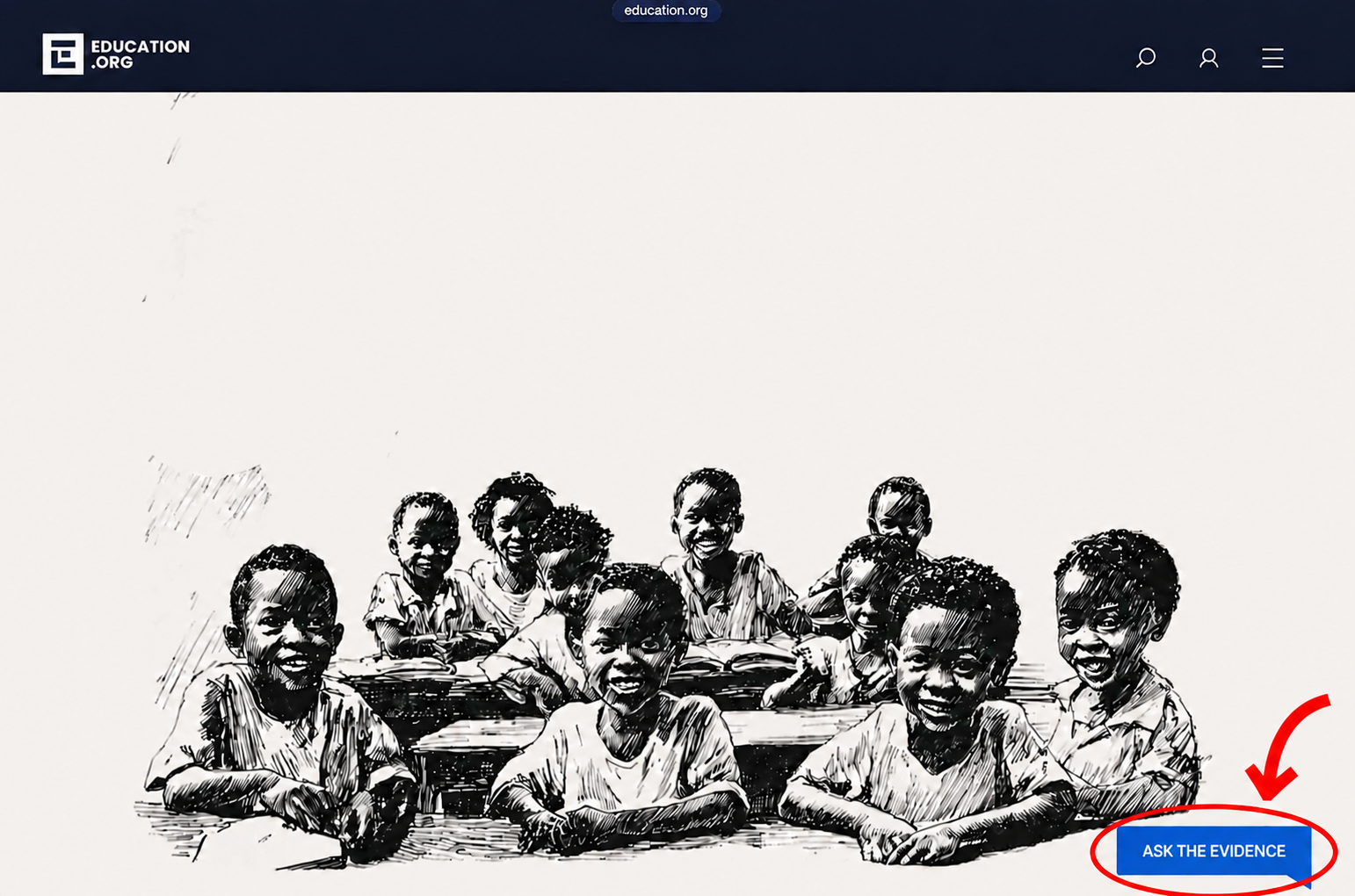
The same tool lives on Education.org’s own site, reachable from an “Ask the Evidence” button on every page. A visitor reading about the organisation’s work can put a question to its research without leaving, which is how the evidence reaches the professionals it’s meant for.
The Solution
What We Built
We started by mapping Education.org’s whole research workflow, the chain that ran from
searching for sources, through cataloguing and screening them, to coding and pulling findings
together. Then we went stage by stage and built to replace the manual work at each one. That
produced three projects: two focused tools that took on specific stages, and
one larger platform that became the centrepiece. Ionio owned the full arc of each, product
strategy, wireframes, UI and UX, the build, deployment and handover.
Project 01
Search Automation
The workflow began where every piece of research does, with finding sources, and that was the
first stage we automated. A researcher used to work through repositories one at a time,
hunting across libraries, journal databases and open repositories, much of it grey literature
that is awkward to find and awkward to read.
We built scrapers that went out to the sources that mattered, among them the World Bank and
the African Education Database, and pulled the documents in automatically. Across the target
sources this gathered more than a thousand documents into one place, turning
days of manual desk searching into a process that ran on its own.
Where the Documents Come From
Scraped, Not Searched
1,000+Documents gathered across the target sources
5 source typesLibraries, journals, open repositories, grey literature
UnattendedThe stage runs without anyone opening a repository
Days of desk searching, replaced by a process that runs on its own.
Project 02
Screening and Coding
The next stage was the hardest, and the most revealing. Once sources are found, researchers
screen each one for inclusion against a set of criteria, then code it, work that is slow,
expert, and done entirely by hand. We built to automate it, and in doing so we found
the real limit was not the tooling but the moment.
The coding framework leaned on subjective human judgment that the models of the day could not
reproduce reliably, so we held this at the pilot stage rather than ship something a research
team couldn’t trust. It became the clearest lesson of the engagement:
sometimes the right build is the one you wait to finish.
Where the Five Passes Landed
Spread, Not Accuracy
A research team cannot use an answer that changes every time you ask.
Project 03
The Ask Evidence Platform
The third project grew into the main one. Rather than speed up one stage, it changed the
question a researcher had to ask at all: instead of hunting for documents,
they could ask the research directly and get an answer back cited to the
studies behind it. This is the platform the walkthrough above steps through, and it comes
down to a few core systems.
Four Systems Around One Shelf
Everything Touches the Middle
Not hunting for documents. Asking the research directly.
The Ask Evidence tool. The part people touch. A plain-language question goes in, and a written answer comes back drawn from Education.org’s own research, cited to the studies behind it. It runs the same way for the internal team and for the public they serve.
The Evidence Library and ingestion pipeline. Every document that enters the platform gets processed on the way in. Language is detected, scanned files are read with OCR where needed, and non-English material is translated through DeepL into one common knowledge base, so a single question can reach across the entire collection whatever language each source started in.
The Contribution System. Researchers add their own documents to the central library, with the metadata that makes them findable. The collection grows with the team, and everything added is processed and searchable straight away.
The CRM and usage view. Behind the tool, every session is kept and readable, listed by the person who asked, so the organisation can see what’s being asked and how the platform is being used rather than guess at adoption.
Internal Infrastructure
Technical Infrastructure
The platform runs on a conventional, staffable stack, chosen so
Education.org could maintain and extend it after handover.
Frontend
React
Carries the query interface and the contribution and admin views. Questions, answers and document uploads happen without page reloads.
Backend
Node.js and Express
Runs the platform’s core modules: users, documents, the library, the processing workers and the chat layer. Mature, well-documented, and easy to hire into.
Vector Database
Qdrant
Stores the embedded representation of every document, so a plain-language question retrieves the passages that actually match its meaning, not just its keywords.
Database
Postgres
Holds accounts, document metadata, usage history and the structured data behind the dashboard.
Translation
DeepL API
Translates non-English documents during ingestion, so the whole library lives in one searchable language.
Language Model
GPT-4o
Generates the written answer from the retrieved evidence, grounded in the documents rather than in the model’s general knowledge.
Document Processing
Worker and job queue
Ingestion runs as background jobs that handle many documents at once, with OCR, language detection and translation happening in sequence before a document joins the library.
Cloud
Docker and AWS
Every component containerised and deployed on AWS across RDS, EC2 and S3, so the platform runs consistently and scales without re-architecting.
The Results
The Business Impact
Most of what Education.org owns is research it already paid to produce, and before this
engagement much of it sat idle, out of reach because getting to it cost days. What we built
changed what that asset is worth. Research that once took days to search now answers a question
in seconds, so the same collection gets used far more often, in more decisions, and
nothing new had to be commissioned for that value to appear. For an
organisation whose whole output is evidence, the cheapest research it can produce is the
research it already owns and can finally reach.
The first flame is no smaller for having lit the rest.
It also changed what kind of organisation they are. They used to publish reports and hope the
right practitioner found the right one; now they run a public tool that answers questions
straight from their library, cited to the studies behind it, in whatever language the question
arrives in. The same shift hands their researchers back the hours that sourcing, translating
and screening used to eat, and it turns every question the field asks into
something they can finally see rather than guess at.
And it gave them a proof point. Education.org became
one of the very few NGOs in their field with AI built into how they actually
work, at a moment when almost none had. In a space where credibility and being early
both count, that is something they can put in front of a funder.
What It Added Up To
What Each Side Gained
01Research Value
What the Archive Gained
Days → Secondsto reach an answer inside the same collection
Nothing newhad to be commissioned for that value to appear
Any languagea question arrives in, answered from one library
02Organisational Value
What Education.org Gained
Hours backfor the judgment only researchers can supply
Every questionthe field asks, now visible rather than guessed at
Among the firstNGOs with AI built into how they work
Sallyann had spent a year telling NGO leaders they needed to become AI-first. When we finished, she could point at Education.org and show them one that was.
Project Roadmap
Our Approach
The engagement ran as a discovery phase, a hard pause, and then a focused build.
Execution Timeline (2024–2025)
Discovery
The Pause
The Build
Discovery & Workflow Mapping2024
Learned how Education.org works, mapping the research workflow from searching through screening and reporting
Established where AI could help and where it could not yet
Defined the projects worth taking on: search automation, then screening and coding, then the platform
Everything we built afterwards, and the one thing we did not, traces back to
that map.
The Pilot That Waited2024
Screening and coding ran into the limit of the models available at the time
The task demanded subjective judgment the models could not reproduce reliably
Held at the pilot stage rather than shipped unreliable into a research organisation
It was the right call, and it is one we would make again.
The Build2024 to 2025
Reasoning-focused models arrived and the shelved work became possible
Ingestion pipeline first, because everything else depended on it
Then the Ask Evidence tool, the contribution system and the CRM
Tested and adopted by the Education.org team, then opened to the public they serve
Retrospective
What We Learned
Four lessons out of two years with a research organisation.
Two of them are about knowing when not to build.
I.
Educating the client is part of the build
Working with experts new to AI, we learned not to assume what was obvious to us was obvious
to them. Setting honest expectations about what the models could and couldn’t do
wasn’t a side conversation, it was part of delivering the product.
II.
Sometimes the right move is to wait
The harder automation wasn’t reliable on the models we started with. Pausing rather
than forcing it, then resuming when the technology caught up, produced a better product
than pushing through would have. Timing is a design decision.
III.
The bottleneck can be the work, not the model
When the harder automation stalled, the real problem wasn’t the model, it was that
the task leaned on subjective human judgment no model of the day could reliably apply. The
lesson was to look hard at the process itself before blaming the tool.
IV.
A search is only as good as what’s been ingested
Most of the real engineering went into the unglamorous work of getting messy, multilingual,
scanned documents into clean, searchable shape.
The quality of every answer traces back to that pipeline.
Evidence that nobody can reach is
evidence that may as well not exist.
That is the whole point of putting a system over a body of knowledge. An organisation
spends years producing research, and we build the thing that puts it in front of the
people who have to act on it, in seconds, cited to the study behind it. Education.org
did that with an archive it already owned and had already paid for.
We mapped how their researchers actually worked before proposing anything, said plainly
what the models of the day could and could not do, held back the one project that
wasn’t ready, and built the rest. What it left behind is an NGO that runs on AI and
can point at the thing to prove it.
How We Operate
01 // Integration
We embed with your technical team. The work you just read represents how we operate. We build production systems that connect into your existing architecture, and transfer the knowledge so you own what we build.
02 // Acceleration
We do not start from zero. The tooling we have developed across our engagements, the pipelines, the agent frameworks, the eval systems, accelerates every project we take on. You are not paying us to learn on your time.
03 // Experience
We know what works. We have been building AI systems for a decade. We shipped architectures before they became mainstream, and we know the pitfalls because we have made the mistakes already.
When to Talk to Us
You hold a body of expertise or evidence that is expensive to reach, the way Education.org’s research was, and you can see that the next version of your organisation runs on it rather than around it.
You want a partner who understands the business model as well as the technology, not a dev shop that only builds what you specify.
When We’re Not a Fit
You want a chatbot for your dashboard, AI for the press release, or features a foundation model will commoditize in six months.
We will tell you that directly.
Next Step
Let’s See If There’s a Fit
30 minutes. No deck. We will talk through your challenge, share some relevant work, and
see if it makes sense to work together. Or honestly, just grab coffee and chat, no agenda
needed.


.jpeg)
.jpeg)
.jpeg)