Case Study • Reelbit
How We Built a $20K MRR Video Automation Platform for a YouTube Coaching Business
A YouTube coaching business doing $5 million a year had students making short-form video for every platform, and every one of those videos took five tools to make: a script, an AI voice, background footage, captions, and an editor.
We turned that routine into a single credit-based platform where a student picks a format and exports a finished vertical video. More than 4,100 people joined the waitlist before launch. The platform reached $10K MRR by month two, growing to $20K MRR within its first six months.
The Expensive Problem
At Ionio, we approach every project through a two-layer framework.
Layer 1: how does this help users achieve their goals 10x better, faster, or cheaper?
Layer 2: how does solving that problem create compounding business value?
Our client ran a coaching program that taught people how to build and earn from YouTube. It was a $5 million a year business with a proven method and a funnel that kept bringing in new students.
The Routine Behind Every Short
Layer 1 · For the UserFive tools for one short, then the same five for the next.
Every one of those videos meant the same routine. Write or find a script. Generate a voice in one tool. Download background footage from another. Time and style the captions. Assemble it in an editor, export it vertical, and start again.
Short-form rewards a steady stream of videos, so the routine never stopped. It was repetitive, rule-based, and the same for every student, which is the kind of work software does better than people.
The Audience Already There
Layer 2 · For the BusinessA second product for students the business already had.
The first software engagement created a research and scripting platform for long-form YouTube videos. It introduced recurring subscription revenue for students using that workflow. Students focused on short-form video still needed a product built around their own production process.
A short-form video platform addressed this on several fronts:
- A second recurring revenue line: subscriptions separate from program sales and from Vidora
- Higher lifetime value: more of the program's students now had a reason to keep paying
- Enterprise value: a second recurring software product adds to the assets the business owns
- Revenue tied to output: the more videos a student makes, the more credits they use, so the platform earns more as students get more out of it
Why It Was Hard
The underlying components were available through existing services: AI models for scripts, voice providers, transcription for captions, image models for visuals, and rendering infrastructure. Our work centred on decisions about pricing, the initial product scope, and launching through the client's existing payment platform.
Video generation has a cost for every minute of voiceover, transcription, and rendering. We modelled the cost at about 30 cents per finished minute against plans starting below $20 a month. A flat, unlimited plan would have made the heaviest users the most expensive to serve. We therefore built a credit-based system, with credits deducted according to the cost of each action, including voiceover and video export.
What this meantCredit-based pricing aligned revenue with usage and delivery costs.
The client wanted the full feature set of the category leader: six video types, five standalone tools, premium media libraries, and an advanced editor connected to all of it. Building the complete platform at once would have taken four to six months before students could use it. We proposed starting with two priority video formats, releasing them to students, and using their feedback to guide the next iterations. This let us work as a product partner, helping the client build toward a platform students would use and the business could earn from.
What this meantStudents shaped the roadmap from the first release.
The client sold through a creator payment platform, and close to launch its webhooks could not reliably tell us which user a renewal belonged to. Holding the launch until it was fixed would have kept a waiting audience waiting. We launched with a manual process for first-month renewals and fixed the integration behind it.
What this meantThe launch went ahead as planned, and renewals were handled by hand until the fix was live.
Every part of the product could be bought. What it cost per minute, what to leave out, and how to launch on someone else's payment rails had to be decided.
Three Decisions on the Way to Launch
The Calls We MadeThe parts were ready. These three calls made it a business.
The Leverage Test
Most software struggles for a reason that has little to do with the code: nobody is waiting for it. The product launches, and then the real work begins, finding people who will try it, trust it, and pay. Coaches and course creators start from the other end. They have already earned an audience's trust, and they usually earn from it once. That trust is the part of a software business that takes the longest to build. With it in place, a well-built product has customers waiting on launch day.
We look for three conditions together:
- Distribution An audience the business already reaches on its own channels.
- A repetitive task Work that audience does again and again, in much the same way.
- Domain expertise Enough understanding of the audience and its work to build the right product.
Distribution helps a product reach its first customers. A repetitive task gives customers a reason to keep using it, and domain expertise helps ensure the product solves a real problem. Together, these conditions create an opportunity to build recurring software revenue and add enterprise value to an existing business.
Inside that test, we look for the widest task. A tool for one niche of an audience earns from that niche. A tool for a task most of the audience repeats earns from most of the audience.
The same client had the audience and domain expertise for both products. The first product supported long-form YouTube research and scripting. The second addressed short-form production, a workflow relevant to students publishing across several platforms.
The audience and the expertise stayed the same. Only the task changed, and the wider task reached more of the people the business had already won.
The Platform in Action
Reelbit takes a student from a blank page to a finished vertical video in one guided flow. Every action draws from a monthly credit balance.
Pick the kind of video to make
Students start by picking the kind of video they want: a Reddit story, a text conversation, a split-screen clip, an AI story video, or a gameplay short. Each format opens the same step-by-step flow, so learning one means learning all of them.

Start with a script, then give it a voice
Write a script, paste one in, import a Reddit post, or generate one with AI. Then choose the AI voice that will narrate it.
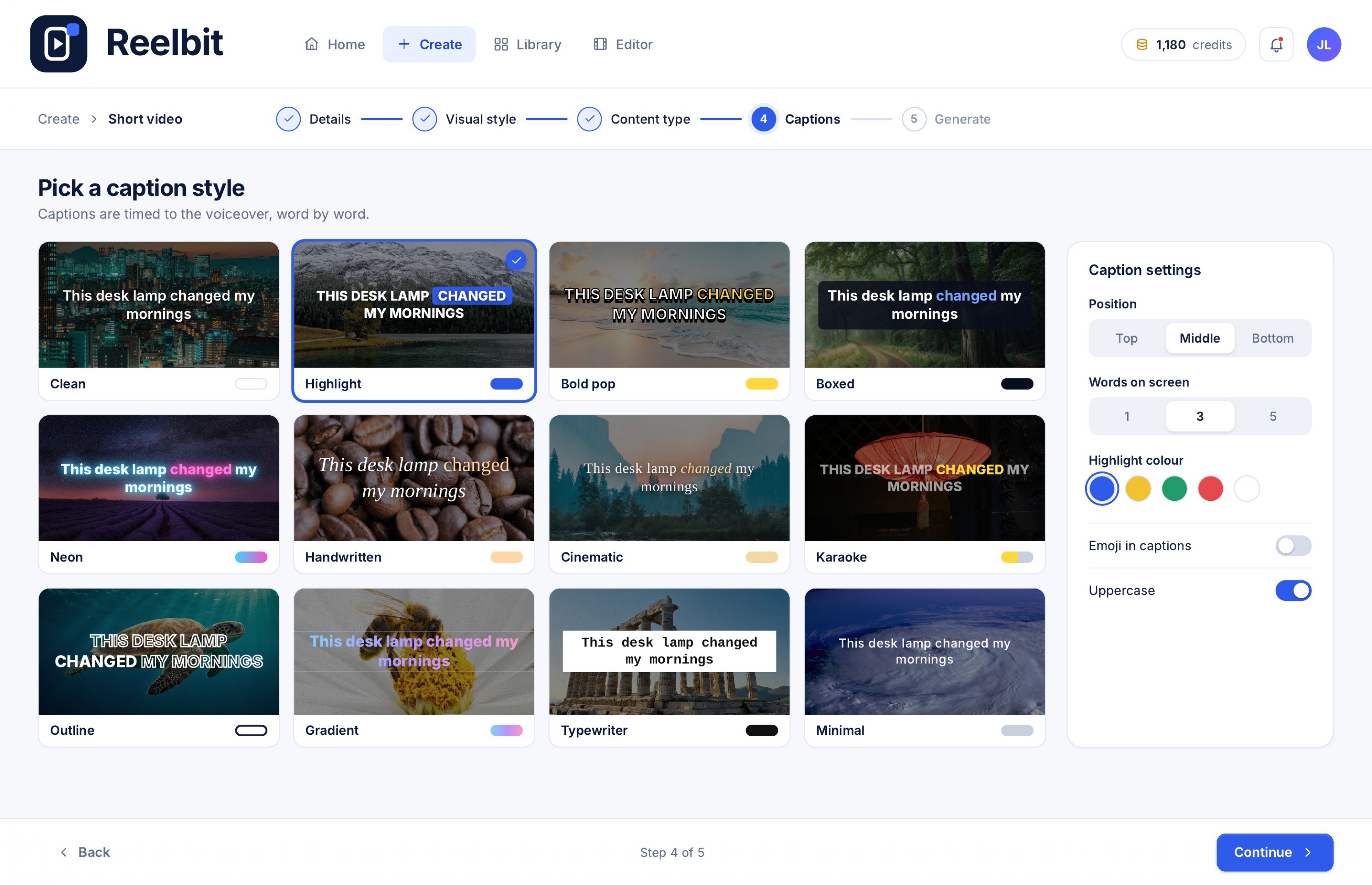
Style the captions and set the scene
Pick a caption style and a background: gameplay footage from the library, an uploaded clip, or a video pulled from a YouTube link.
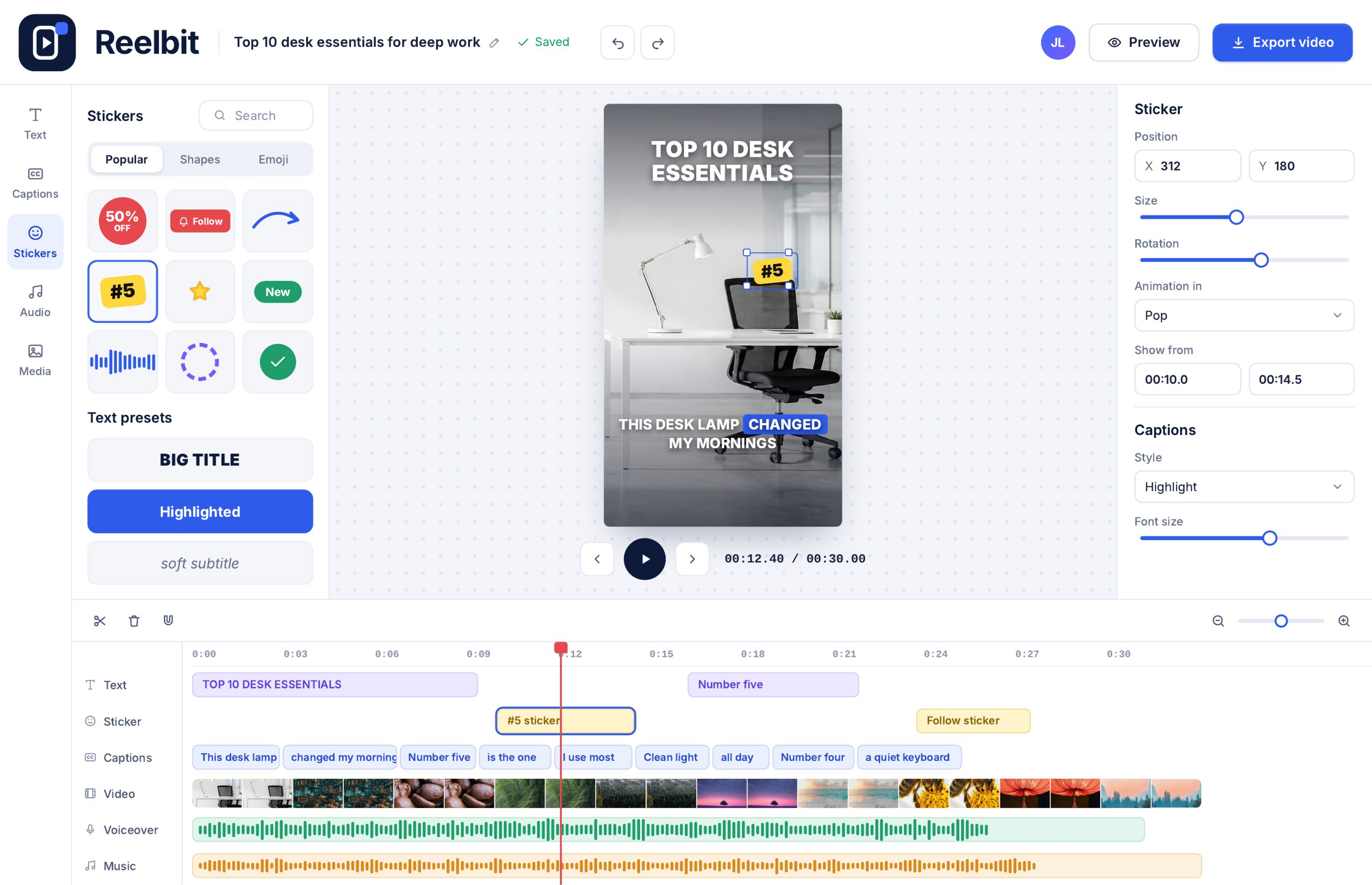
Preview it, adjust it, export it
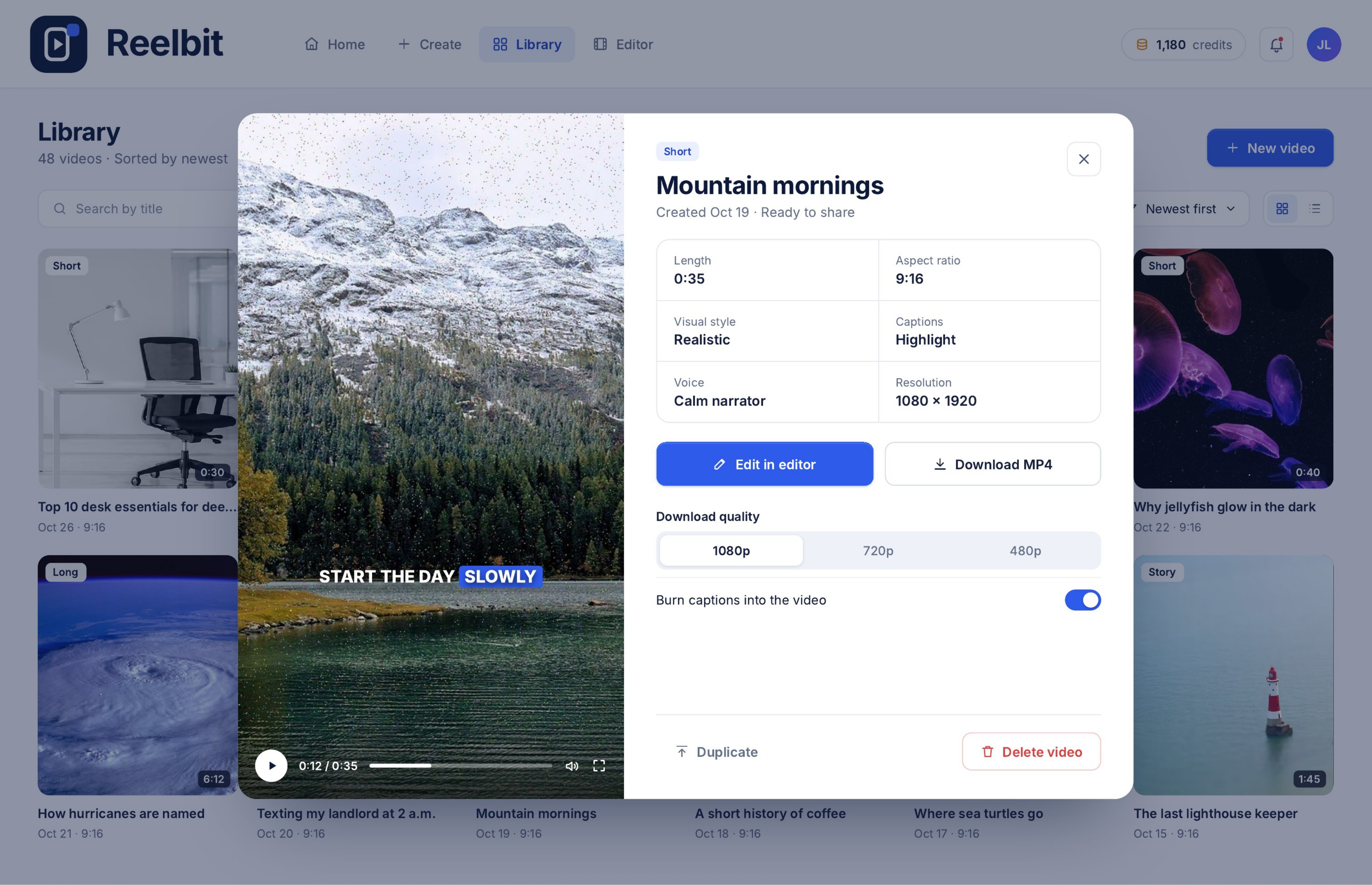
The platform assembles everything into a vertical video. Students preview it, regenerate if needed with the credit cost shown up front, adjust it in the editor, and export.
The Solution
What We Built
Ionio owned the product from research to launch: the competitor teardown, scoping, the credit model, design, development, deployment, and the rollout. The client brought the audience, the funnel, the brand, and the original idea.
Researching the Category Leader
We subscribed to the leader's product and went through every flow: onboarding, each video type, the tools, the editor, the libraries, and the pricing. We also studied a long-form AI video generator. Three findings shaped the build. The AI underneath was ordinary. The editor was the expensive part, because everything plugged into it. And clicking "Join Now" sent us straight into a webinar sales funnel, so the leader sold software the same way our client sold coaching.
The Core Workflow
Five formats, one guided flow: pick a format, add a script, choose a voice and caption style, set the background, then generate, edit, and export. Steps that used to happen across five tools now happen on one screen, in the order a creator already works.
The Credit System
Every action spends credits in proportion to what it costs to run: a minute of voiceover, a minute of export, an edit, an AI image, a script. We sized each plan from the cost side, so a subscriber who spends every credit still costs less than half of what they pay. Unused credits roll over while a student stays subscribed and disappear if they cancel, so the same system protects the margin and gives students a reason to stay.
The Launch
The platform launched into an audience that already trusted the program, with more than 4,100 people on the waitlist. Opening to all of them at once would have tested rendering, payments, and support on the same day. We released access in batches of 150, so each part of the system grew with demand.
Technical Infrastructure
The technical goal was simple to state: generate and render video at a cost per minute the pricing could carry, and keep every expensive step metered.
Browser app and Webflow
A browser-based app covers the full workflow, from format selection and scripting through captions, background, preview, and editing. The marketing site and pricing pages run on Webflow.
Node.js and the credit ledger
Node.js handles accounts, subscriptions, and the credit ledger. Every action checks the student's balance and deducts credits as part of the request.
Bull
Video generation runs on a Bull job queue, so a spike in requests waits its turn and the system stays stable.
AWS Lambda
Videos render on AWS Lambda, which scales with demand and costs nothing when idle. Rendering is one of the largest per-minute costs, so it runs only when a video is actually generated.
OpenAI, ElevenLabs and AssemblyAI
OpenAI's models write scripts, ElevenLabs generates voiceovers, AssemblyAI transcribes the audio so captions land on the right words, and image-generation models supply visuals for AI story videos.
AWS EC2 and RDS
Application servers and the database run on AWS (EC2 and RDS).
Postmark and payment webhooks
Postmark sends transactional email. Subscriptions run through the client's existing payment platform, connected by webhooks.
The Business Impact
$20K in monthly recurring revenue within the first six months, and $1.2M added in enterprise value
The business moved from revenue that arrived in spikes, one cohort at a time, to two recurring software products billing every month. Within two months, monthly recurring revenue had reached approximately $10K, growing to $20K MRR within the first six months and adding $1.2M in enterprise value.
What Each Layer Delivered
What Students Gained
- Five tools replaced by one guided flow
- Proven short-form formats, ready to use
- Pay for the videos you make
What the Business Gained
- Reached approximately $10K MRR within two months
- Grew to $20K MRR within the first six months
- A second recurring revenue line for the business
- $1.2M added in enterprise value
Growth to $20K MRR. Monthly recurring revenue reached approximately $10K within the first two months, then grew to $20K MRR within the first six months. Framing the result as MRR makes the recurring revenue model clear, rather than combining monthly revenue with total revenue since launch.
A Second Recurring Revenue Stream. The coaching business now has two software products serving different student workflows: long-form YouTube research and scripting, and short-form video creation. Alongside one-time course sales, both products provide recurring software revenue.
Enterprise Value. Adding a second software product added approximately $1.2M in enterprise value, expanding the business's recurring revenue base and adding another software asset. Recurring software revenue can contribute to enterprise value, with valuation depending on factors such as growth, retention and financial performance.
Back for the Next Version
AI video moved faster than any category we have worked in. Within a year, what the first version shipped had become the baseline. In 2026, we scoped the next version with the client: scene-by-scene storyboards, characters that stay consistent across scenes, newer viral formats, and direct publishing to social platforms.
From revenue that arrives in spikes to two recurring lines that bill every month.
Our Approach
Four phases, from a paid walkthrough of the category leader to a launch released in batches of 150.
- Paid walkthrough of the category leader: onboarding, every video type, the tools, the editor, the libraries, and the pricing
- Review of a long-form AI video generator
- Evaluation of existing video editor libraries to save building an editor from scratch
- Two scopes: the full feature set, or a focused first version around the most important formats and the editor
- Per-minute cost model across voice, transcription, scripting, and rendering
- Credit allowances and plan prices set so every plan stayed profitable at full usage
- One guided creation flow shared by every format
- Reddit story, text conversation, split-screen, AI story, and gameplay formats
- Script generation, Reddit import, AI voiceover, caption styles, a background library, preview, regenerate, and editor
- A credit ledger showing the estimated cost before a regeneration and the actual deduction after
- A waitlist set up ahead of launch
- Soft launch to the existing audience in 2025
- Access released from the waitlist in batches of 150
- A manual fallback for first-month renewals while the payment integration was fixed
From research to launch, the project took six months.
What We Learned
Study the Market Before Writing the Scope
We researched existing products in the category, including their video formats, tools, editor, media libraries, and pricing. We also reviewed a long-form AI video generation product. This helped us understand the market and plan an initial release around the most important student workflows.
Set Pricing Around Usage Costs
Video has a real cost for every minute it produces. We worked out that cost first, about 30 cents per finished minute, and sized every credit plan around it, so the heaviest possible user still cost less than half the price.
Release Access in Batches
More than 4,100 people waiting is a good problem, and still a problem. Letting everyone in on day one would have put rendering, payments, and support under peak load at the same moment, on a payment integration that was already fragile. Releasing access 150 people at a time turned one launch into a series of small ones. Anything that broke would affect 150 people, at a point when it was cheap to fix.
Design for Ongoing Product Development
AI video generation continues to evolve, so we built a shared workflow that can support additional formats and models. The client can extend the product over time, with future features including scene-by-scene storyboards, consistent characters, and direct publishing to social platforms.
Who This Is For
This works for coaches and course creators whose students all do the same piece of work, over and over, with tools that were never designed to fit together. If you already reach those students on your own channels, already teach them how the work should be done, and already have students paying for your program, there is very likely a product in that routine.
It is the wrong fit in three cases.
Your audience is still being built
A product launches best into people who already know and trust you.
Your method is still taking shape
Software locks a routine in place, so the routine needs to be settled first.
What you teach is a one-time decision
A tool students use once rarely becomes something they pay for every month.
A product needs a task students come back to every week. This was the model at its most efficient: a coaching business with an audience that trusted it, a task most of that audience repeated every day, and a product the market had already proven. Customers were on a waitlist before the software was finished.
“The waitlist was the proof. The software only had to keep up with it.”
How We Work With Coaches and Course Creators
We launch into what you already run: your funnel, your email list, your payment platform, and your community. The product arrives as part of the program, with an audience ready on day one.
Credit systems, subscription billing, usage metering, and AI pipelines are patterns we have built before. That experience goes straight into your product.
We have been building recurring software for coaching businesses since 2023, and we know where these products break: pricing, payments, and launch day.
When to Talk to Us
You already have a software product, or the audience for one, and your students keep asking for the next tool.
You want to know which task is worth building for, how to price it so heavy users still pay their way, and how to launch it smoothly on day one.
When We're Not a Fit
If you want a chatbot on your website, AI added for the headline, or a tool a major AI provider will release for free within a year, we are not the right partner.
We will tell you on the first call.
Let's See If There's a Fit
A 30-minute call. No deck. Bring your program and a rough picture of your audience. We will tell you honestly whether there is a software product in it, and what it would take to build.
Book an Intro Call → Prefer email? contact@ionio.ai