Case Study • GLEAC

How We Turned a
1,000-Person
Mentor Network Into an
AI-Native Platform

Ionio partnered with GLEAC to turn a 1,000-person mentor network into an AI-native platform. The network onboards, evaluates and supports experts hired on demand by companies and governments worldwide. Mentor onboarding went from an hour down to under ten minutes and doubled how many mentors made it through.

It all started with Sal, GLEAC's founder. She had already decided the company was going all in on AI. Neither her internal team nor her stretch team had the room to chase a new AI product every quarter. So we became her AI arm. Six systems shipped in two years and the partnership is still running today.

Book a call
1,000+
Mentors in the network
6
AI systems built
100%
Mentor intake increase
1hr 10min
Onboarding time
Origin

How We Met

Sal's CTO reached out first, back in May 2023. GLEAC had just shipped their first Mentor GPT and was watching the market closely, trying to work out what was real and what was hype. The outreach itself wasn't what earned the relationship.

"It was your teaching. I noticed your teaching and I think that's where I must have reached out to you."

Sal, Founder

Sal is a non-technical founder running a global platform. She'd worked with plenty of developers before. What she hadn't found was someone whose thinking she could evaluate before hiring them.

The first real conversation happened later that year, a call that ran close to two hours: GLEAC's business model, their mentor pipeline, their client acquisition process, their data, their tech stack, their ambitions. We asked for seven to ten days, took everything she'd told us, and came back with a full product roadmap and PRDs.

Eighteen months before a line of code
Over a year before active building
May 2023

Sal's CTO reaches out

Later that year

A two-hour call, then a roadmap and PRDs in seven to ten days

November 2024

Active building starts

Active building didn't start until November 2024, over a year after that first call. The relationship came first. The roadmap came first. The six systems came after both.

Testimonial

What the Founder Said

Sallyann Della Casa, Founder and CEO of GLEAC.

On why she chose us

“There’s a million and one developers out there. When you allow a customer to understand your mental model and your thought process, it gives a level of comfort. That’s why I chose you.”

On the first proposal

“The number one thing that impressed me was your PRD on the very first product. Very few analysts at tech companies take the time to map that out.”

On the build timeline

“I think it took us between six to eight weeks. We did it during Christmas, and clearly it’s a product that’s used.”

On the team

“Pinak is someone you should invest in. There’s nothing you can say to him that he wouldn’t go figure out and come back with an answer.”

On trusting us with a client of her own

“I had very little involvement, maybe three or four meetings. You and your team handled that end to end.”

On reliability

“A huge part of this isn’t just the technical ability. You have to deliver what you say you’re going to deliver, on the time you’re going to deliver it.”

On the overall relationship

“It’s been an absolute pleasure working with you over these last eight months. Even if we had fights, I enjoyed our fights.”

The Expensive Problem

Four Fires, One Founder

GLEAC runs a mentor network over 1,000 experts deep, hired on demand by companies and governments who need outside judgment fast. Sal built that network herself over seven years. By late 2024, growing it further meant fixing four different things at once, and none of them were small.

Mentors dropped out of the application process constantly. Roughly half of everyone who started never finished it, discouraged by a process that took the better part of an hour and gave nothing back while they waited.

The people who did finish created a second problem. GLEAC could only actually onboard 25 to 30 mentors a month, because evaluating each application took three people and stretched the approval timeline past three weeks. Demand for mentors was growing faster than GLEAC could clear its own intake pipeline.

Underneath both of those sat a third issue: the profiles GLEAC already had were going stale. Mentors changed jobs, picked up new expertise, moved industries, and GLEAC's records never caught up. That fed directly into a fourth problem downstream: client-mentor matches getting worse, because the system was matching against information nobody had checked in months.

Four Locks, One Door
  1. 01

    The Application

    Half of everyone who started never finished it

    Unlocked
  2. 02

    Evaluation

    Three people per application, past three weeks

    Locked
  3. 03

    Stale Profiles

    Records that never caught up

    Locked
  4. 04

    Matching

    Matched against information nobody had checked

    Locked

Turn one lock and the door still does not open. They needed four, at minimum.

Four problems, compounding into each other. Fix the front door and the evaluation backlog still throttles growth. Fix evaluation and stale profiles still produce bad matches. None of these were fixable with one product. They needed four, at minimum, and Sal ended up commissioning six.

Product Walkthrough

The Platform in Action

Six systems, one platform. Before we walk through what each one solves, here's what the first and most-used part of it, applying to become a mentor, actually looks like from the inside.

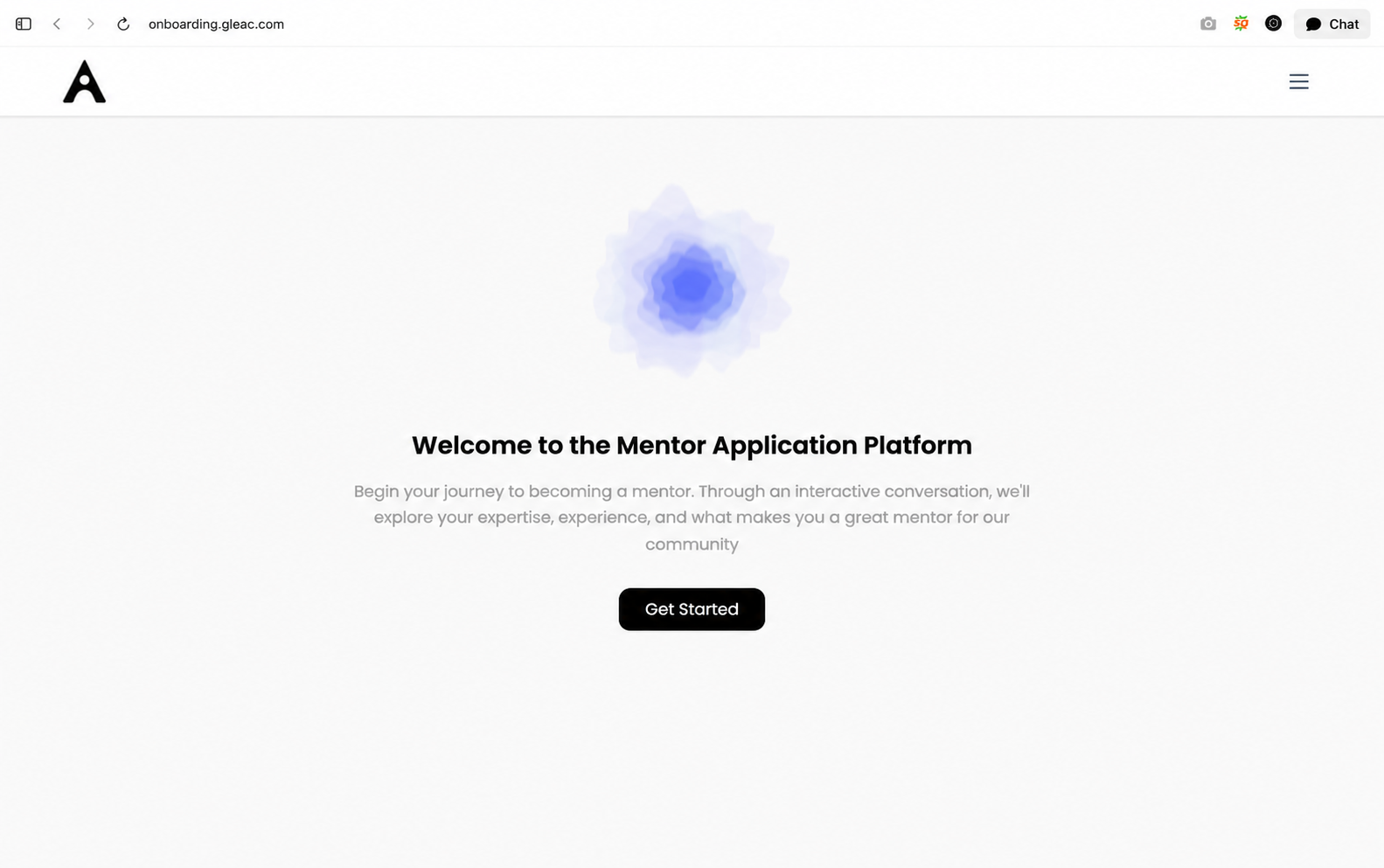
01 / Welcome

No Surprises at the Door

An applicant lands on GLEAC's onboarding page and sees exactly what they've signed up for before they click anything: a conversation, not a form. No hidden page count, no vague instructions. They know what the next ten minutes looks like before they commit to it.

GLEAC mentor application platform welcome screen with a Get Started button
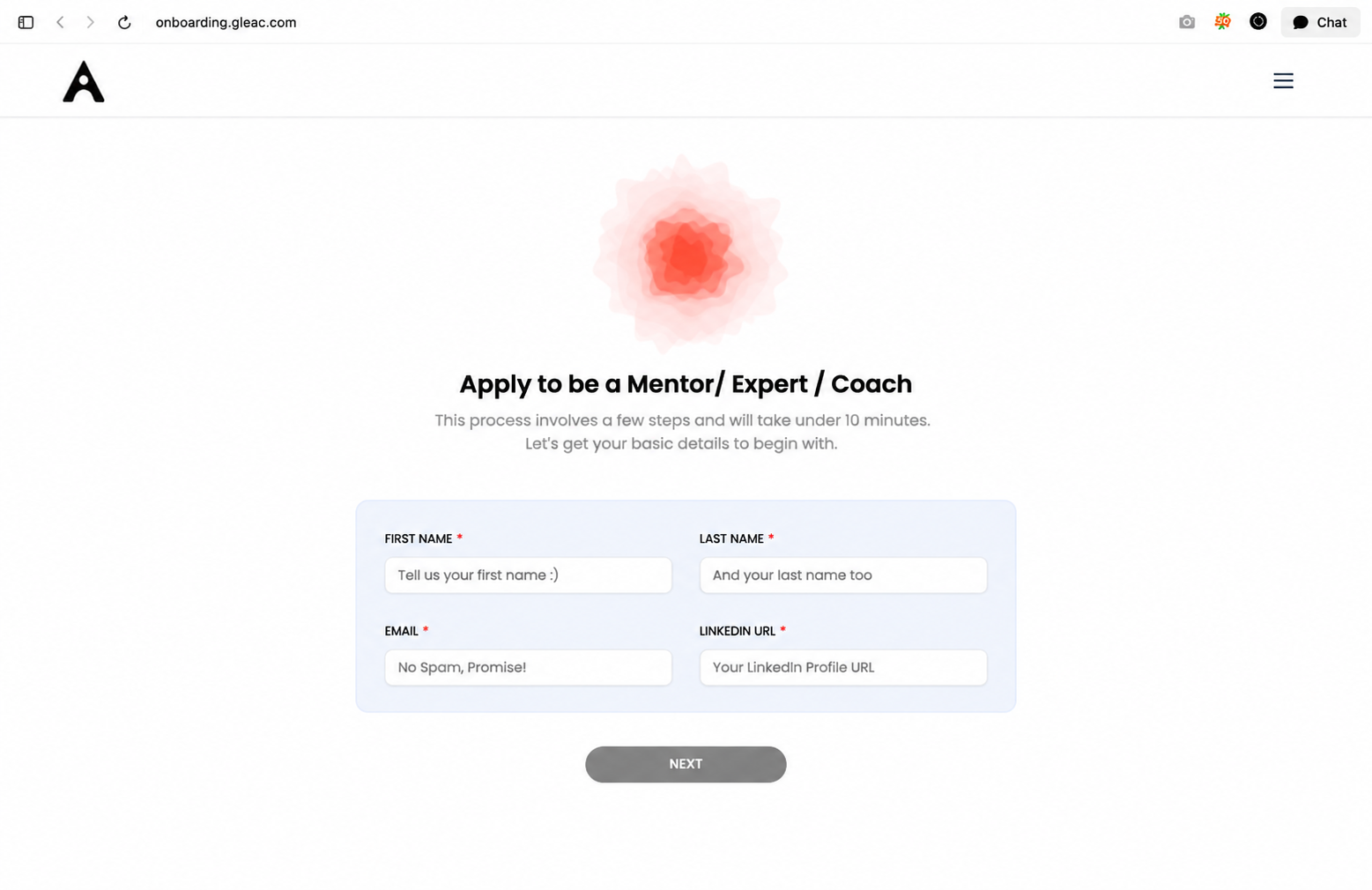
02 / One Screen

One Screen, Four Fields

Name, email, and a LinkedIn URL. That's the entire manual input GLEAC asks for. Every application used to run 30 to 45 minutes and lose more than half the people who started it. This screen is most of why that number changed.

GLEAC application form asking for first name, last name, email and LinkedIn URL
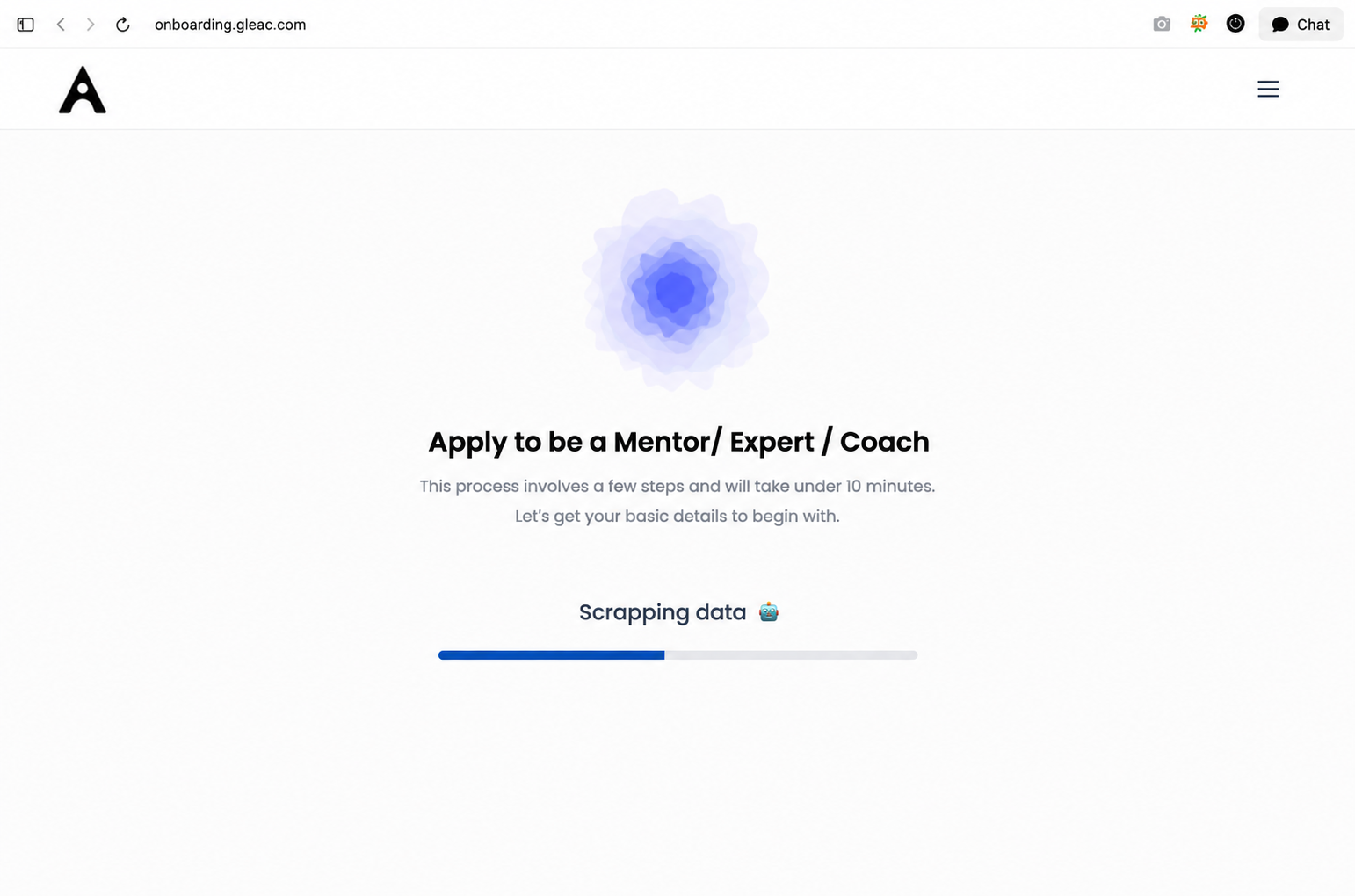
03 / Reading

The System Starts Reading

The moment an applicant submits their LinkedIn URL, the platform pulls their real career history instead of handing them a blank text box and asking them to summarize it themselves. Nobody starts from zero.

GLEAC platform reading the applicant's career history in the background
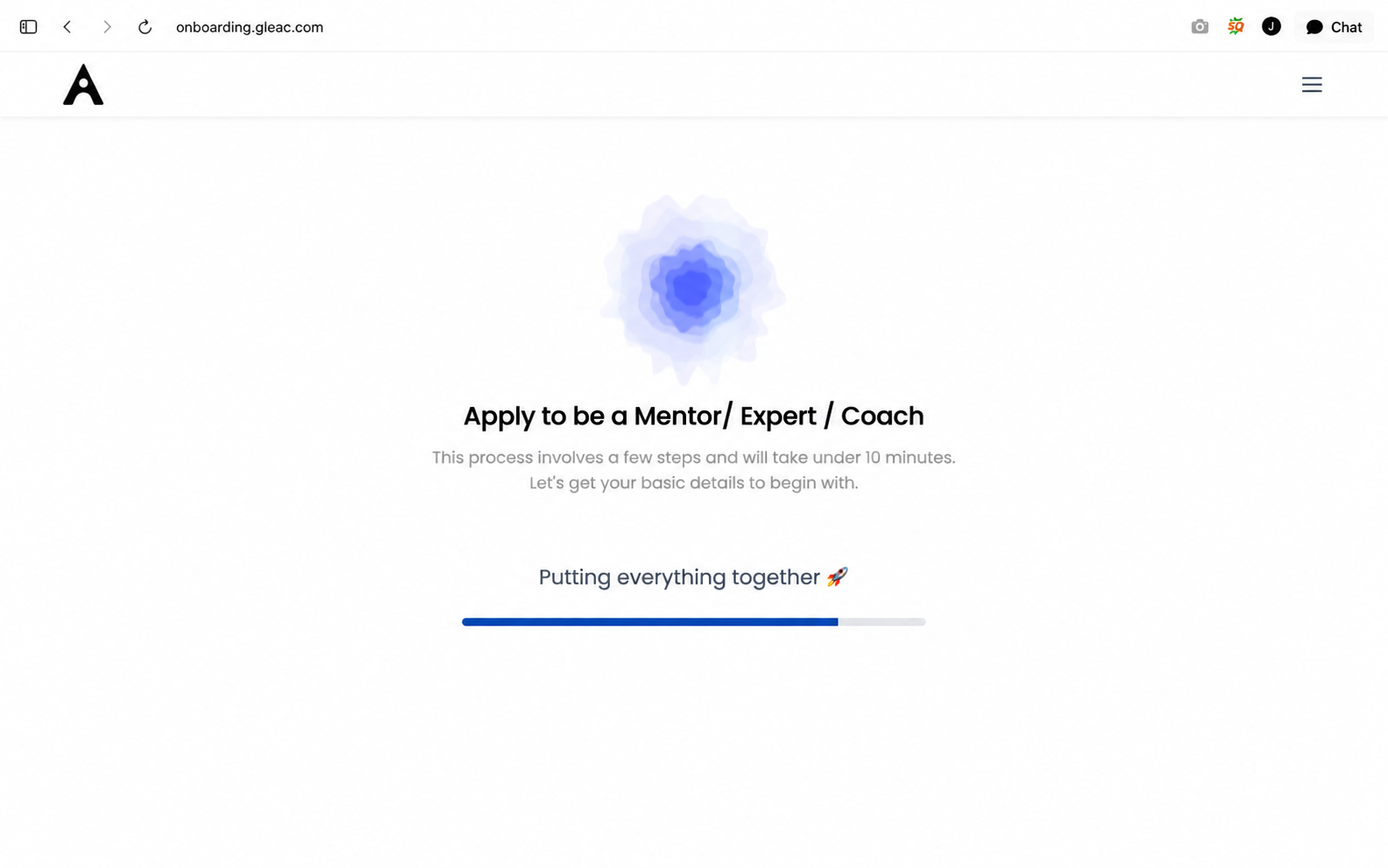
04 / Assembling

Building a Set of Questions That Doesn't Exist Yet

While the applicant waits a few seconds, the system is assembling an interview that has never been asked before, built from what it just read about them specifically. No applicant gets the same set of questions.

GLEAC platform assembling a tailored interview for the applicant
05 / Confirmation

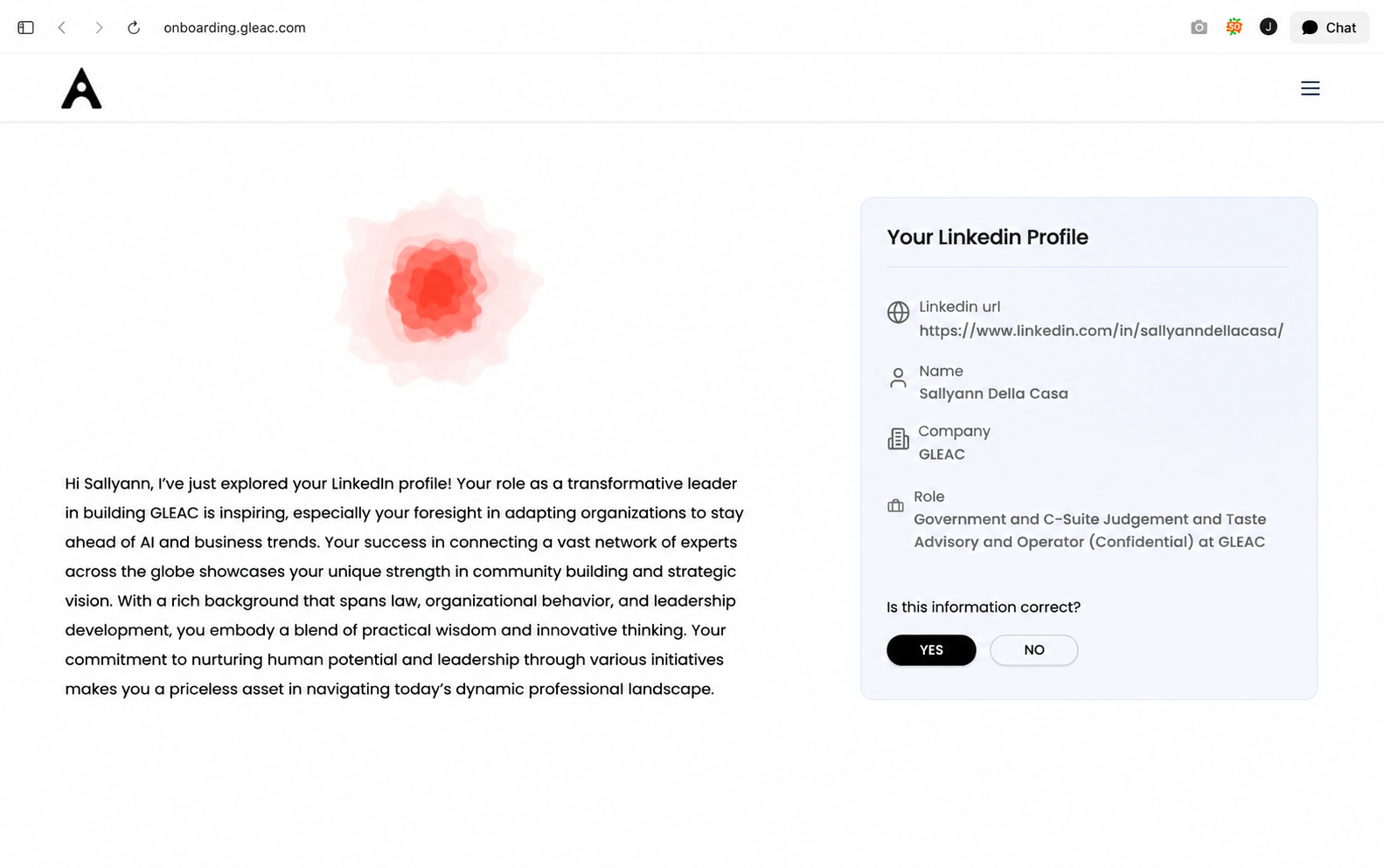
Confirm the Read Before It Goes Live

Before a single question gets asked, the applicant sees what the system understood: name, company, role, and a short paragraph written about their actual background. Sallyann's screen names her real title and ties it to her actual work at GLEAC, not a generic placeholder. Wrong read, and they correct it here. Right read, and the interview that follows already knows who it's talking to.

GLEAC showing the applicant what it understood from their LinkedIn profile, with a confirm option
06 / The Interview

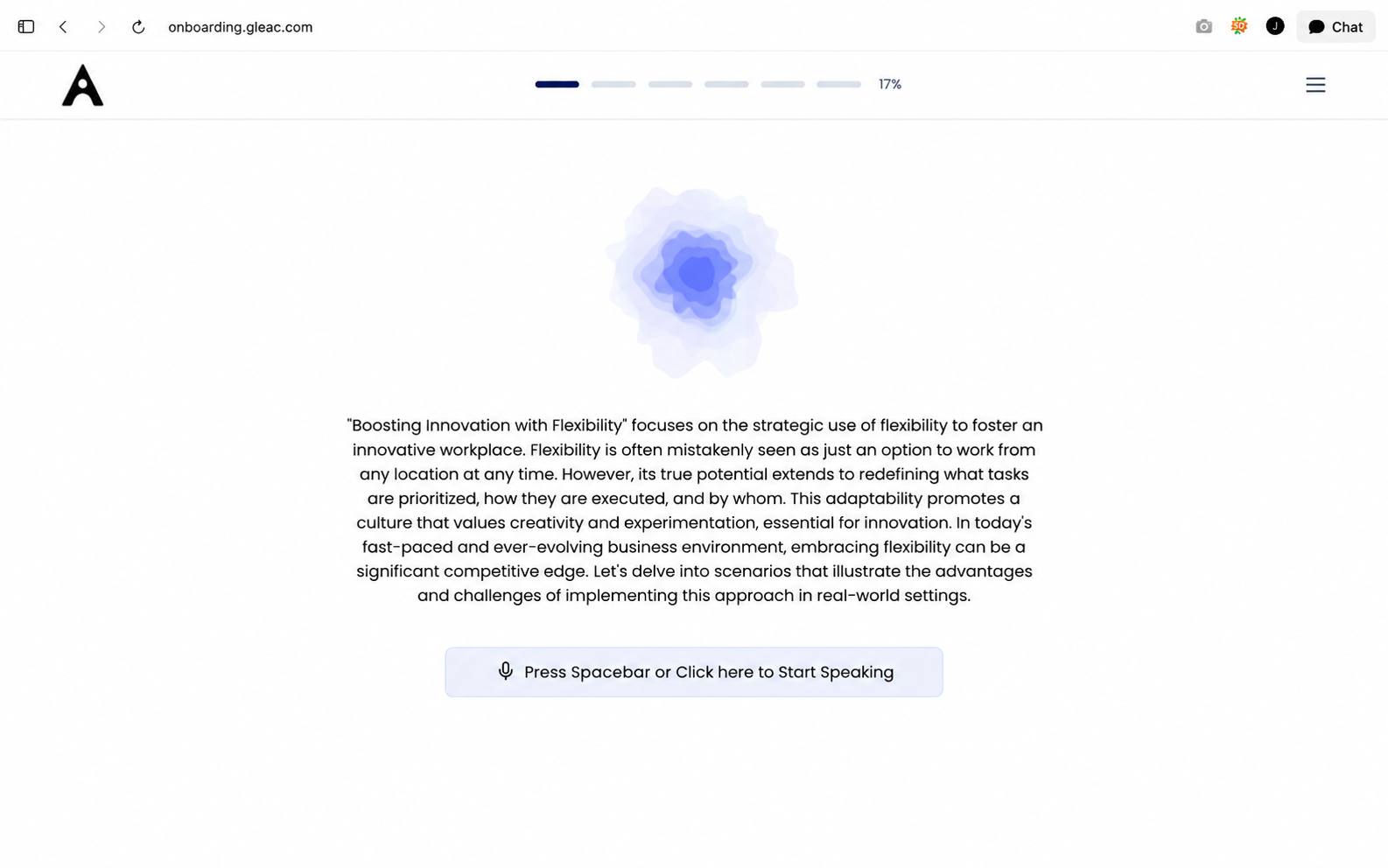
A Live Question, Not a Script

The interview opens on a topic pulled straight from what the platform just read about the applicant. They answer out loud, by speaking. GLEAC needed that specifically: a live conversation is hard to fake, in a way a typed answer copied from ChatGPT never was.

GLEAC voice interview presenting a live question with a press-to-speak control
07 / The Follow-Up

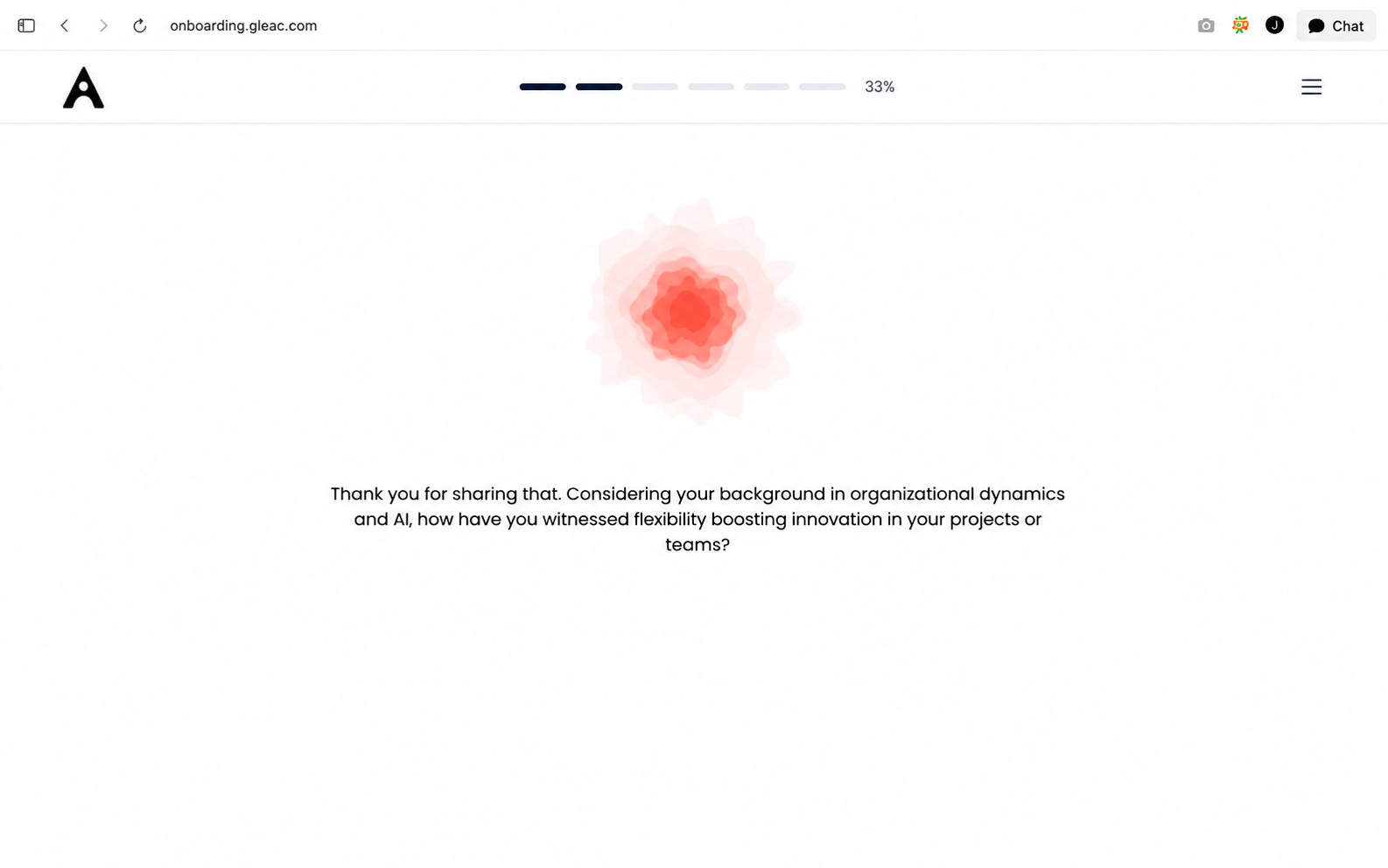
The Follow-Up That Proves It Was Listening

The next question doesn't move to the next item on a list. It references what the applicant just said, by name, and asks them to go deeper on it. Six to ten questions like this make up a full interview, and no two applicants ever get the same one.

GLEAC asking a follow-up question that builds on the applicant's previous answer
The Solution

What We Built

Six systems, each answering a different piece of the four problems above. Not one platform with six features bolted on, six separate engagements that happened to share a client. Here's each one on its own terms.

Product One

The Voice Interviewer

This is the one that started everything. Sal came to us first with the front door: the mentor application itself.

The Problem

GLEAC's application ran close to an hour. More than half the people who started it never finished. And a growing share of the ones who did were pasting in ChatGPT answers, polished, generic, and useless for judging whether someone actually knew their subject. GLEAC's own screening algorithm was catching over half of submissions as inauthentic and rejecting them on the spot.

"It was a very clear business problem statement that we had to solve. The outcomes if we solved it well was going to be less drop off and a higher volume of people we could onboard."

Sal, Founder

The Goal

Sal's target was aggressive: cut onboarding from an hour to under ten minutes, roughly six times faster. Double completion rates. Get 90% of profiles to at least 80% complete without a manual follow-up. Her answer to all of it was voice. A live conversation is hard to fake on the spot, in a way a text box never was.

That single shift, from a form to a conversation, is what took onboarding from 45 minutes down to under ten.

Every question built from the last answer
Generated live Follows the last answer
One applicant, speaking No two interviews alike

A script asks the same thing every time. This one listens first.

Why This Was Hard Core

We started building in November 2024. Nothing about it was routine, and most of what made it hard had nothing to do with the AI itself.

Personalizing every interview in real time.

Any team can wire up a voice API and call it an interviewer. Ours had to do more. It asked a different question to every applicant based on their actual background. It followed up on what they'd just said instead of running down a script. Every question was generated live, inside a conversation with no retakes. That's the part that turned a working prototype into something that could actually hold a conversation, and it's the part that took the most time to get right.

Making the voice feel like a person, not a system.

GLEAC's applicant pool skews Gen X. Most were talking to an AI interviewer for the first time in their working life. We had to get the pacing and the tone right. Feel robotic or move too fast, and people just stopped talking. That was a product design problem before it was ever a technical one.

Shipping through a holiday break, on a tight window.

The build ran six to eight weeks end to end. That window included a full break over Christmas where neither side was working. Everything downstream had to happen in whatever time was left, with no room for a second pass at the parts that turned out harder than expected.

Product Two

The Mentor Evaluation System

Fixing the front door only mattered if GLEAC could actually process what came through it. That's the second fire.

The Problem

Every mentor application went through three human evaluators, in a batch process that took three to four weeks. That capped GLEAC's entire pipeline at 25 to 30 new mentors a month, no matter how many qualified people applied. The work itself was repetitive and manual: exporting answers, building evaluation sheets, running scoring meetings, invoicing evaluators by hand.

The Goal

The target was automation, not incremental speedup: cut manual evaluation effort by roughly 95%, and bring the approval timeline down from 30 days to same-day, ideally within hours. A secondary goal mattered just as much to Sal: consistency. Three human evaluators scoring the same application differently was its own quiet problem, one an automated system could remove almost entirely.

Same application, three opinions
Three evaluators 3–4 weeks
A B C
A spread nobody could explain
Automated Same day
One reading, every time

The wait was the visible problem. The disagreement was the quiet one.

These are the goals GLEAC set out to hit with this system. Confirmed, audited results for this specific product weren't part of what Sal covered in her own account of the engagement.

Why This Was Hard Complex

Evaluation isn't pattern-matching against keywords. It's judgment: does this answer actually demonstrate the expertise being claimed, or does it just use the right vocabulary. Building a system that could make that call automatically, at a consistency rate close to what three trained humans agreed on together, meant the model had to reason about answer quality, not just check for the presence of relevant terms.

Product Three

The Profile Podcast Pipeline

Not every product on this list came from a business problem. This one came from an instinct Sal had about how new mentors should feel on day one.

The Idea

The moment a mentor gets accepted, the system pulls their LinkedIn profile and produces a two-host conversational podcast about their own background, fully automated, live on their profile before they've done anything else. A Lambda function fires on acceptance and the whole pipeline runs with no manual step.

Live before day one begins
Profile Podcast
A conversation about their career
Two hosts
Shared onward, unprompted

No bottleneck was removed here. It just made a first day feel like something.

When Sal first pitched it, our own read was that it was technically trivial, a thin wrapper around NotebookLM, nothing groundbreaking. We were wrong about what mattered.

Sal's read on it was the opposite, and she was right. Mentors started sharing their own podcast across their networks unprompted, something no other onboarding step at GLEAC does.

Why This Worked Delight

This wasn't a product built to fix a bottleneck. It was built to make a first day feel like something. That's a different kind of hard to justify technically, and it's exactly the kind of call that only made sense in hindsight.

Product Four

The Micro Practice Engine

GLEAC's mentors don't just apply once and disappear into the network. They keep learning inside it, through a library of short, structured lessons GLEAC calls micro practices.

The Problem

A library of lessons is only useful if people can find the right one. Static browsing doesn't work when the relevant lesson depends on who's asking and what they actually need.

What We Built

A RAG-based recommendation system with three separate ways in: paste a LinkedIn profile and get practices suggested from your background, ask a plain-language question about what you're trying to figure out, or upload a document and get practices generated against it. All three resolve to the same experience: a journey map of relevant practices, then a conversational walkthrough of six to ten situational questions once one is selected, rather than a static page to read.

Three on-ramps, one road
One journey map
ProfilePasted from LinkedIn QuestionAsked in plain language DocumentUploaded and read
Milestones are the practices themselves Then six to ten questions, spoken through

Three ways on. One road, and the same destination.

Product Five

The Mentor Chat Assistant

Once someone was inside GLEAC's platform, they needed a way to ask general questions and get pointed toward the right expert without digging through a directory themselves.

What We Built

A chatbot that handles two jobs: answering general platform questions, and helping a user find the right mentor through an embedding search against GLEAC's own expert metadata.

What We Missed the First Time Optimization

The first version made a full OpenAI call on every single message just to classify whether a query needed a tool at all, before it had even decided what kind of question it was looking at. It worked, but it meant paying for and waiting on a classification call that Supabase's own stored metadata could have handled with a keyword match and a similarity threshold instead.

Charged on every message
What we ran Classification call Latency and spend, every time
What would have done Keyword match & threshold Already sitting in the metadata

Nothing broke. It just quietly ran the meter.

We were also fetching complete mentor profiles from the backend on every match, when roughly 80% of what a user actually needed was already sitting in the metadata GLEAC already had. Neither mistake broke anything. Both quietly cost latency and money on every message, for as long as they went unnoticed.

Product Six

The Mentor-Client Matching Layer

This is the product that answers the fourth company-level problem directly: matches getting worse because GLEAC's own profile data was going stale.

The Problem

Mentors change jobs, pick up new expertise, and move industries without ever telling GLEAC. A matching system built on old data produces bad matches no matter how good the underlying algorithm is.

What We Built

The same embedding search that powers Mentor Chat's expert lookup does double duty here, matching client needs against mentor metadata that stays current because it's refreshed through the other systems already pulling fresh LinkedIn data, the Voice Interviewer and the Micro Practice engine both feed it. Rather than build a fourth separate system, we made the existing ones keep each other honest.

Nothing new was built
Voice InterviewerPulls fresh LinkedIn data Micro PracticeFeeds the same index Mentor metadataStays current on its own MatchingRuns on data that never went stale

No fourth system. The existing ones keep each other honest.

Internal Infrastructure

Technical Infrastructure

Voice

OpenAI Realtime API

Powers the live conversational layer in the interviewer. Handles the back-and-forth of an actual spoken interview rather than a scripted question-and-answer exchange.

Speech-to-Text

ElevenLabs

Transcribes the applicant's spoken answers in real time during the interview, so responses can be processed and acted on as the conversation happens.

Text-to-Speech

Deepgram

Generates the interviewer's spoken voice.

Audio Generation

NotebookLM

Powers the podcast pipeline, turning a scraped LinkedIn profile into a two-host conversational audio piece with no manual production step.

Vector Database

Qdrant

Stores embeddings generated from GLEAC's micro practice library, so the recommendation engine can retrieve the right practice fast, regardless of whether the entry point was a LinkedIn profile, a question, or a document.

Profile Enrichment

Enrich Layer

Pulls structured LinkedIn data for both the interviewer and the micro practice engine, so recommendations and interview questions are grounded in an applicant's real professional background rather than generic prompts.

Content Generation

OpenAI

Generates the dynamic, personalized questions across both the interviewer and the micro practice flows.

Infrastructure

AWS and Docker

RDS for the relational database, EC2 running backend services, S3 handling document storage for the micro practice document flow. Everything containerized, deployed the same way across every environment.

Project Roadmap

How Six Products Fit Into Two Years

Each product above tells its own build story. What doesn't show up inside any single one of them is how the six overlapped, and how one engagement kept turning into the next.

Execution Timeline · Nov ’24 → Dec ’25
Foundation Expansion Parallel Referral

Foundation

November 2024 – February/March 2025

The Voice Interviewer and the Profile Podcast Pipeline were built back to back, close enough together that the Interviewer's LinkedIn-scraping groundwork fed directly into the Podcast's. The Interviewer ran six to eight weeks end to end, including a full Christmas break neither side worked through. The Podcast's Lambda pipeline was scoped for mid-December and shipped close to that window.

Expansion

January 2025 onward

With the front door fixed, GLEAC turned to what happened after someone joined. The Micro Practice Engine came next, three entry points into one recommendation system, built and refined through January 2025. This is roughly where the account stopped being one product Sal wanted and became a platform we kept extending.

Parallel

Commissioned alongside, timeline separate

The Mentor Evaluation System and the Mentor Chat assistant were both commissioned as part of the same broader AI roadmap, addressing the evaluation bottleneck and expert-matching problems respectively. Mentor Chat's optimization work continued well into 2025, well past initial build, this was the kind of ongoing refinement that only happens on an account GLEAC intended to keep investing in, not a one-off delivery.

Referral

Running in parallel, a different client entirely

Partway through this same window, Sal handed us the education.org engagement, paused in November 2024 and resumed that December once better models became available. It ran alongside GLEAC's own build schedule rather than after it, which meant two active engagements, two different problem sets, sharing the same trust that had been built on GLEAC's own products first.

The Results

The Business Impact

"Our intake has gone up 100%. I'm a big KPI nerd, so our numbers have gone up 100%."

Sal, Founder
01

Mentor intake doubled.

That's the number Sal tracks closest, and it's the one she led with unprompted. A mentor network's growth rate is capped by how many qualified people make it through the front door, and doubling that number means GLEAC can grow the network at twice the rate without spending twice as much to do it.

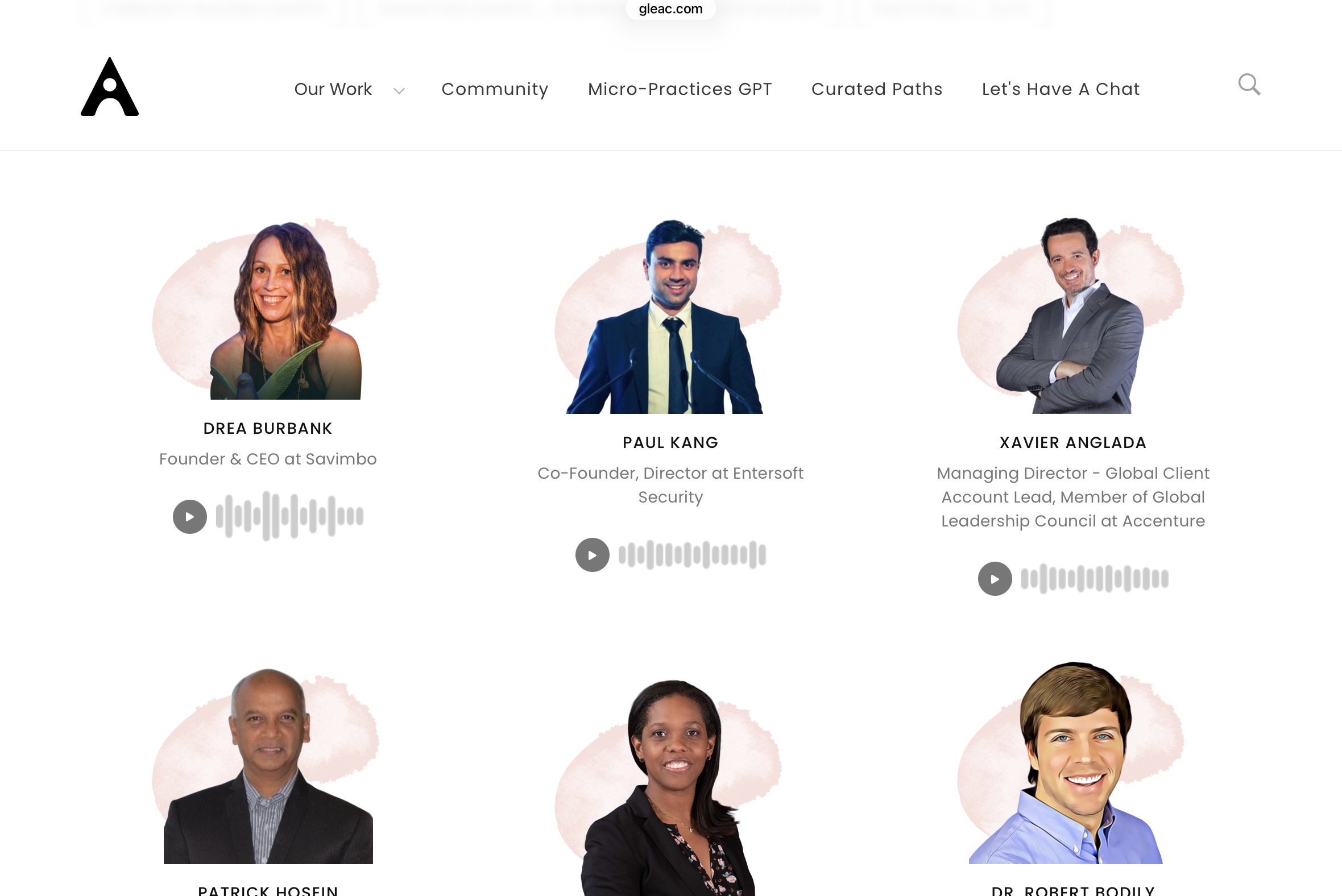
GLEAC's live community page, showing mentors with their titles and profile podcast players
GLEAC's live community page today. Real mentors, real titles, real profile podcasts, not a demo environment.
02

The product earned its own adoption.

Seventy percent of applicants are choosing the voice interview over the option to fill out the old written form, which is still available for anyone who wants it. That matters because GLEAC's mentor pool skews Gen X, professionals used to a resume and a form, not a live conversation with an AI. GLEAC didn't force the new path. It kept the old one open and let the product earn the adoption on its own.

Out of every hundred applicants
70went all the way through the voice interview 30stopped at the written form, which stayed open

Nobody was pushed. The product earned it.

03

What compounds past the intake number is the relationship itself.

Two years in, GLEAC has referred Ionio to other companies in their network, and handed us an entire external engagement to run end to end under their own name.

Six systems shipped, a referral GLEAC staked its own reputation on, and an advisory relationship that's still running. That's what a mentor network gets from doubling the one number that actually caps how fast it can grow.

Retrospective

What We Learned

I.

A founder's conviction isn't a spec, but it's not nothing either

Sal came to us with an outcome in mind and very little of the how. Most of our early work wasn't writing code, it was turning a founder's accumulated sense of her own product into something we could actually build against.

II.

The best idea sometimes sounds like the worst idea

When Sal first described the profile podcast, it read to us as a technical curiosity, a wrapper around an existing tool, not a real feature. It became one of the most-shared, best-received things we shipped. Mentors sent it to their own networks unprompted.

III.

Adoption isn't binary, and forcing it backfires

GLEAC's Gen X mentor base wasn't uniformly ready for a voice-based application. Some pushed back. GLEAC's answer was to keep the old path open rather than force everyone through the new one.

IV.

Trust compounds across an account, not just within one project

The reason GLEAC handed us an entire external engagement with almost no oversight wasn't anything specific to that project. It was two years of shipped work before it.