Connect the Doc | Case Study Hero

Case Study • Connect the Doc

From Agency Hours to
SaaS Revenue
In Five Weeks

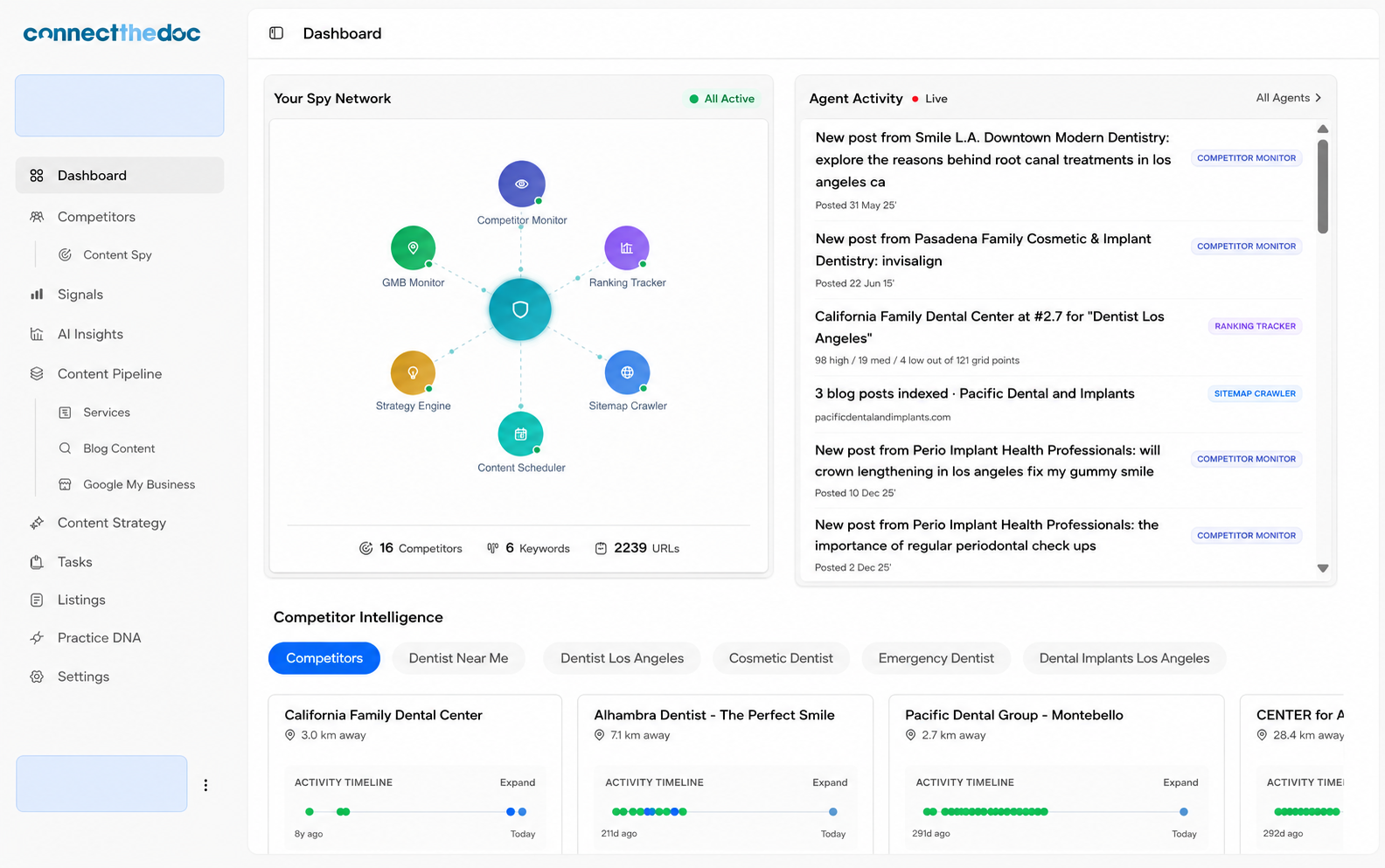
Ionio partnered with Connect the Doc (CTD) to design, build, and launch CTDAI, an autonomous SEO platform for dental practices. Behind a single search box sits a network of specialized AI agents that read a clinic's entire online footprint, benchmark it against every competitor nearby, and then write and publish the content it needs to win the searches that bring in patients.

What started as an SEO service CTD delivered by hand became a standalone AI product, built in five weeks against a fixed trade-show deadline, creating a new recurring revenue stream and turning service hours into software that a market can actually price.

Book a call
5 Weeks
Concept to conference-ready
First
AI-native product in CTD's history
Service SaaS
Revenue reclassified, in motion
Fully Owned
Source code, no lock-in

Figures are expressed as categories and multiples rather than absolute revenue, at the client's request.

Connect the Doc | The Expensive Problem

The Expensive Problem

Getting found is the whole game, and it is grinding work

Every dental practice is fighting to get found on Google. When someone nearby searches for a dentist, the practices at the top of that list book the patient, and the ones below it mostly do not. Winning that placement comes down to SEO, and SEO is slow, grinding work.

It never really stops. You have to know which searches you are losing, publish content that ranks for them, keep your Google profile complete and current, watch what competing clinics are doing, and then do all of it again next week. Most practices cannot keep up:

  • A dentist does not have time to write patient-intent content between appointments.
  • The agencies that offer to do it charge a lot for something the practice can never quite see working.
  • So the clinic down the street ranks for the searches that matter, and books the patient first.

The practice knows it is losing ground online. It just has no clear picture of where, or why, or what to do about it next.

This is the problem Connect the Doc had been solving for over a decade. Since 2011, CTD has helped dental and medical practices get found online, and earned real trust doing it. But the core of that work, the SEO itself, was delivered by hand. Practices paid for an outcome that depended on CTD's people doing the research, writing the content, and watching the rankings, one clinic at a time.

Nadeem (founder) wanted to turn that service into a product. Not a dashboard bolted onto the existing offering, but a platform that could do the SEO work itself: read a clinic's entire online presence, find exactly where it is losing patients, and write and publish the content to fix it. That meant two problems worth solving. One for the practice using it, and a bigger one for CTD as a business.

At Ionio, we approach every project through a two-layer framework. It guided every decision we made with CTD.

Our Approach

The Two-Layer Framework

01
Surface

The User Problem

How does this help users achieve their goals 10x better, faster, or cheaper?

For the practice Get found, without hiring an agency or turning a dentist into an SEO expert.

02
Deep

The Business Problem

How does solving that problem create compounding business value?

For CTD Turn hand-delivered service hours into an asset a market can price.

Layer 1: The User Problem

For the practice, the goal is easy to say and hard to deliver: get found, without hiring an agency or turning a dentist into an SEO expert. That means taking the weeks of manual research, writing, and monitoring a clinic could never keep up with, and collapsing it into something that runs on its own and shows the practice exactly where it stands.

The First Pass · One Clinic
The Manual Way Weeks
Keywords Content Competitors
of ongoing work, every month and again next week
Research keywords by hand
Write content one clinic at a time
Watch competitors manually
Costs that scale with headcount
With CTDAI Minutes
Keywords Content Competitors
to a full picture, then automated still running
Every keyword scanned at once
Content generated and published
Competitors tracked continuously
One platform, not a growing team

Manual SEO is slow and never finished. CTDAI collapses the first pass into minutes, then keeps working.

Layer 2: The Business Problem

For CTD, the deeper problem was not on the practice's side. It was on their own balance sheet. The SEO work delivered by hand was service revenue, and service revenue is the fragile kind.

I

It is tied to headcount.

Every new client needs more people to serve it.

II

It does not recur on its own.

The work has to be redone, sold, and delivered again and again.

III

It is valued at a fraction of software.

A buyer prices a services dollar well below the same dollar earned as recurring software.

So turning the service into a product was never really a feature decision. It was an enterprise-value decision. Another manual tier, or one more dashboard, would not change the math. Only productizing the service could.

Connect the Doc | Why This Was Hard

Why This Was Hard

We build platforms like this often, so the plumbing was familiar. What made CTDAI hard was the shape of the problem itself: a clinic's online presence is scattered across dozens of unrelated sources, and turning all of that into one trustworthy answer, fast, is where the real work lived.

A Deadline That Would Not Move
Fixed

The whole build was pinned to a trade show in March. A conference is not a soft launch. The buyers walk the floor once, on that date, and if the product is not ready to demo live, the opportunity is gone for a year. That gave us five weeks to design, build, and get a real SEO platform running on live clinics.

What this meantThe scope could flex. The date could not.

Dozens of Signals, None Agreeing
Scattered

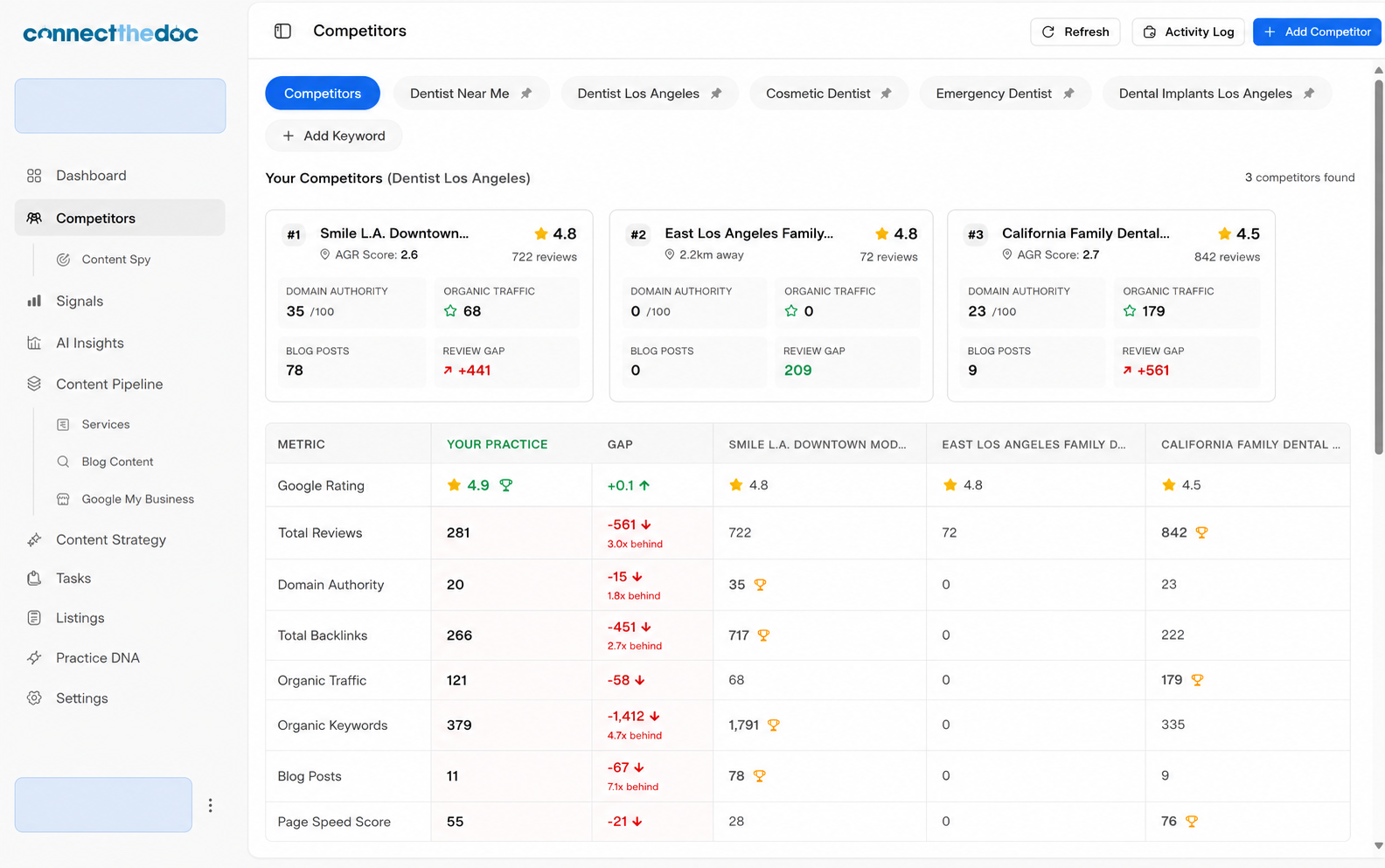
A clinic's real standing lives in fragments: its Google profile, its reviews, its keyword rankings, its website health, the moves of every competitor nearby. None of it lines up, and none of it agrees. The hard part was resolving all of it into a single verdict a practice owner could act on—not just a pile of raw data.

What this meantA verdict, not a data dump.

Eight Agents, Running at Once
Parallel

Each of those signals needs its own kind of expertise, so we built a dedicated agent for each one. Getting eight specialized agents to run in parallel and then reconcile into one coherent result is a different problem from calling a model once. That orchestration, and the third-party services it depends on to read the open web, is where the engineering got interesting—and where a dependency we did not own would later cost us a Friday night.

What this meantEight agents, reconciled, in seconds.

"The hard part was never the plumbing. It was making eight agents agree—on live clinics, in seconds, before a date that would not move."

Connect the Doc | What We Built

The Solution

What we built

We built CTDAI around one job: do the SEO a dental practice never has time to do, end to end, and do it well enough to publish. A practice types in its name, and the platform goes to work. It reads everything about how that clinic shows up online, figures out exactly where it is losing patients, and produces the content and fixes to close the gap. Here is what happens under the hood.

01  /  The Scout System

A team of agents, each with one job

The engine behind CTDAI is a set of specialized agents we call Scouts. Local Scout, Review Scout, Website Scout, Content Scout, Ranking Scout, Competitor Scout, Strategy Scout, and Listing Scout. Each one owns a single slice of a clinic's online presence and scans it in parallel with the others. Together they do in seconds what a human SEO team would take days to assemble by hand.

Eight Scouts, Scanning in Parallel
Local
Review
Website
Content
Ranking
Competitor
Strategy
Listing

What a human SEO team assembles in days, the Scouts do in seconds.

02  /  The Live Scan

Reading a clinic's entire online presence in real time

The moment a practice is entered, the Scouts pull its real data from the open web: its Google Business Profile, reviews, photos, hours, its website on both desktop and mobile, its keyword rankings, and the competing clinics nearby. The practice watches this happen live, a full picture of how patients actually find them, assembled in front of them in real time. That live scan is also what makes the product sell itself in a demo.

Google
Profile
Reviews
Website
Rankings
Nearby
Clinics
Assembling Live Picture

Live, in front of the practice — not a canned demo.

03  /  The Clinic Score

One number that says where you stand

Everything the Scouts find rolls up into a single Clinic Score out of 100, with a plain-English read on what it means. Where the practice ranks against nearby competitors, which searches it is winning and losing, and where the biggest gaps are. It turns a fog of scattered data into one clear verdict a busy practice owner can act on.

74 Out of 100
Local Profile
Rankings
Reviews
Content Gaps

One clear verdict, not a pile of raw data.

04  /  The Growth Plan

Not just the problem, the content that fixes it

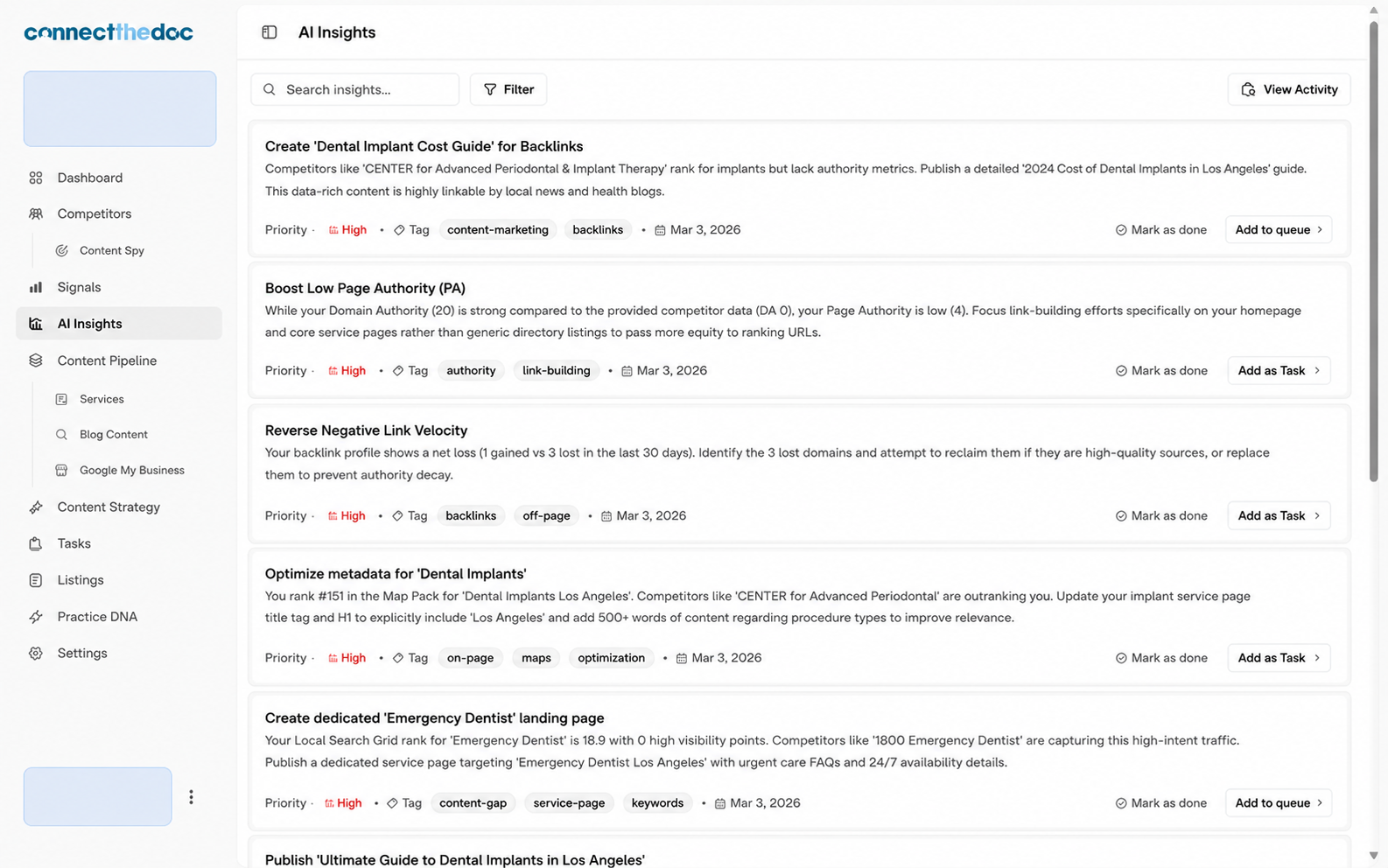
This is the core of the product. CTDAI does not stop at a diagnosis. It produces a growth plan: the specific, patient-intent content the clinic should publish first, chosen from the exact searches it is losing. Then it does the work, generating and publishing SEO content good enough for the practice to put its name on, fixing technical issues, and tracking competitors continuously so the plan stays current.

1
Identify Losing SearchesPatient-intent keywords ranked against nearby competitors
2
Generate Publish-Ready ContentSEO content accurate to the practice, good enough to publish
3
Fix Technical IssuesClosing the gaps the Scouts surfaced
4
Track Competitors ContinuouslySo the plan stays current, not a one-time snapshot

CTDAI does not stop at a diagnosis — it does the work.

Connect the Doc | Under the Hood
Under the Hood

Technical Infrastructure

The hard engineering was never the model. It was making a fleet of agents run reliably on live, messy, real-world data, fast enough to feel instant, and stable enough to sit on top of a platform CTD's practices already used.

Architecture

An Agentic Architecture

The Scout system runs many specialized agents in parallel, each scanning one dimension of a clinic's presence, then merges their findings into a single result.

Data Pipeline

Built for Messy Real-World Data

Google profiles, reviews, competitor listings, and live website audits never arrive clean or consistent. The pipeline is engineered around missing fields, broken pages, and data that looks different every time.

Content Engine

Content Generation With a Quality Bar

The AI does not just draft text. It produces SEO content accurate to the practice and good enough to publish, wrapped in the controls that keep it on-brand and reliable.

Walter

An In-Platform AI Assistant

We also built Walter, a conversational assistant embedded in the product, so a practice can ask questions and get answers without leaving the platform.

Handoff

A Clean, Ownable Handoff

Full source code, documentation, and admin access. CTD can run and extend the platform independently, with no lock-in.

Connect the Doc | Testimonial
Testimonial

What the Founder Said

Nadeem, founder of Connect the Doc, on working with Ionio

On Speed

“The first 3 to 4 days, we had a complete high-fidelity version of what the platform was going to look like.”

On Quality

“It is definitely up to standards… whether those are shortcuts, or just you guys doing a really good job with a long cut, overall, very, very happy.”

On His Own Team

“You are not replacing our current staff, you are augmenting our team, you are providing a skill set that maybe our team does not have.”

On the Crisis

“I messaged you at 10:50, and you were on a Zoom call with three of your soldiers at 10:55. I would not even know how to contact my staff on the weekend.”

On Pricing

“If you have a real deadline, the business owner should be totally willing to pay a premium for you hitting a milestone. I think that is a great idea.”

On the Relationship

“On paper you are a vendor, but I communicate with you as if you are a partner, not as if you are a vendor.”

Connect the Doc | The Business Impact
The Results

The Business Impact

Two things came out of this build. One for the practices using CTDAI, and the bigger one for CTD itself — told the way they actually happened, because the buyer who matters can tell a real result from an invented one.

◆ What Each Side Gained

What the Build Delivered

01For the Practice

A Service Turned Instant

What a clinic used to wait weeks for, and pay an agency to deliver, now runs in minutes and keeps running. The practice sees exactly where it stands, gets the content it needs to rank, and never has to become an SEO expert to compete.

02For CTD

A Service Turned Into an Asset

This is the part that changes the company, and it is the reason the build mattered. CTDAI gives CTD a way to move clients off hand-delivered SEO and onto the platform, which reclassifies that revenue from service to recurring SaaS. Nadeem describes the move in the language of the valuation conversation, not ours.

Before · Service Model
Hours

revenue tied to staff

  • Delivered by hand, per clinic
  • Does not recur on its own
  • Scales only with headcount
  • Priced at a services multiple
After · SaaS Model
Software

revenue tied to a subscription

  • Delivered by the platform
  • Recurring by default
  • Scales without new hires
  • Priced at a software multiple

The same customer relationship, repriced.

Service → SaaS
Revenue Reclassified, Migration In Motion

Not a finished transition. Not a projection either — adoption underway, measured over the coming quarters.

“There were some things we were manually doing, which in our company would be considered agency revenue, which we wanted to convert over to SaaS revenue so that our enterprise value increases. We are slowly but surely moving our clients over.”

Nadeem, Founder

The financial return will be measured over the coming quarters as the migration completes. Nadeem is candid that it is early, and so are we. What is already true is that the platform did exactly the job it was built for: it landed at the conference, on the date that mattered, as a sales tool the team could put in front of buyers.

Connect the Doc | Our Approach
Project Roadmap

Our Approach

We ran the whole engagement in five weeks, structured to land the platform in front of the exact room it was built for, while CTD's own team kept shipping its core roadmap the entire time.

Execution Timeline · 5 Weeks
Discovery Development Integration Launch

Discovery & High-Fidelity Design

Week 1

We translated the product Nadeem arrived with into a buildable scope, then designed a complete high-fidelity version of the whole platform before writing production code. That let him see it, react to it, and redirect it while changes were still cheap.

Core Development

Weeks 2–4

We built the Scout system, the live scan, the scoring, and the content engine against the approved design, with tight, continuous scoping to protect the five-week window.

Integration & Stabilization

Weeks 4–5

We connected CTDAI into CTD's live infrastructure without disrupting the practices already on it. This is also the phase where a third-party dependency failed without warning, covered next.

Launch

March

Live at the conference, on the date that mattered, demo-ready on the floor, with CTD's internal roadmap untouched the whole time.

Connect the Doc | When Things Broke
When Things Broke

The Friday Night the API Key Went Public

We said the biggest risk was a dependency we did not control. Here is where it showed up.

Google silently changed the permissions on an API key that was supposed to be locked to CTD's domain. No warning. The key became effectively public, and in about an hour it ran up close to fifteen thousand dollars in usage, billing in the thousands every few minutes. It happened on a Friday night.

10:45
Nadeem gets the alert
10:50
Messages Ionio
10:55
Three engineers on a call

Five minutes, alert to three engineers on a call — on a Friday night.

“I got the notification around 10:45, I messaged you at 10:50, and you were on a Zoom call with three of your soldiers at 10:55. I wouldn't even know how to contact my staff on the weekend.”

— Nadeem

We offered to cover the cost before we even knew what caused it. It later turned out to have nothing to do with our systems. Five minutes from alert to three engineers on a call, on a Friday night, for a problem that was not ours to fix. That is a better answer to what happens when something breaks than anything we could write into a contract.

Connect the Doc | Partner, Not Vendor
Partner, Not Vendor

Not Our First Project Together

CTDAI was a big bet, and big bets are easier to make with people you already trust. That trust was not a given. It was earned, years before CTDAI existed.

Our first project with CTD was much smaller: a custom reviews dashboard for their clients. It was deliberately low-risk, a way for both sides to learn how the other worked before anything important was on the line. It went well, and that is exactly why CTDAI could happen at all. By the time the big project came around, we were not an unknown outside vendor. We were a known quantity.

01

Crawl

A small reviews dashboard. Low-risk, low-stakes.

02

Walk

It went well. Both sides learned how the other worked.

03

Run

CTDAI. A five-week build that needed total trust.

That path, a small project first and the bigger bet once the relationship is proven, is the same advice Nadeem now gives other founders weighing up whether to trust an outside team:

“Crawl before you walk, walk before you run. Build a standalone product, get comfortable with the working relationship, then feed it through an API into whatever you've already built.”

— Nadeem

It is why he describes the relationship the way he does. On paper a vendor, in practice a partner. And it is why, when a five-week build needed total trust to move fast, the trust was already there.

Connect the Doc | What We Learned
Retrospective

What We Learned

Four lessons from a five-week build that had to work the first time.

I.

Speed Comes From Deciding Early

A complete high-fidelity version in the first few days let Nadeem make the big calls before they got expensive. A fast build only feels rushed when the decisions come late. Ours came first.

II.

Productizing a Service Is a Business Move, Not a Feature

The most valuable thing we shipped was not the platform. It was the mechanism that turns hand-delivered service revenue into recurring software revenue, which is what actually moves what a company is worth.

III.

Trust Shows Up When Something Breaks

No contract clause moved faster than three engineers on a Friday-night call for a problem that was not even ours. That is the proof that outlasts any pitch.

IV.

Start Small, Earn the Big Bet

CTDAI happened because a much smaller project happened first. The relationship compounded instead of resetting, which is the strongest signal that working with us is a beginning, not a one-off.

Connect the Doc | Closing

Five weeks from a hand-delivered service to a live AI platform on the conference floor. When the product is right and the trust is already built, speed stops being a risk and becomes the advantage.

CTDAI proved that a service business sitting on years of trust has a software company hiding inside it. The same SEO work CTD used to deliver by hand, one clinic at a time, now runs as a platform, and the revenue that came with it can be repriced from a service into recurring SaaS.

What made this work was not just execution speed. It was product thinking, real technical depth, and a client who trusted us to move fast and make calls in real time. We did not just build what was specified. We built the engine, handled the messy data, and shipped something that was ready to sell from the day it launched.

How We Operate
01 // Integration
We embed with your technical team. The work you just read represents how we operate. We build production systems that connect into your existing architecture, and transfer the knowledge so you own what we build.
02 // Acceleration
We do not start from zero. The tooling we have developed across our engagements, the pipelines, the agent frameworks, the eval systems, accelerates every project we take on. You are not paying us to learn on your time.
03 // Experience
We know what works. We have been building AI systems for a decade. We shipped architectures before they became mainstream, and we know the pitfalls because we have made the mistakes already.

When to Talk to Us

You run a category-leading service business, like CTD in dental SEO, and you can see the next version of your category is a product, not more hands.

You want a partner who understands the business model as well as the technology, not a dev shop that only builds what you specify.

When We're Not a Fit

You want a chatbot for your dashboard, AI for the press release, or features a foundation model will commoditize in six months.

We will tell you that directly.

Next Step

Let's See If There's a Fit

30 minutes. No deck. We will talk through your challenge, share some relevant work, and see if it makes sense to work together. Or honestly, just grab coffee and chat, no agenda needed.

Book an Intro Call →

Prefer email? contact@ionio.ai