The intelligence layer mid-market commerce SaaS has not shipped — and why the next six months decide who gets to charge for it.
AN IONIO STRATEGIC THESIS · OPEN SOURCE · V1
A signature document by Ionio. Companion to our broader architectural thesis on Prescriptive Intelligence.
— Pranav Patel, CTO, Ionio
Preface
AI Employees are a paradigm observed, called out, and formalized for how vertical SaaS finally monetizes the intelligence it has spent a decade accumulating.
By the time you are reading this, the move has shipped at platform scale:
Salesforce has rolled out Agentforce inside Slack, deployed it across 76,000 of its own employees, and reports 500,000 hours saved annually — the Engineering Agent alone running at the equivalent of 130 full-time engineers.
Slackbot reached GA as a true Employee Agent in January 2026 and was, per Salesforce's framing, the fastest-adopted feature in Slack history.
ServiceNow paid $2.85B for Moveworks — the largest acquisition in its history — to put an IT/HR Employee into every enterprise's Slack workspace.
Zendesk has spent over $500M in two years rolling up Unleash, Forethought, and others toward a $1B agentic ARR target by 2028.
OpenAI launched Workspace Agents in April 2026, framed explicitly as fleets of permissioned colleagues rather than single chat windows.
Everyone will be building on top of these very very soon…
The pattern is the dominant move in enterprise software, and it has not yet reached the commerce vertical SaaS slice where Klaviyo, Yotpo, Loop, Recharge, Gorgias, Smile.io, Okendo, Stamped, and AfterShip all sit on the substrate to ship it.
This document is the operator's argument for why every one of them owns the unspent asset and why almost none of them have spent it.
Within six months of publication, at least two vertical incumbents in commerce ship a true Employee Agent — named role, lives in the merchant's Slack or in-product as a teammate, trained on the SaaS's accumulated substrate — priced at three to five times their current top tier.
The first to ship in their vertical sets the language. The rest backfill.
Intelligence, the most important (yet unspent) asset
Every mid-market commerce SaaS has accumulated three assets over a decade.
Proprietary cross-customer data.
Formalized operational expertise, mostly trapped in support transcripts and senior heads.
Brand authority in a single category — Klaviyo's right to ship anything email, Yotpo's right to ship anything reviews, Loop's right to ship anything returns.
We will talk about all of these in later sections…
The product was a tool, the tool was priced against the wage of the operator using it, and the operator earned $20–$60 an hour. The ceiling sat at $200–$800 per merchant per month no matter how many features got bolted on.
The intelligence operating through these tools is human, and the SaaS has only ever been able to charge for the use of the tool, not for the intelligence operating through it.
The Klaviyo thought experiment
Imagine Klaviyo ships a Klaviyo Marketer Employee. It lives in the merchant's Slack. It carries fourteen years of cross-merchant email performance data — every subject line, send time, segment outcome across 193,000 brands — as judgment. It learns the merchant's brand voice and pricing rules in week one. It works 24/7.
It takes no PTO. It does not leave after eighteen months. Klaviyo prices it at $1,000 a month.
The merchant runs the comparison the moment they read the pricing page. A marketing coordinator hire is $80K base, roughly $110K all-in once you load benefits, equipment, ramp, and the cost of replacement when they leave. That is $9,200 a month.
The Klaviyo Marketer at $1,000 a month is one-ninth the cost, and it does not sleep.
The Klaviyo Marketer is not a thought experiment. It is a product Klaviyo could ship in a quarter on infrastructure that already exists. They have not. Neither has anyone else with comparable substrate.
The numbers
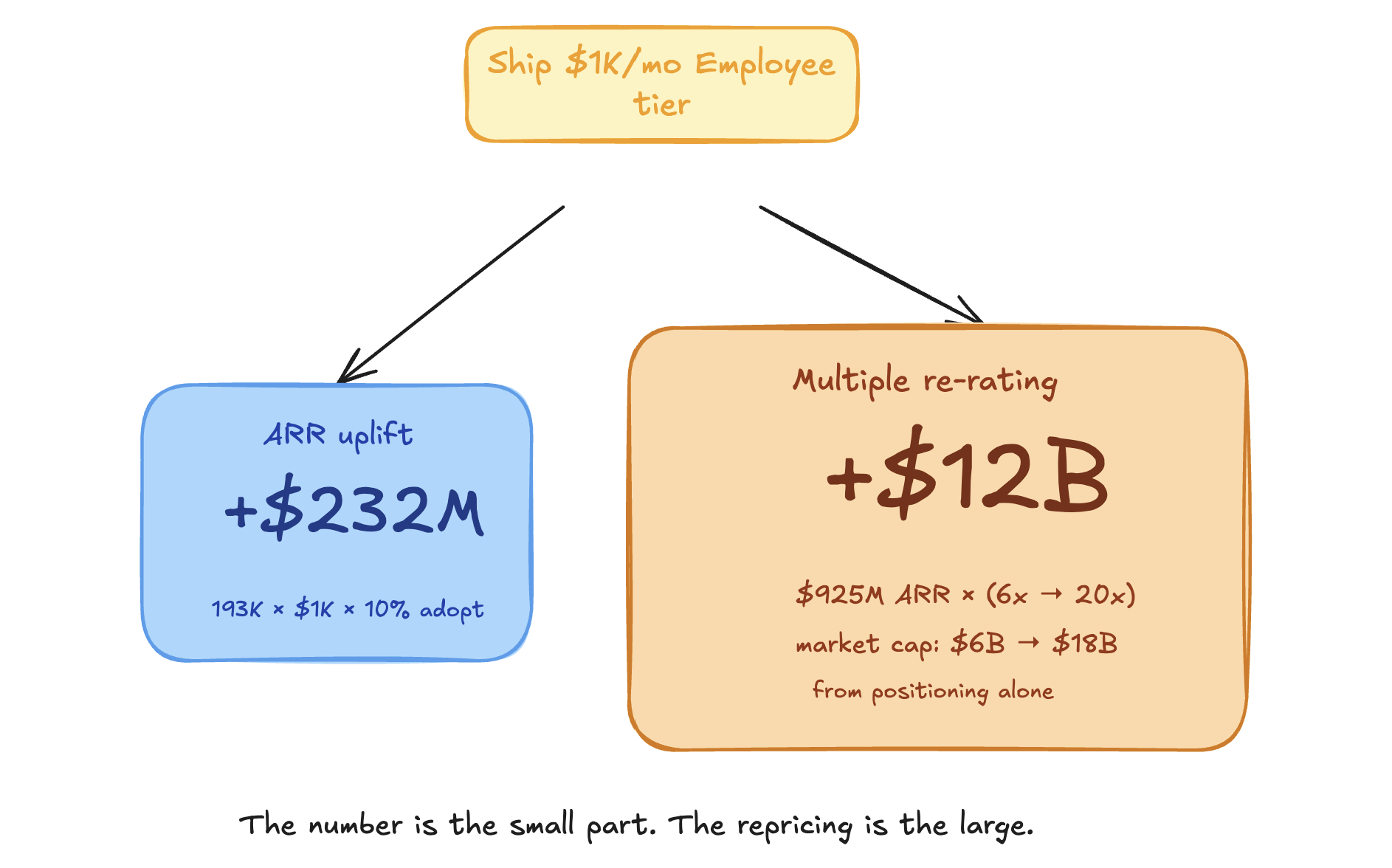
Klaviyo: roughly 193,000 customers, $400 average ARPU, ~$925M ARR. A $1,000/month strategic Employee tier landing at 10% adoption is $232M of net new ARR. Conservative 5% adoption is $116M — a 12% lift on the base from a single SKU launch.
The number is the small part. The repricing is the large part. Vertical commerce SaaS trades at 5–7x ARR. Vertical AI Employee companies — Harvey at roughly 58x, Hebbia, Rogo, Abridge in the same band — trade an order of magnitude higher because the revenue is anchored to executive comp, not coordinator wages. Even partial re-rating to 20x on Klaviyo's $925M ARR moves market cap from $6B to $18B. $12B of enterprise value from a positioning shift.
Run the same math on Yotpo, Loop, Recharge, Smile, Okendo. On your company…
This is the unspent asset. The wrapper to spend it shipped at platform scale months YEARS ago and has not yet reached commerce.
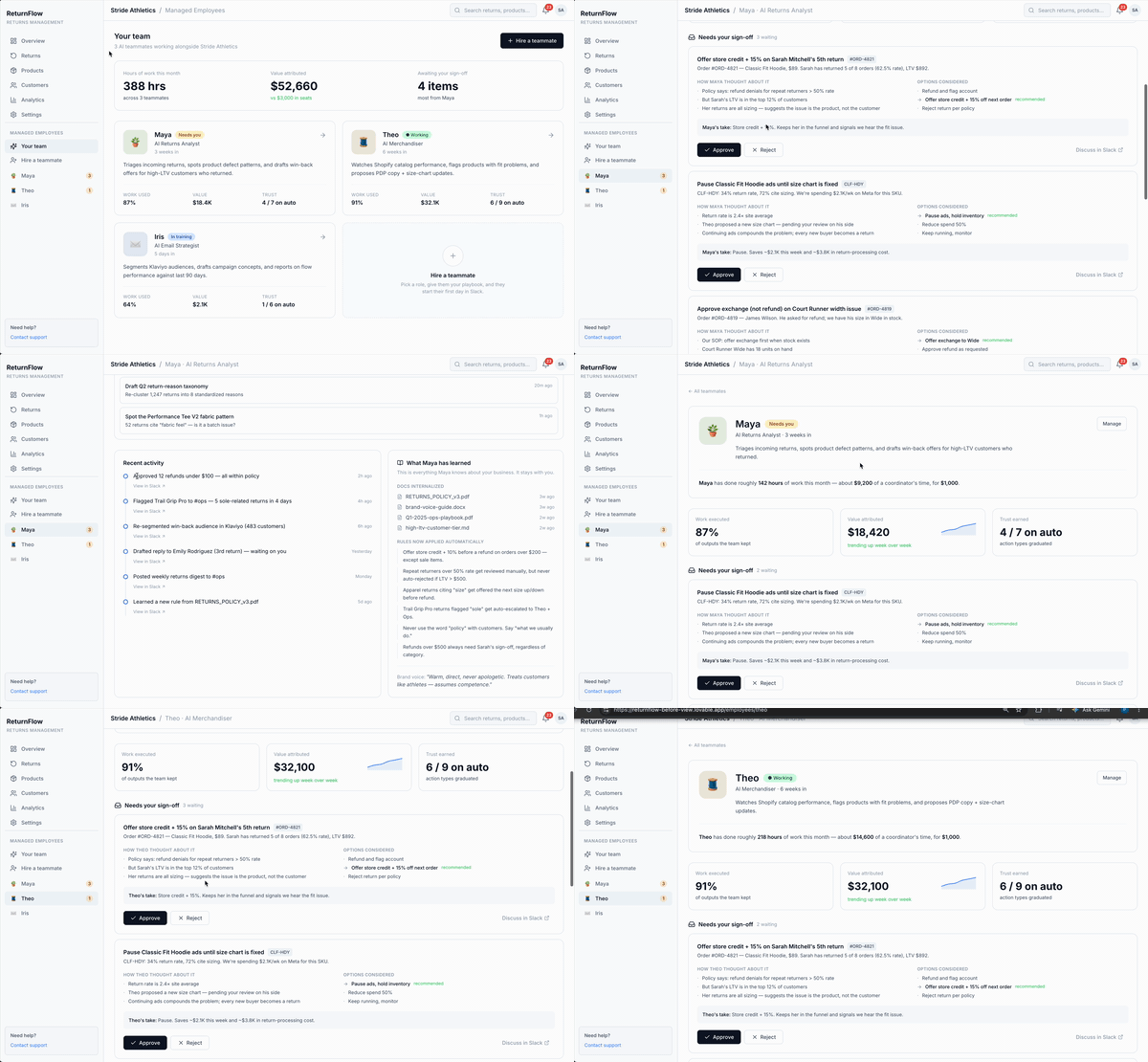
Above is the demo of our AI Employee Layer being integrated with a Returns platform.
AI Agent corroded in 2024 because the term covered everything from a smart autocomplete to a fully autonomous workflow. AI Employee is on the same trajectory. A hard filter before going further.
An AI Employee satisfies five attributes. Miss on any one and what you are looking at is adjacent — useful, sometimes related, not the same product.
Three false positives the discourse currently lumps in:
A customer-facing agent — Klaviyo Customer Agent, Gorgias AI, Siena, Yuma, Decagon — misses the surface attribute by design. It talks to the merchant's shoppers, not the merchant's team. Different product, different category, different buyer logic.
An in-product autonomous workflow — Klaviyo Marketing Agent, Klaviyo Composer — misses the teammate surface and the bidirectional interaction. The merchant clicks a button and gets a generated artifact. There is no @ mention, no escalation, no two-way conversation with a colleague. Closer than a chatbot. Still adjacent.
A smart predictive feature with a role-shaped name — Yotpo's Onsite Agent, Content Agent, Activation Agent; Loop Returns' Intelligence layer — misses the teammate shape entirely. These run in the background and surface outputs. The merchant consumes them. The merchant does not work with them.
The interaction model
The five-attribute anatomy is a static description. What makes the Employee an Employee is the interaction.
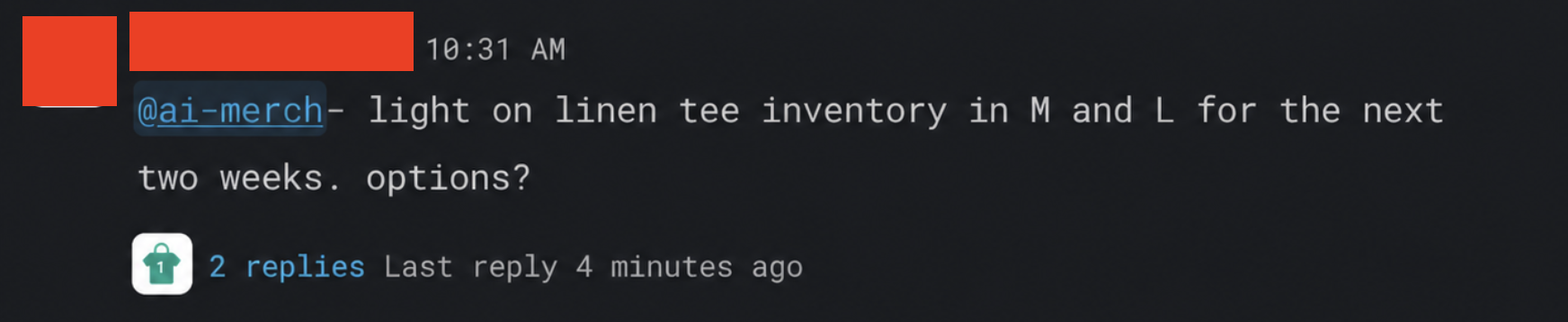
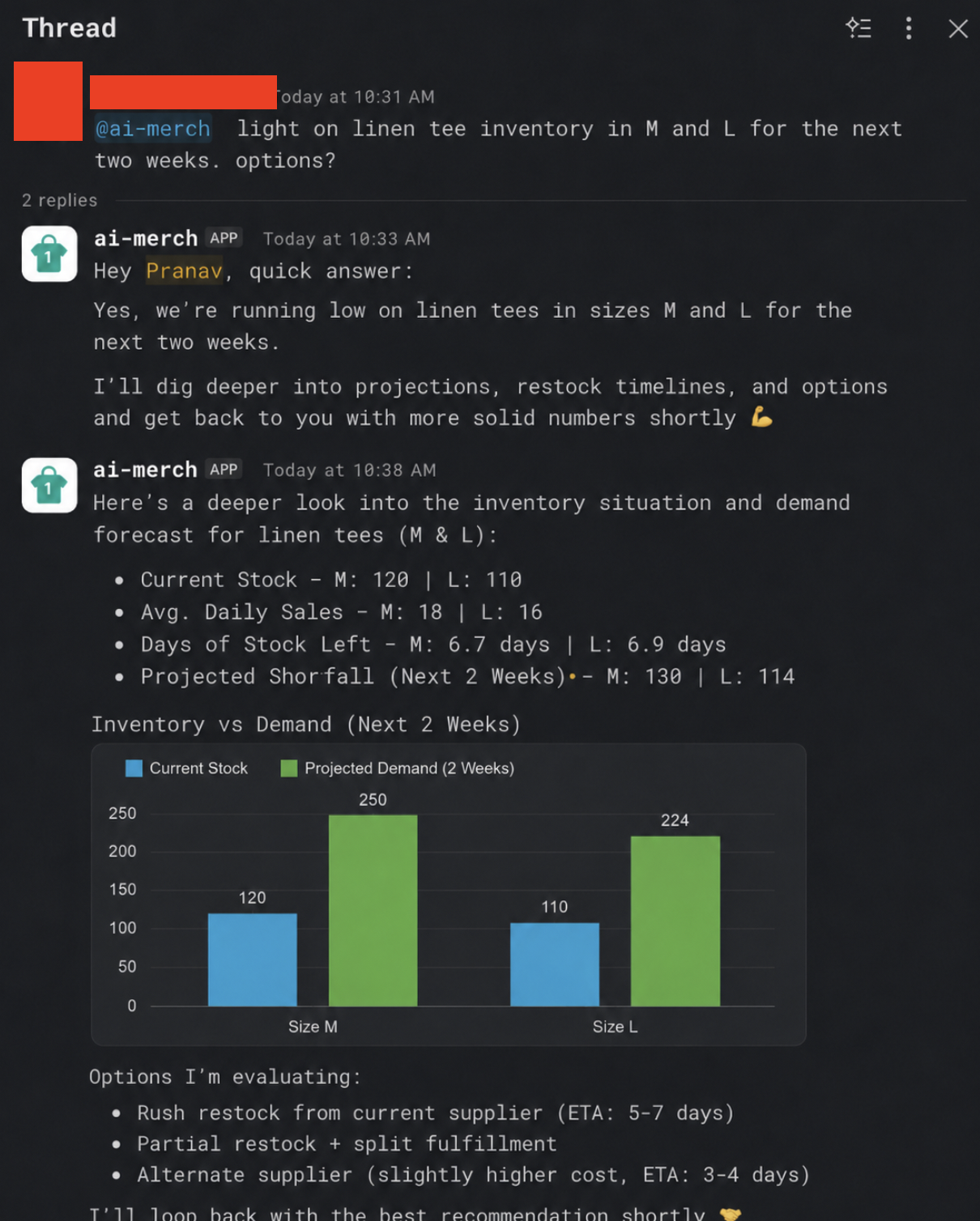
The brand's growth lead opens Slack on Monday morning and types into the #merchandising channel:
The whole interaction took four minutes and replaced what used to be a 90-minute spreadsheet exercise across three tabs.
Behind the screen, four pieces of infrastructure made it work.
The Employee read live order and inventory data through the SaaS's API layer. It consulted the merchant's uploaded SOP document for the margin floor and the restock authority rules. It pulled cohort patterns from 193,000 brands' worth of past out-of-stock events. It wrote back to Shopify, Klaviyo, and Slack through the action surface with the permissions the merchant configured during setup. The growth lead saw none of this. She saw a colleague responding to a question in Slack.
Memory accumulates per merchant. Six weeks in, the Employee no longer asks about the margin floor — it knows. Three months in, the AI Merchandiser at this brand sounds different from the AI Merchandiser at a brand two states over selling outdoor gear, because the SOPs, brand voice, and decision history have diverged. Twelve months in, the merchant has trained their own Employee without ever opening a config file. The merchant cannot leave without losing the Employee's accumulated knowledge of their business.
Switching costs compound month over month, embedded inside the Employee itself.
The SaaS-CEO's view of the same product is different. They see the Workbench — the management surface where they configure which Employees exist, which actions auto-execute, which require approval, what data each Employee can read and write per merchant. They see usage metrics: which Employees get @ mentioned daily, which actions graduate from approval-required to auto-execute, which merchants are pushing usage hardest. They never see individual conversations unless escalated.
The intelligence layer is missing
Look at every wave of software in commerce SaaS over the last decade and the same shape repeats. Each wave built more of the execution layer. None of them built the intelligence layer.
Dashboards executed display. They surfaced the data, sorted it, charted it. Interpretation stayed with the merchant. Workflows executed automation. They moved a customer from one segment to another, fired an email when an event happened, triaged a return. Logic stayed with the merchant. Copilots executed drafting. They generated a campaign template, suggested a subject line, summarized a thread. Judgment stayed with the merchant. Agents executed action. They could perform the task; the merchant still had to decide what task to perform, in what sequence, with what tradeoffs.
Every wave shipped more hands. The expert kept supplying the head.
The intelligence layer is not the model. The model is rented. The intelligence layer is everything that has to wrap the model for it to operate inside a specific business — the data substrate, the formalized expertise, the decision history, the brand voice, the permissions, the action surface, the feedback loop. It is what converts raw foundation-model intelligence into operationalized judgment that can be trusted with real work in a specific vertical.
This layer exists today in every mid-market commerce SaaS. It is sitting on the company's servers and in its senior people's heads. It has never been delivered to the merchant because no form factor existed that could carry it. The Slack-resident teammate is one form factor. The prescription feed described in our Prescriptive Intelligence thesis is another. Both ship the same underlying intelligence layer. The wrappers differ; the layer beneath is identical.
The case for the next eighteen months is the case for shipping the intelligence layer in your vertical before someone else ships it in yours.
The wrapper sets the buyer's mental anchor
The wrapper and the capability are both required. The wrapper does work the capability cannot do on its own: it tells the buyer's brain what to compare the product to, and the comparison sets the price ceiling.
A feature gets compared to the next feature on a competitor's pricing page. Ceiling: $50–$200 per merchant per month.
A recommendation gets compared to the merchant's existing decision-making time. Ceiling: $200–$800 per merchant per month, which is where most operational mid-market SaaS plateaus.
An Employee gets compared to the merchant's next hire. Ceiling: $2,000–$10,000 per merchant per month. The merchant is picking between subscribe to this software and post the job rec, and the software wins on cost, ramp, and availability before the capability question is asked.
Same intelligence, three wrappers, twenty-fold price difference. The wrapper does not produce the intelligence. It produces the comparison that determines what the intelligence is worth.
Crazy, right?
The merchant's mental model already has the slot
Every operational business runs on roles. Merchandiser, retention specialist, email designer, returns analyst, influencer manager, paid acquisition lead. The merchant hires against those roles, evaluates against those roles, fires against those roles. An AI Merchandiser lands in a slot the merchant has already built cognitive infrastructure for. The buying decision compresses to is this Employee good enough to fill this slot for less than I would pay a person? — a question the merchant knows how to answer.
A recommendation feed asks the merchant to invent a new behavior pattern. A chatbot asks the merchant to invent a new ritual. These are the most expensive cognitive operations a B2B buyer can be asked to perform, which is why most intelligence features in SaaS today are adopted by under 10% of the user base regardless of the underlying model quality.
Employees inherit escalation for free
Everyone becomes a manager.Without getting paid manager salaries. Lol…
Our research team is already setting up claude on GPU servers and letting it work through things!
A human employee escalates to their manager when something is out of scope. The manager intervenes. The work continues.
The merchant has thirty years of organizational muscle memory around this pattern.
An AI Employee inherits the same pattern. The AI Merchandiser surfaces a $30K inventory commitment with margin uncertainty and routes it to the CFO for sign-off. The CFO sees a Slack message with the full reasoning chain, three options, the Employee's recommendation, a one-click approve button. He clicks. The work continues.
A chatbot cannot escalate because there is no role hierarchy. A recommendation feed cannot escalate because there is no concept of a task being out of scope. Only the Employee form factor inherits the entire escalation ladder for free, by mirroring the org chart it sits inside. The Employee can therefore be trusted with real work — not because the model is more capable than the model behind a recommendation feed, but because the wrapper produces a legible escalation path the merchant already understands.
Slack is the operating system of operational work
Sixty percent of mid-market commerce ops happens in Slack already. Sales, ops, CX, marketing, retention — all coordinating in shared channels, all @ mentioning each other, all running async standups and incident response and weekly reviews in the same surface. Teams covers most of the rest.
An Employee in Slack inherits the notification model, the @ mention pattern, the channel-context behavior, and the shared-history affordance the merchant's team is already trained on. Zero retraining. Salesforce internally runs Agentforce in Slack across 76,000 employees with 86% sustained adoption — numbers that occur only on top of behavior already established. The Employee rides Slack the way iOS apps rode the iPhone keyboard.
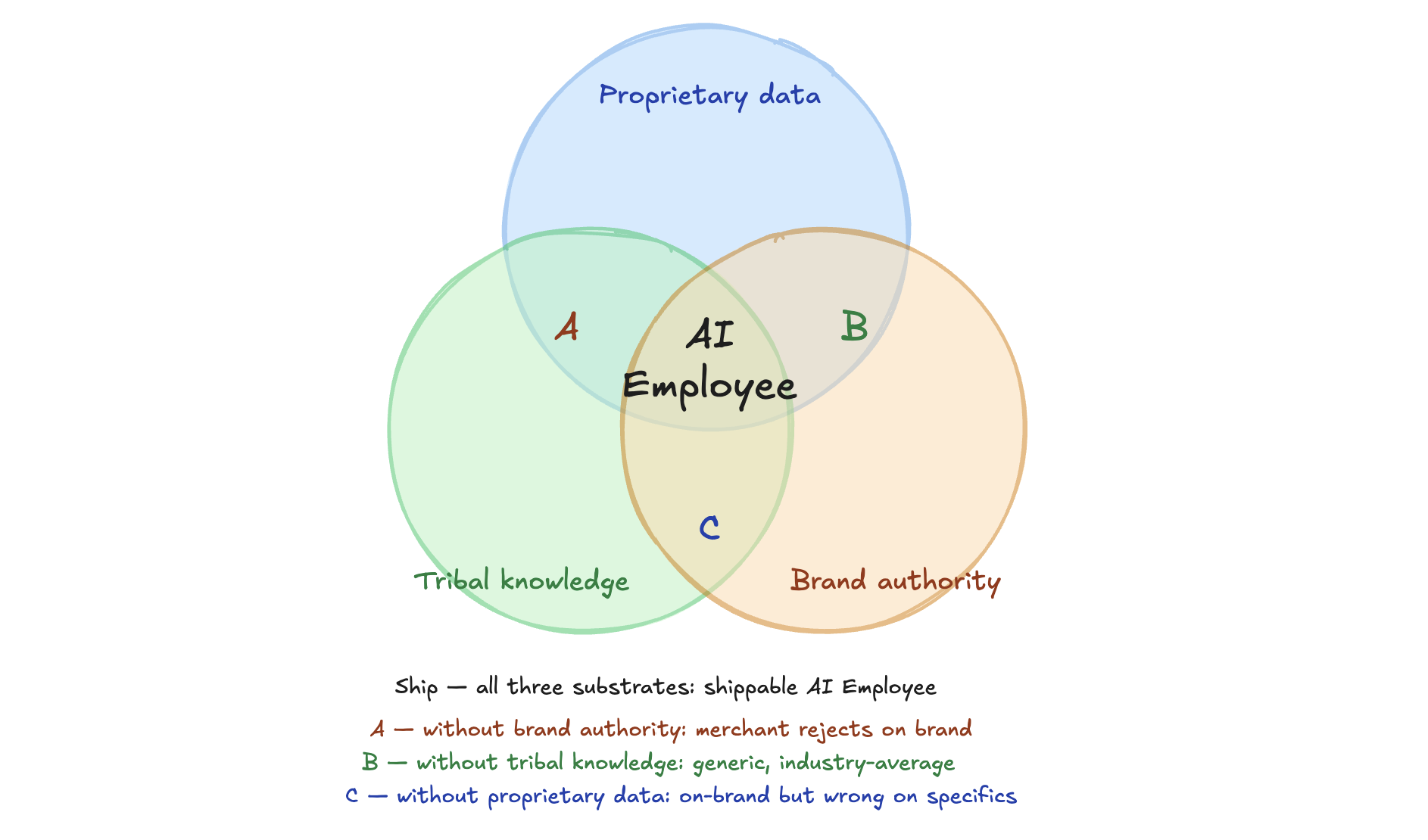
Every AI Employee is built on three substrates
Strip the wrapper from the picture and three substrates carry the rest of the work. They are what make the Employee credible, defensible, and pricable. They are also what foundation model providers cannot replicate inside your vertical, regardless of model quality. The substrates are the uncopyable delivery layer.
Proprietary data
Klaviyo has fourteen years of email performance data across 193,000 brands — open rates, click patterns, send-time effects, subject-line outcomes, conversion correlations across billions of consumer interactions. Loop Returns has 100M+ returns and 200M+ shoppers across 5,000+ Shopify brands, plus 1,000+ carrier integrations annotated with outcomes. Yotpo sits on 300M+ reviews from 15,000+ brands. Triple Whale tracks $82B+ in annual GMV across 50,000+ brands. Recharge sees subscription patterns and churn signals across thousands of merchants in every consumable category.
Klaviyo specifically builds their agents on top of their “14 years of intelligence”
An Employee trained on this substrate is structurally better than any generic AI marketer wired into the same APIs. A horizontal AI player can read the API; they cannot read what worked across fourteen years of priors. That asymmetry is exactly what the model behind the Employee converts into judgment.
It is also why why not just build on top of OpenAI's agents directly fails the CTO's pressure test. OpenAI does not have access to the SaaS's proprietary substrate. The SaaS is not going to expose it. The Employee has to live where the substrate lives.
Formalized tribal knowledge
The most underused asset in the building and the one most engagements spend the most time on.
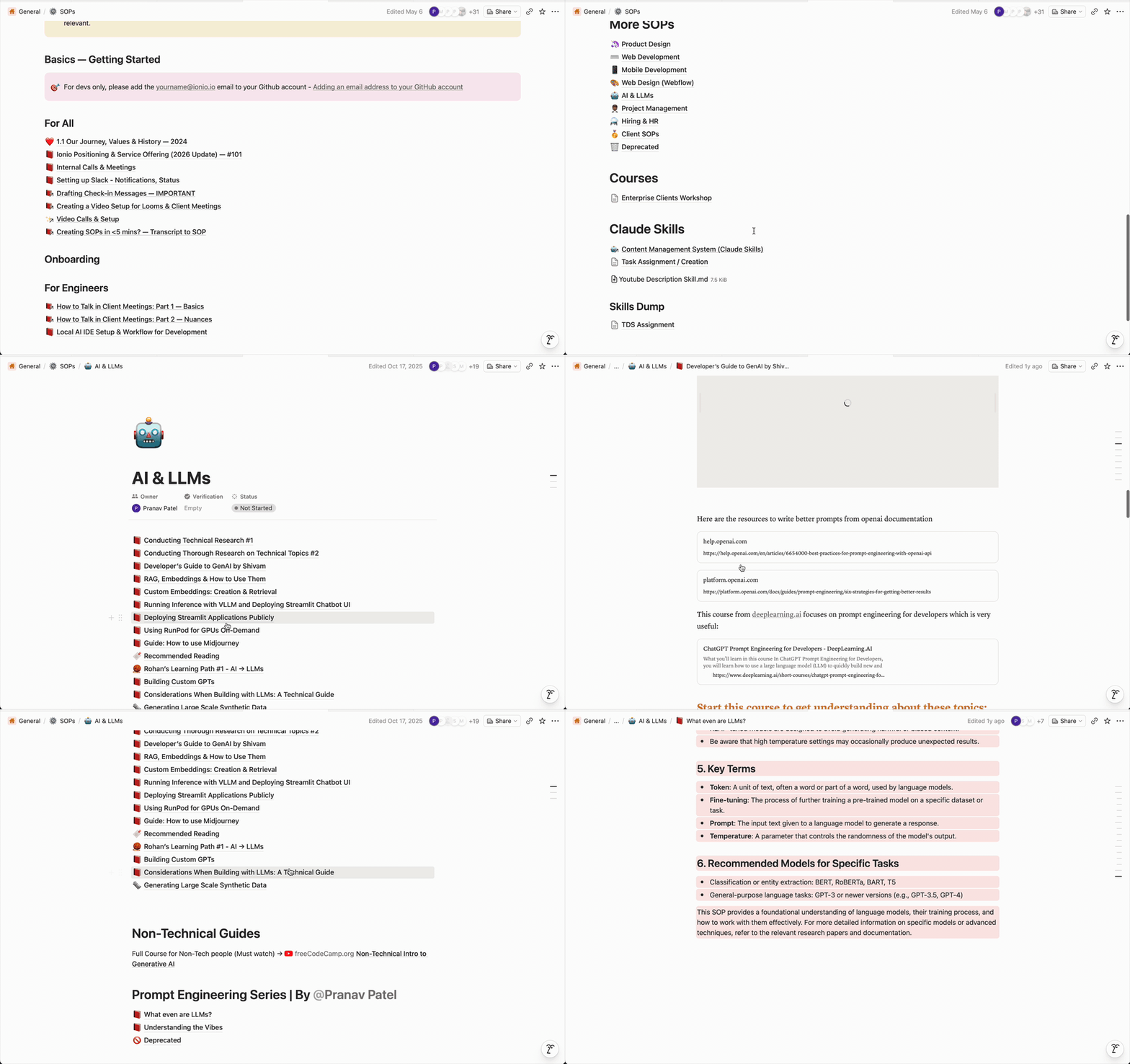
At Ionio, we have a total of 274 SOPs as of writing this doc.
Every commerce SaaS has accumulated thousands of pages of unstructured operational context — internal SOPs, customer success playbooks, support ticket transcripts, founder explanations of how the product is supposed to work, escalation patterns from hard accounts, decisions made on edge cases, the senior retention strategist's mental model of when this pattern shows up in the data, the right move is usually X, except when Y, then Z.
None of it is structured. Most of it lives in Notion, Google Docs, Slack threads. Some of it lives only in two or three people's heads and dies when they leave.
Our open-source harness ingests this material via a YAML pipeline and consolidates it into a single canonical operational document the Employee reasons against. The same harness defines what the Employee is allowed to do — which actions auto-execute, which require approval, which trigger escalation, which are off-limits per merchant configuration. Permissions and knowledge live next to each other because both are operational context.
This is what turns a generic AI Returns Analyst into one that knows we always offer store credit before refund for orders over $200, except for sale items, except for top-loyalty-tier customers who get the refund without question, and we always flag anything over $500 to the ops lead before resolving. None of that is in any foundation model. All of it sits in the SaaS's operational documentation, scattered across systems. The harness brings it together.
Brand authority in a category
The right, in the merchant's mind, to ship a credible Employee in this vertical. The substrate no engineering effort can manufacture.
Klaviyo has it in email. The merchant's brain has spent a decade categorizing Klaviyo as the company that runs my email, then a further few years categorizing it as the company that defines what running email is — to the point where the merchant's next hire's resume will list “Klaviyo” as a skill, recruiters will filter inbound on “3 years of Klaviyo experience,” and an entire ecosystem of Klaviyo Experts, Klaviyo agencies, and Klaviyo certification programs has grown up around the product.
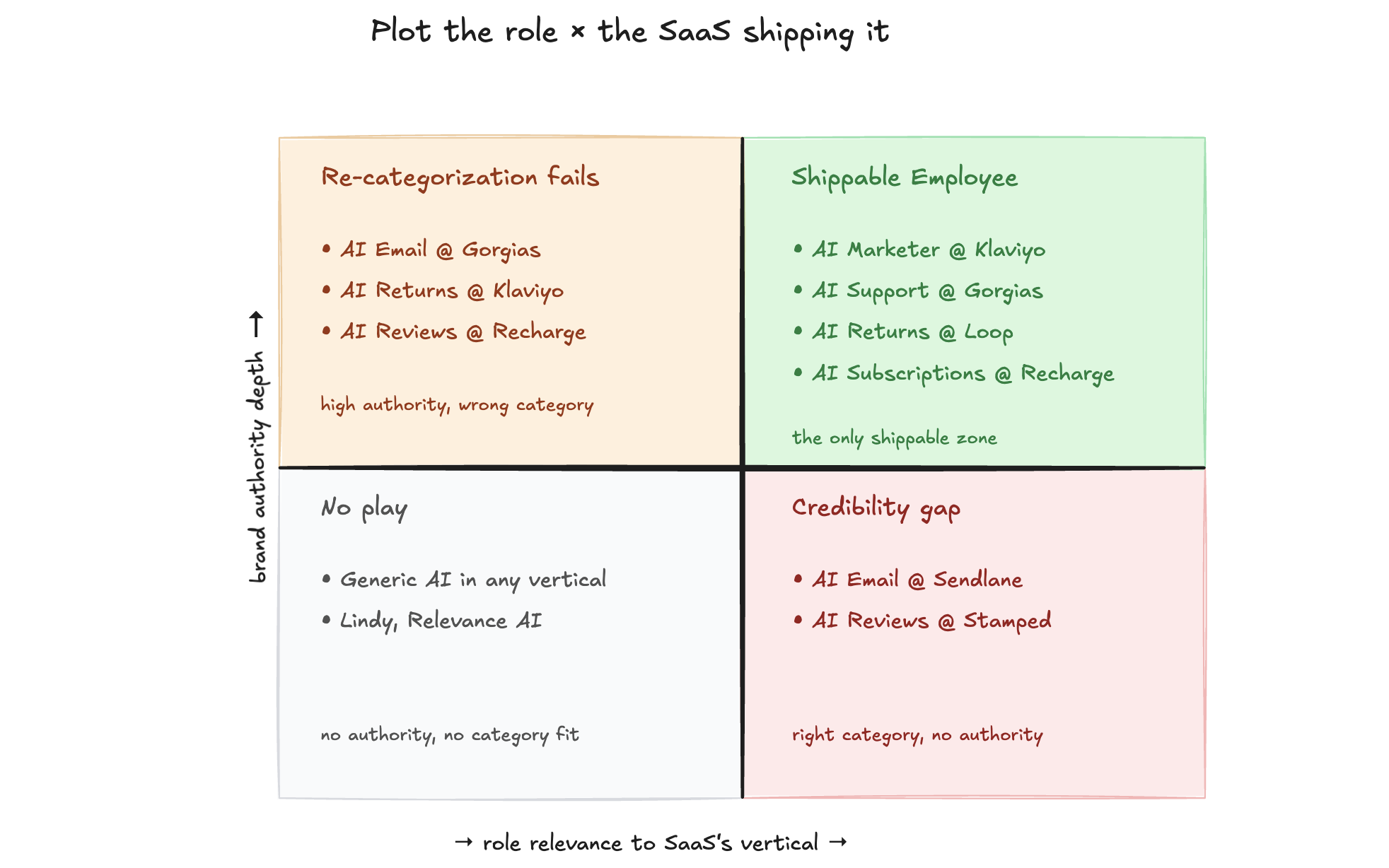
The merchant does not buy Klaviyo software at this point. They subscribe to Klaviyo as a category the way SEMrush and Ahrefs subscribers buy into those products. The same dynamic exists for Recharge in subscriptions, Loop in returns, Yotpo in reviews, Gorgias in support. The depth of category authority is uneven across verticals; the pattern is consistent at the top.
At that depth, a $1,000–$2,000/month AI Employee is trivial to position. The merchant is buying Klaviyo expertise as a colleague, and they already pay for Klaviyo expertise in the form of consultants, agencies, and certified hires. The Employee is a more efficient delivery wrapper for an expense the merchant is already running.
Run the same thought experiment with Gorgias shipping an AI Email Designer. The merchant has to mentally re-categorize Gorgias from support vendor to marketing vendor. Re-categorization is the most expensive cognitive operation in B2B. The merchant says interesting and clicks away. Same product, different brand, different outcome.
Authority is perishable. Every quarter a vertical incumbent waits to spend it, three things happen. A competitor in the same vertical ships first and starts to claim the category language — the way Klaviyo did with Marketing Agent in September 2025, leaving Omnisend, Sendlane, Drip, MailerLite structurally in catch-up posture for four quarters running. Horizontal AI platforms — Lindy, Relevance AI, Ema, Dust — chip at the edges with generic Employees that do some of what a vertical incumbent could do, worse but available. Foundation model providers extend downstream — OpenAI Workspace Agents, Anthropic's Claude skills, Google Gemini Enterprise — each reducing the set of jobs a vertical SaaS can still credibly own.
The authority leaks a quarter at a time. The CEO who waits eighteen months because the technology will be better then has by then lost the asset they were waiting on, and will compete on technology against players who own both.
Where this has already shipped
The proof is dense and most of it is outside commerce.
We can bring it inside 😏
The form factor at scale
Salesforce Agentforce in Slack is the cleanest existence proof. Internally deployed across 76,000 employees with 86% sustained adoption. 500,000 employee-hours saved per year, of which the Engineering Agent alone accounts for 275,000 hours — the equivalent of 130 full-time engineers replaced in a single agent at a single company. Slackbot reached GA as a true Employee Agent in January 2026 and was, per Salesforce's framing, the fastest-adopted feature in Slack history. The form factor works at $300B-market-cap scale. The economics are publicly measurable.
Adjacent enterprise: Wiley deployed Service Agents in Q4 2025 and reported 40%+ improvement in first-contact resolution within 90 days. ServiceNow's Now Assist — the AI Employee SKU sold at a 50–60% uplift on the base — crossed $600M ACV in FY25 with a publicly stated $1B FY26 target.
Two acquirer pools forming in parallel
The M&A pattern has two distinct shapes. Worth naming separately.
The first pool: agentic AI capability, bought wholesale by incumbents who can't build it in-house.
These are tech acquisitions — the buyer wants the capability, not the category position. Three of these are internal-employee-facing, the directly-relevant Employee precedents; two are customer-facing CX, included as evidence of the same buy-don't-build urgency in the adjacent category.
Deal
Price / Date
Shape
ServiceNow → Moveworks
$2.85B, announced Mar 2025, closed Dec 2025
Largest acquisition in ServiceNow's history. Internal IT and HR employee agents. The cleanest Employee precedent in the list.
Automation Anywhere → Aisera
Nov 2025, undisclosed
ITSM, HR, and customer-service self-service agents, mostly internal-employee-facing.
Zendesk → Unleash
Late 2025
Internal knowledge agent that lives in Slack and Teams. Employee-facing.
Zendesk → Forethought
Mar 2026, ~$200M+
The largest Zendesk deal in nearly 20 years. Customer-facing service AI, not an internal Employee. Same buy-don't-build signal, adjacent category.
NICE → Cognigy
$955M, closed Sep 2025
Customer-experience and contact-center AI. Customer-facing, same caveat as Forethought.
Zendesk alone has spent nearly $500M on AI M&A in 18 months, framed publicly as bridging customer-facing and internal-facing AI.
The second pool is vertical Employee depth bought by strategic acquirers — Salesforce, Adobe, Shopify, the platform-scale players who already have AI capability in-house and want category authority, proprietary data, customer relationships, and absorbable teams. This pool has not yet acted in commerce. Triple Whale's Moby 2 is the closest existence proof of the form factor in our vertical, but Triple Whale has not been acquired. The next move is one of the strategic acquirers buying a vertical Employee company in commerce — probably email first because Klaviyo and Adobe-via-Marketo are the only public SaaS at the scale where the surface is worth a strategic acquisition.
Both pools are active now. The first one is buying tech. The second one is preparing to buy market position. The vertical SaaS that has shipped its Employee before the second pool moves is the one being bought at a premium. The vertical SaaS that has not is bought at SaaS multiples — if at all.
Triple Whale's Moby 2, launched April 2026, is the only fully-shaped Employee in commerce vertical SaaS. Triple Whale's own framing: an autonomous ecommerce employee that can launch ads, rebalance budgets, and audit performance while you sleep. Delivered to Slack and Teams as the primary surface. Powered by the $82B GMV substrate across 50,000+ brands. The Custom Agents tier ships with a context engineering team that tailors the Employee to specific brand workflows — which is, structurally, the productized service this document is describing, except Triple Whale only sells it on top of their own data platform.
We were about to start hiring a few analysts. Then we started testing Moby Agents. There is no way we need to hire these people. It's mind-blowing, really.
The customer testimonial worth memorizing — the entire thesis in plain language.
Moby is the existence proof. It is also a competitor to every vertical incumbent SaaS that overlaps with Triple Whale's analytics surface. The other verticals — email, reviews, returns, subscriptions, loyalty, influencer, support — have no equivalent shipped.
The other side of the pressure
Direct-to-brand startups — ShopVision ($5.68M seed, AI super agent in Slack for merchants), Stormy AI (YC-backed, four named role-Employees marketed as a team — Hire one — or all four. They share context), Deliberate Studio (six AI Employees as a team in Slack, approval-based workflow). All vertical AI Employee companies from day one, not bolted-on offerings. Their entire business is building Employees. The substrate is shallower, the brand authority is thinner, the scale is small. The shipping velocity is real.
Two-sided pressure. Foundation model providers from above with horizontal infrastructure. Vertical D2B startups from below with focused form factor. The vertical SaaS that does not ship inside the next 6–12 months gets squeezed between them.
What this changes
For the merchant's ops team, the change is structural. Operational marketing roles — the email coordinator, the segment builder, the send-time analyst — are the headcount that gets compressed. The supervisory roles above them stay. Hiring patterns in mid-market commerce are already softening on these operational roles, and Triple Whale's customers are on the record about why. Underoutfit's CXO, in a published testimonial on Triple Whale's site: we were about to start hiring a few analysts, then we started testing Moby Agents — there's no way we need to hire these people, it's mind-blowing. The category-defining customer quote for the next decade of vertical SaaS is already public.
For the SaaS company, the change is a categorical re-rating. Vertical SaaS in mid-market e-commerce trades at 5 to 7 times revenue. Vertical AI Employees in adjacent categories trade at 30 to 60 — Harvey near 58x at last raise, Hebbia and Rogo in the same band, Cognition implied higher. ServiceNow paid $2.85B for Moveworks because Moveworks owned the AI Employee form factor in IT and HR. Wiley reports 40%-plus case resolution lift on Agentforce in production. Salesforce's internal Agentforce deployment is running at 500,000 hours saved per year, with the Engineering Agent alone replacing 130 FTEs. The math is not a projection. The math has been paid out by named companies, with public numbers, in adjacent verticals. The vertical SaaS in commerce that ships the Employee layer earliest absorbs the language of the category, the multiple expansion, and the strategic acquirer set. The vertical SaaS that ships third explains the gap to its board.
For the shopper, the change is invisible at first. The email arrives in the brand's voice, at the right moment, with the offer that fits — because the AI Marketer was trained on the SaaS company's accumulated corpus of what works across its customer base.
Operational quality at a $50M brand becomes equivalent to the experience at a $500M brand.
The competitive bar in every category moves up, and share concentrates toward the brands that moved first.
The infrastructure for all of this has already shipped:
Slack's Agentforce Hub is live — a directory inside every Slack workspace where teams discover and @ mention agents the same way they would a teammate.
The Slack Marketplace AI Apps & Assistants category is live, with Adobe, Anthropic, Cohere, Perplexity, IBM, and Glean already shipping into it.
Salesforce has named the Employee Agent type as a distinct product category, separate from customer-facing Service Agents, and shipped pre-loaded templates for it.
Slackbot became GA as an Employee Agent in January 2026 and is the most-adopted feature in Slack's history.
This is the craziest one tbh if you ask me…
OpenAI launched Workspace Agents three weeks ago, plugging directly into Slack and Salesforce.
All a vertical SaaS has to ship is the Employee itself, trained on its proprietary substrate, distributed through its existing customer relationships. — Big 💰💰💰
This is parallel infrastructure, not a feature
(or: why internal teams might struggle to build this)
The most common failure mode in this space is the one the CEO is about to fall into. Read the document. Forward it to the CTO. Tell them to figure out the AI Employees roadmap. Move on.
Six months later: a feature that technically works in a demo, has 8% adoption, generates no measurable lift on either ARPU or NRR, absorbs every quarterly review under the heading AI initiative — in progress.
An AI Employee is not a feature inside Klaviyo. It is a harness over Klaviyo.
The feature team's work — what they ship sprint after sprint — sits inside the product. New flow builders, new segmentation tools, new template editors, new attribution dashboards. They are building parts of the product itself. The Employee is a completely different shape: a colleague that uses the product's features, makes decisions across them, reasons over the substrate, talks to the merchant in Slack. The Employee operates on Klaviyo. The feature team operates in Klaviyo. These are different layers of the same system, and they cannot be built by the same team using the same process.
This is why internal teams struggle to ship the Employee. The work shape is unfamiliar. Feature teams have not built harnesses before — they have built features.
The skills are adjacent but not identical: agent orchestration patterns, permission models per merchant, knowledge ingestion pipelines, white-label deployment topology, validation frameworks for non-deterministic systems.
Each one is its own specialty. The team that ships a returns flow in two weeks needs three months to ship the first version of a returns Employee, and the first version usually does not work.
The technical aspect of harness-building is real but partially commoditizing. Open-source frameworks and reference implementations — including the one we have published — have lowered the floor. The durable advantage now is sequencing experience: knowing which corners to cut, which abstractions to ship first, where to use foundation models and where not to, how to structure the tribal knowledge harness, what the validation framework needs to cover, how to white-label without bleeding the SaaS's brand into the merchant experience. Teams that have shipped this multiple times know the sequence. Teams that have not are learning from scratch on the production version, which is where the 70% internal-AI-failure rate comes from.
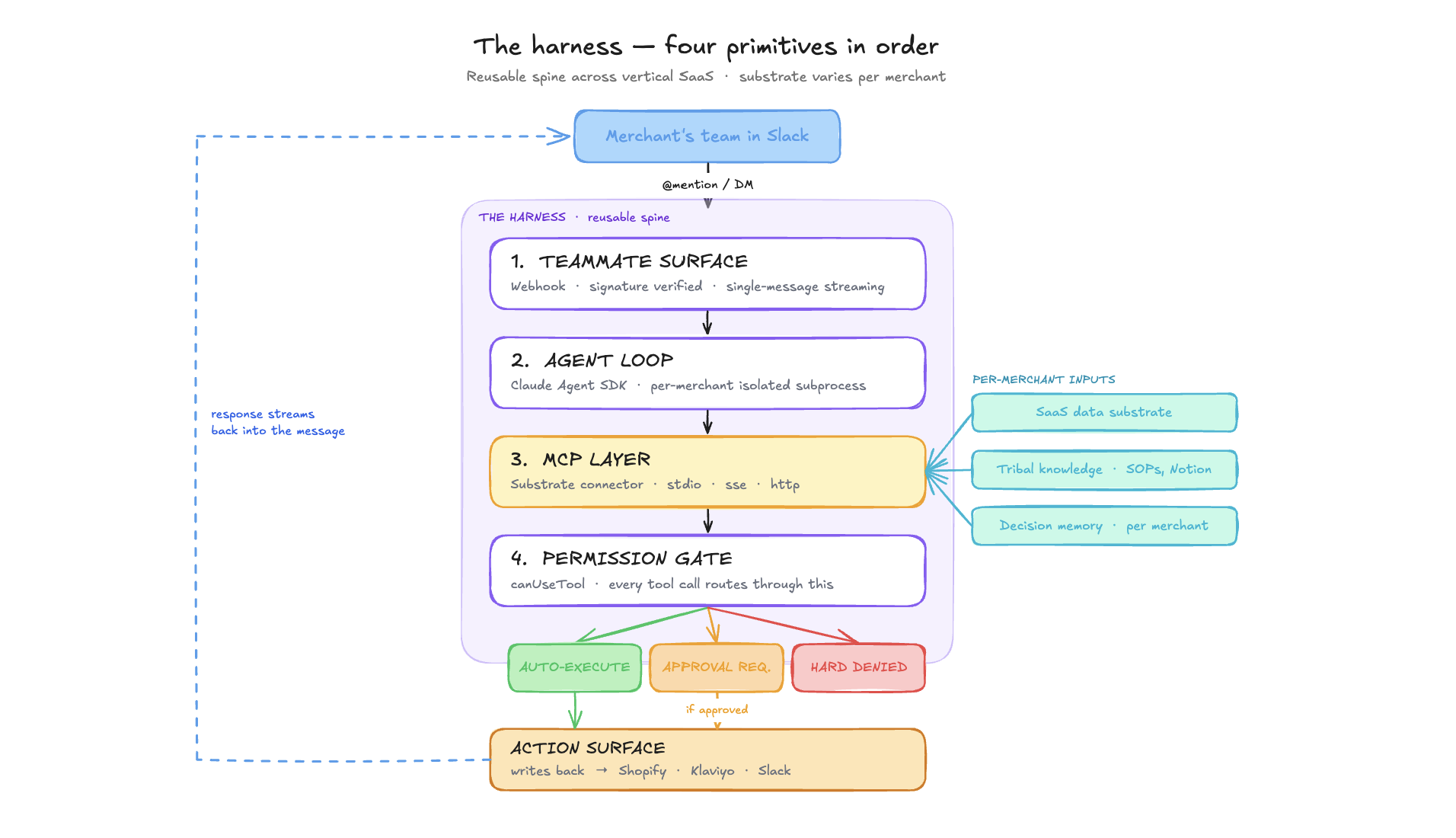
The harness
Read the thesis to here and the natural CTO question is: show me what is actually in the harness. The honest answer is that four primitives — wired in a specific order, with a specific permission model around them — carry the entire AI Employee.
The reference implementation is open-source. The four primitives are these.
One — the teammate surface. A webhook host that receives Slack events (or Teams, or in-product), verifies the signature, and routes each @ mention or DM to the agent.
In the reference implementation this is a Next.js route handling Slack's standard event subscription model — app_mention, message.im, message.channels — with HMAC verification on every payload.
This surface is what makes the Employee feel like a colleague.
The Vercel Chat SDK handles that streaming-into-one-message pattern, which is what turns AI response into colleague typing in real time. Get this wrong and the Employee posts walls of text into the channel like a chatbot. Get it right and the merchant's team forgets which colleagues are human.
Two — the agent loop. The Claude Agent SDK runs the loop. Per-merchant context, per-merchant memory, isolated subprocess. The merchant's Employee never sees another merchant's data, never sees another merchant's decisions, never sees another merchant's brand voice — even though every Employee runs on the same harness, the same model, and the same SaaS infrastructure. Each invocation is a fresh subprocess with that merchant's permissions, that merchant's MCP server set, and that merchant's accumulated memory loaded from the canonical operational document.
Three — MCP, the substrate connector. This is where the SaaS's proprietary data layer plugs in. Every SaaS's existing API surface gets wrapped once as an MCP server, and the Employee reads and writes through it for the rest of the harness's life.
The merchant's Notion is one MCP server. The merchant's Shopify is another. The SaaS's own substrate — Klaviyo's fourteen years of email performance data, Loop's 100M+ returns history, Yotpo's 300M+ reviews — is the third.
Swap notion for klaviyo, shopify, loop, yotpo. Anything you want.
This is what reusability across vertical SaaS looks like at the code level — and it is also why the why not just build on top of OpenAI's agents objection collapses on inspection. The SaaS owns the data; the SaaS publishes the MCP server; the harness routes through it. A foundation model provider extending downstream does not get to skip that step. They can read the public API. They cannot read what the SaaS chooses not to publish, which is most of the substrate that matters.
Four — the permission gate. Every tool call routes through a canUseTool function before it executes. The default disallow list hard-denies destructive primitives — shell, file write, file edit, notebook edit, kill-shell. The allow list is small, explicit, and per-merchant configurable. The gate is what makes the Employee trustworthy with real work.
Without it, an AI Employee is a remote code execution surface attached to untrusted Slack input. With it, the Employee inherits the same approval ladder the merchant's organization already runs on, mirrored in code.
UI/UX design for this
The four primitives are the engine; none of them are what a human looks at. The Employee works in Slack, but it gets hired, governed, and measured here — the only screen a non-engineer ever touches.
The hiring page. A wizard that treats standing up an Employee like onboarding a person — pick a role, connect data and tools (the MCP primitive, made clickable), drop in the SOPs and watch them read back as plain-English rules, set the guardrails (primitive four, as Off / Needs approval / Auto). This is where the buyer files the product under next hire, not next feature.
The dashboard. One page where the Employee becomes a colleague you manage — impact priced against a human hire, an approvals inbox with one-click sign-off (escalation-for-free), the task board and activity feed, and what it's learned: the accumulated SOPs and decisions that make leaving expensive.
How this gets built
A sequence, not a timeline. Timelines are a function of how fast the room can move; the order of the steps matters more than the calendar.
Get the room right. The six seats above, aligned, with CEO sponsorship explicit. If any seat is empty or skeptical, fill it first. This is the step that gets skipped and then blamed on the technology nine months later.
Substrate audit. Inventory the cross-customer data no competitor in your vertical has. Inventory the tribal knowledge that is undocumented and should be. Inventory the merchant interaction logs containing the operational decisions your senior CS team has been making one ticket at a time for five years. Most SaaS companies discover their substrate is more fragmented than they assumed — multiple databases from acquisitions, schemas that were never designed to interoperate, knowledge that lives only in a senior person's head. The audit tells you which Employee can ship in eight weeks and which one needs six months of data work first.
Pick the first Employee. One role. Not three. The role with the highest action frequency, the clearest attribution path, and the deepest substrate behind it. For email SaaS, the AI Email Strategist (segment selection, send-time decisions, performance attribution). For returns SaaS, the AI Exchange Recommender (sizing prediction, retention math). For subscriptions, the AI Churn Investigator. The first Employee is the proof of the architecture, not the whole product.
Define the measurement framework. Three metrics. Inside the core product analytics, not on a separate AI dashboard.
Employee-to-action rate — what fraction of Employee outputs the merchant actually executes.
Attributed work value per Employee — projected revenue impact, actual revenue impact, time saved versus the human alternative.
Time-to-graduation per action category — when a category moves from approval-required to auto-execute.
If you cannot answer these three numbers in production, the Employee does not exist. It is a demo.
Launch the strategic tier ahead of full capability. Ship the pricing tier before the Employee is fully built. Early-access pricing is how you build the proprietary dataset that makes the tier defensible. Price the tier at 3–5x your current top tier. For most mid-market commerce SaaS, $1,500–$5,000/month per merchant, with custom enterprise above.
Hire the Employee Architect. Before your next feature PM. Highest-leverage external hire over the next 18 months.
Ship the second Employee. Six weeks faster than the first because the Workbench architecture is reused. Then the third, four weeks faster than the second. The sequence compounds because the substrate is already wired up and the harness is already running.
The economics
In-house path. Realistic team: three ML engineers, two data engineers, one senior PM, dedicated. At fully-loaded mid-market US comp, $1.5M–$2.5M over the engagement. In Europe, $1M–$1.8M. In emerging markets with senior AI talent, $400K–$700K over twelve months. Timeline: nine to twelve months to a production-grade first Employee with attribution wired. Failure rate of internal AI initiatives: roughly 70% never reach measurable ROI. The failure mode is sequencing, not engineering capacity.
Any vertical SaaS with the budget can run the internal path. Most will not. The backlog is feature work. Harness-building is not the muscle. The sequencing experience does not exist inside the company.
Partnered path. We ship the first production-grade Employee in 6–8 weeks from kickoff, with attribution wired and the Workbench deployed on the SaaS's own infrastructure. The code is the SaaS's — they own the repository, they can fork it, they can hire any other team to extend it. Pricing is outcome-tied: 5–10% of the attributable enterprise value increase generated by what we ship, structured so we only take engagements where the math works for both sides. Optional managed services tier for ongoing tuning and new Employee builds, recurring at $5K–$25K/month, opt-in.
The timeline differential is sequencing experience. We have shipped this multiple times. The SaaS is buying compressed sequence and avoided failure modes. Everything else is theirs.
Where this could break
Three risks. Stated plainly.
The top tier of mid-market SaaS builds it internally. Klaviyo did versions of this with Marketing Agent and Composer. Triple Whale shipped Moby 2. Loop has Loop Intelligence. The public, well-funded, and cash-rich top 20% of the market can absorb a 9–12 month internal build. We are not selling to them. The bottom 80% — the $5M–$50M ARR vertical incumbents and challengers who have the urgency but not the capacity — is where the offer lands.
The retrofit thesis loses to fully-agentic UX inside 18 months. If merchants prefer Swap-style fully-agentic surfaces to Employees layered into existing SaaS UI, the architectural bet becomes a transitional category. The data layer, the tribal knowledge harness, and the feedback loops are reusable in a fully-agentic future. The wrapper would need to change. We are betting retrofit is correct now; we are not betting it is permanent.
AI Employee corrodes as a term inside 12 months.AI Agent did this in 2024 — the language saturated, the term lost meaning, every chatbot rebranded as an agent. AI Employee can suffer the same fate. The discipline is to name the next stage before this one saturates. Prescriptive Intelligence is the next stage we have already named. The stage after that gets named in 2027 by whoever moves first.
Three predictions
In the spirit of falsifiable thesis-writing.
We have started doing this across all our documents, and this is honestly very fun. And our predictions are often completely correct!
One. Within six months of publication, at least two vertical-incumbent commerce SaaS companies — outside Triple Whale — ship a true Employee Agent with a named role, a Slack/Teams or in-product teammate surface, and a strategic pricing tier 3–5x their current top tier. The first to ship in their vertical sets the language and the price anchor. The next two backfill against it inside 12 months.
Two. Within 12 months, a strategic acquirer in the second pool — Salesforce, Adobe, Shopify, or ServiceNow — acquires a vertical Employee company in commerce. Email first, then analytics, then returns. The companies bought are priced at 30–60x ARR, not the 5–7x range vertical SaaS trades at today.
Three. Within 18 months, AI Employee saturates as a term and the next stage emerges in the discourse — Operator, Executive, Specialist, or Prescriptive Intelligence. The companies that named the move first set the anchor for the next move. The companies that arrived late are selling the previous category's language to a market that has already moved on.
How to engage
If your board is asking where the AI Employees layer is and you do not yet have an answer that holds, this is the conversation we are built for.
The call is with our founders, not a sales team. We will tell you inside fifteen minutes whether your vertical and your authority profile are right for this move. If they are, we scope the first Employee on the same call. If they are not, we tell you that — there are vertical-and-stage combinations where shipping AI Employees is structurally wrong right now, and we will not waste your time pretending otherwise.